Microsoft has committed more than $10bn to cloud and AI capacity across the Gulf, according to Arabian Gulf Business Insight (AGBI). For healthcare operators and founders in the region, the useful read is not that AI has arrived, it is that the infrastructure floor is being levelled. When every polyclinic group, lab network and homecare startup in Dubai, Doha or Riyadh can rent the same frontier models from the same regional data centres, access to models stops being anyone's advantage.
What an infrastructure commitment of this size actually changes
Capital of this scale buys three things that matter operationally. First, regional capacity: compute that sits inside the Gulf rather than a continent away, which shortens response times for anything a clinician or coordinator waits on in real time. Second, data residency options, which is the practical unlock for healthcare, patient-linked workloads that a compliance officer would previously have refused to move off-premise become reviewable, because the data stays in-country under local regulatory scrutiny rather than crossing borders by default. Third, procurement simplicity: enterprise agreements, local billing, local support, and vendors who already sit on the approved list.
None of that is trivial. A polyclinic group in Abu Dhabi that spent eighteen months arguing internally about where patient text could be processed now has a shorter argument. A lab chain running across Bahrain and Qatar can consolidate analytics without a cross-border data question stalling every review meeting. But it is worth being precise about what this investment does not deliver. It delivers capability. It does not deliver context. The model that arrives in the new regional zone knows a great deal about medicine in general and nothing at all about how a specific clinic books, prices, bills, chases, escalates or closes anything.
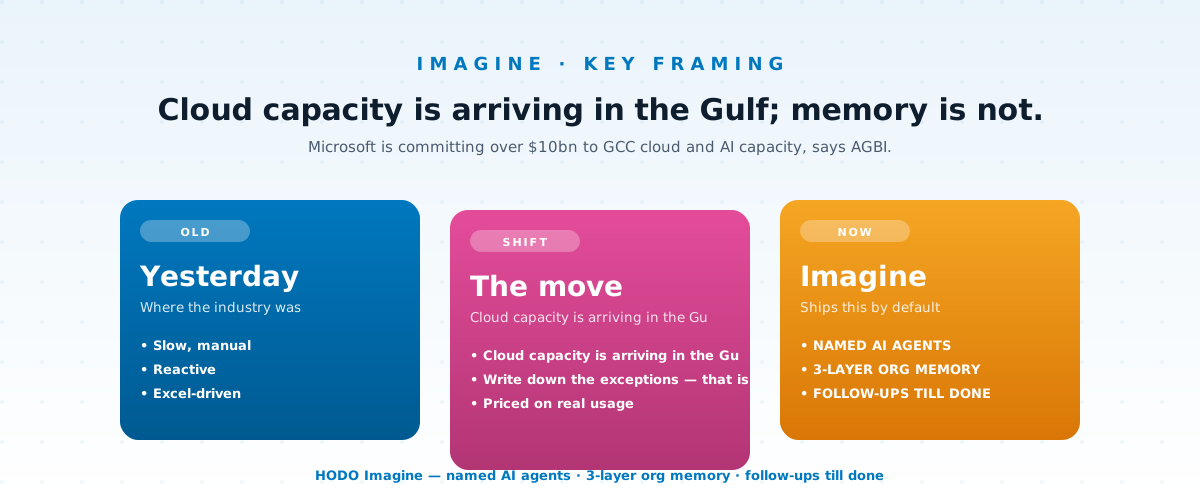
Cloud capacity is arriving in the Gulf; memory is not.
Capability is levelling; context is not
The pattern is familiar from every prior infrastructure wave. Cloud hosting was a differentiator for roughly two years, then it was table stakes. Mobile apps were a differentiator, then every operator had one. AI model access is compressing faster than either, because the switching cost between providers is a configuration change rather than a migration project.
What stays scarce is the accumulated, specific, written-down knowledge of how an organisation actually runs. Which insurer takes four days on pre-approval and which takes fourteen. Which referring doctor wants results as a PDF and which wants a call. What the escalation path is when a home-collection phlebotomist cannot reach a patient at the booked slot. Which three sentences the practice uses to explain a package price to a walk-in, in Arabic and in English, so that two receptionists do not quote differently.
That knowledge exists today, but mostly in people's heads and in scattered WhatsApp threads. A general-purpose assistant with a blank context window cannot use it. It answers every question from first principles, produces something plausible and generic, and the operator quietly goes back to doing it manually. This is the reason so many healthcare AI pilots in the region stall after the demo, not model quality, but the absence of anything for the model to stand on.
The churn problem the Gulf already understands
Every operator in the GCC runs on a workforce with structurally high turnover. Clinical and administrative staff rotate on visa and contract cycles, and expatriate teams move between markets. The clinical side is handled: licensing bodies, credentialing files and protocols make sure a departing doctor does not take the standard of care with them.
The operational side has no equivalent. When a practice manager who spent three years learning an insurer's quirks leaves, that learning leaves. The replacement rediscovers it over six to nine months, making the same rejections and the same escalation mistakes along the way. Founders building homecare, lab-at-home or marketplace platforms feel this sharpest, because the whole business is operational knowledge, routing logic, pricing exceptions, partner-specific rules, and almost none of it is written anywhere a new joiner can read.
This is the gap worth funding while the infrastructure debate is settled elsewhere. Organisational intelligence means the knowledge sits with the organisation, not with whoever happens to hold the role this quarter. A new hire inherits the context instead of rebuilding it. That is a hiring-cost line, a quality line and a growth-rate line, all at once.
Named agents with jobs beat a shared chat window
The common first attempt is to buy licences for a chat assistant and tell the team to use it. Usage spikes, then decays, because nobody owns anything. A shared chat window has no job description, no reporting line, and no memory of what it said last Tuesday.
The alternative is to treat AI capacity the way an organisation treats headcount. An agent has a name, a defined job, a manager it reports to, and a record of what it has done. One handles insurer follow-ups. One drafts partner and referring-doctor communication. One keeps content and outreach consistent. Each accumulates memory of its own domain, and each produces an audit trail that a compliance review can actually read, which in a DHA or MOHAP-regulated environment is not optional decoration.
imagine is built on that model rather than the chat-window model. It does not replace Microsoft 365, Copilot or ChatGPT, those are the capability layer that this $10bn is making cheaper and closer. It connects them with memory, so that the capability has something specific to work from.
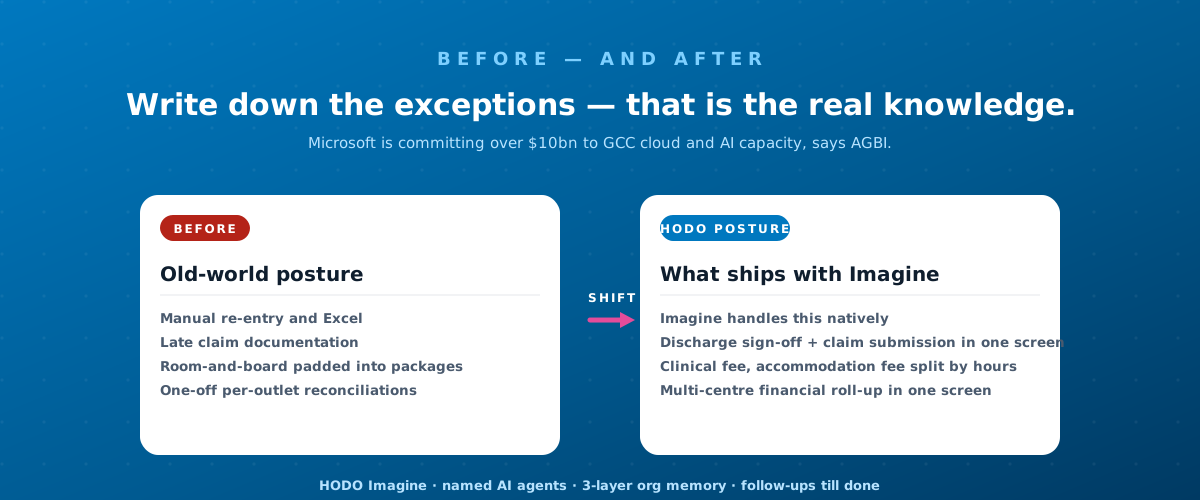
Write down the exceptions, that is the real knowledge.
Sequencing this over the next two quarters
Practical order of operations for a founder or operator who wants a genuine digital differentiator rather than a logo on a slide. Start by picking the three processes where knowledge loss hurts most, usually insurance follow-up, partner communication and patient callbacks. Write down how each actually works today, including the exceptions, because the exceptions are the knowledge. Assign each process to a named agent with a defined job rather than to a general assistant.
Then measure the thing that matters: whether tasks close. Most operational leakage is not bad decisions, it is good decisions that nobody followed through on. A pre-approval chased once and then forgotten costs the same as one never filed. Track the close rate before and after, and let that number justify the next expansion rather than a vendor roadmap.
What this means for digital transformation
Regional cloud and AI capacity will be commodity infrastructure within a couple of years. The durable differentiator for healthcare operators and founders in the GCC is organisational intelligence, knowledge that compounds instead of resetting with every resignation.
imagine is built for exactly that layer. Named AI agents with jobs, memory and reporting lines give each process an accountable owner and an audit trail instead of an anonymous chat window. 3-layer memory, today, this week, forever, means context from a partner escalation in March is still available in September, to whoever holds the role then. Brand voice consistency keeps patient and insurer communication uniform across outlets and languages, and follow-ups until tasks close turns intent into completed work rather than a to-do list that ages quietly.
See how imagine turns AI into organisational intelligence, explore imagine.