Computer Weekly reports that Microsoft has committed roughly $10bn to expanding its cloud and AI footprint across the Middle East, covering datacentre capacity, regional AI services and local skills programmes. For a founder building a lab-at-home platform in Dubai, a doctor-at-home network in Doha or a clinic operations product in Riyadh, the headline number matters less than what it quietly removes from the roadmap. Capacity, latency and in-region hosting are on their way to becoming commodities, which means the thing a healthcare product is actually judged on has to sit somewhere else.
Infrastructure commitments compress the boring half of the stack
Three years ago, a health product founder in the GCC spent real engineering time on questions that had nothing to do with the product: where the database lives, whether inference runs close enough to the user, how to explain hosting arrangements to a hospital group's IT committee. Hyperscaler expansion of this size pushes those questions down to configuration. Regional availability zones, managed model endpoints and compliance documentation arrive as line items rather than as projects.
That is good news and a warning at the same time. Every competitor in the same market gets the same discount on the same problems. A pitch built around "cloud-hosted, AI-enabled, hosted in-region" describes a baseline, not a position. The advantage moves to the parts of the system a hyperscaler will never supply: the workflow a phlebotomist follows at 6:40am, the pricing logic for a corporate contract, the rule that decides which partner lab receives an outsourced sample, the reconciliation between an insurance approval and a cash counter receipt. Those are domain problems. They get solved by reading operations closely, not by provisioning more compute. Founders who treat the infrastructure announcement as permission to skip the domain work usually discover the gap during the first multi-branch deployment.
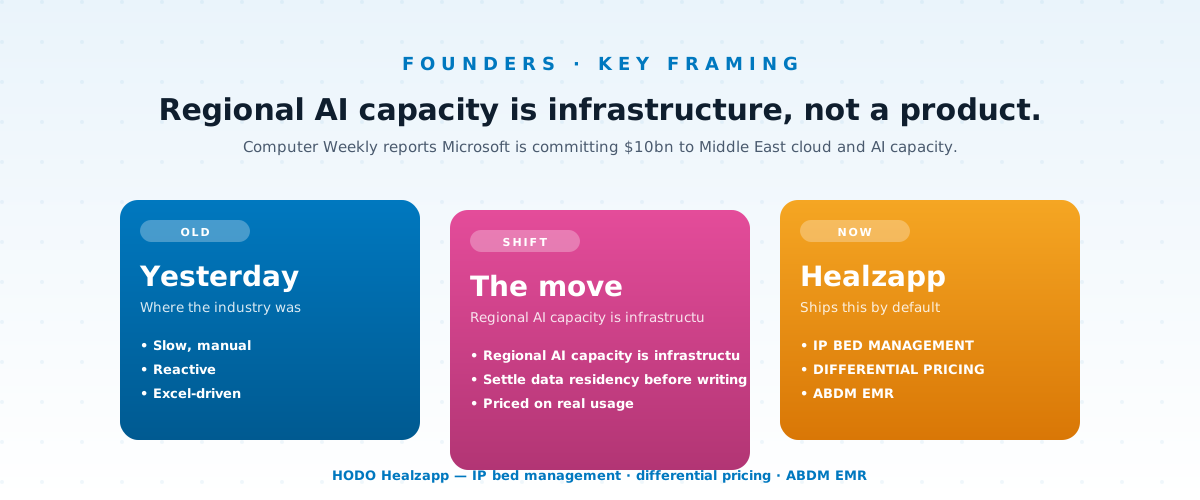
Regional AI capacity is infrastructure, not a product.
Data residency is a sales question before it is a technical one
In the Gulf, hosting location is procurement, not architecture. A polyclinic group under DHA or MOHAP oversight, a hospital under Abu Dhabi's health authority, a lab licensed in Qatar or Bahrain, each will ask where patient records physically sit, who can access them, and what happens when the contract ends. Regional cloud capacity makes the correct answer cheaper to give, but it does not write the answer. That still needs a documented data map, a retention policy, an access log and an exit clause.
Founders should settle this before writing the first schema, because retrofitting residency is expensive. Decide early which data classes are clinical records, which are operational telemetry, and which may leave the region for model inference or analytics. Many teams find a cleaner split than expected: identifiers and results stay in-region, while anonymised volume and turnaround statistics can travel. HODO's own products show the pattern in production, Labzapp runs on Google Cloud Platform hosting for lab clients, with partner-lab integration built on anonymised sample tracking so an outsourced test can move between organisations without moving patient identity. That distinction is worth copying regardless of which cloud a founder picks.
Decide which thin layer you actually own
The most common failure for health product founders in the region is not choosing the wrong cloud. It is spending eighteen months rebuilding primitives that already exist, a patient index, an appointment engine, a billing ledger, a barcoded sample workflow, a report delivery pipeline, and reaching the market with a thin version of software that mature vendors have shipped for a decade. Meanwhile the differentiated layer, the one investors and customers were promised, never gets built.
A more defensible structure treats the record system as infrastructure and the differentiated layer as the product. A doctor-at-home operator can run Appointments, Teleconsultation and a Patient Health App as the ops spine, and put its own engineering into visit routing, clinician supply and pricing. A lab-at-home builder can rely on barcoded samples, machine interfacing and automated report delivery, and build the demand side and the courier network instead. This is not an argument against building, it is an argument for knowing which part of the stack a customer will ever pay a premium for. Nobody in Sharjah or Dammam switches vendors because someone rewrote a bill printer.
Unit economics still get denominated in dirhams and riyals
GCC health products carry a different cost shape from Indian equivalents. Labour is more expensive, distances between branches are larger, self-pay share is higher in some segments while mandatory insurance dominates others, and a single group may bill in more than one currency across markets. Cheap inference does not move any of those lines much. A founder who cannot state cost per home visit, cost per test after partner-lab fulfilment, and collection lag by payer is not running a business model, just a growth chart.
Three numbers deserve weekly attention. First, cost per completed visit or test by zone, not blended across the network, because one dense emirate will subsidise three thin ones until it stops. Second, revenue per clinician hour or per phlebotomist route, which is where scheduling quality shows up in cash. Third, the gap between billed and collected, split by insurance versus self-pay. AI spend belongs in this frame too: a model call that saves four minutes of coordinator time has a defensible cost per transaction, while one that produces a dashboard nobody opens does not. The infrastructure being built in the region makes experiments cheaper, not free.
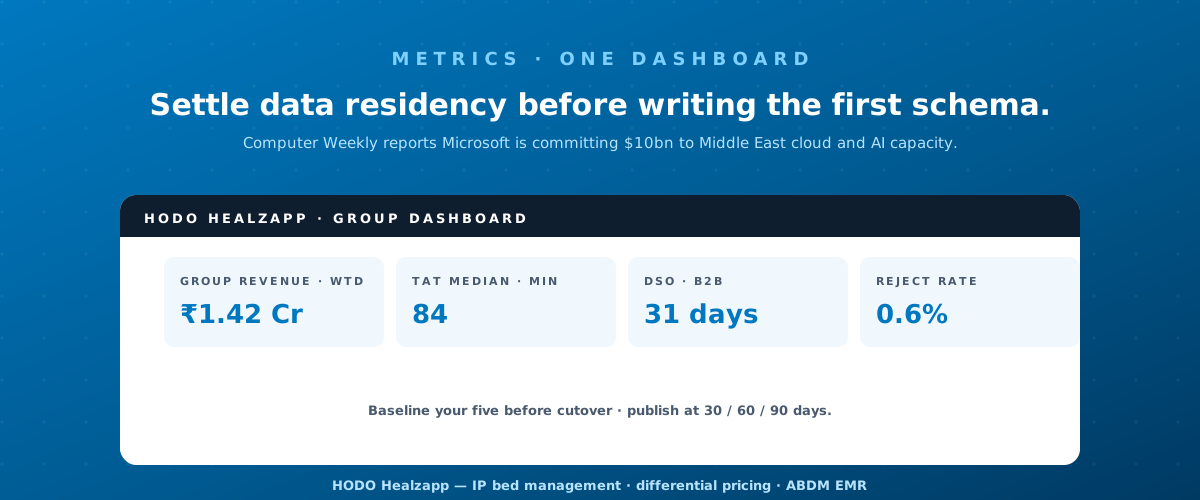
Settle data residency before writing the first schema.
Where regional AI capacity earns its keep first
The early wins in Gulf healthcare operations are administrative rather than diagnostic, for a simple reason: administrative work is high-volume, repetitive and measurable, and a mistake is recoverable. Summarising a returning patient's history so a consultant does not scroll through four years of visits. Drafting insurance documentation from structured encounter data. Flagging samples whose turnaround is drifting before the referring doctor calls. Converting free-text booking requests on WhatsApp into structured appointments.
Each of these depends on clean structured data far more than on model quality. A clinic whose diagnoses live in three different free-text fields will get mediocre output from the best model in the region. This is why the sequencing matters for founders: structure the record first, then apply intelligence to it. Products that skip the first step end up demonstrating well and deploying badly. It is also why the buy-versus-build decision and the AI roadmap are the same decision, a mature record system is the training and retrieval substrate for everything demonstrated on top of it.
What this means for builders
Regional cloud investment lowers the floor for everyone building health software in the GCC; it does not raise anyone's ceiling. The ceiling is still set by how well a product handles multi-branch operations, local billing patterns and the paperwork a licensing authority asks for. Founders evaluating whether to build a record system or stand on one can look at HODO's products as reference architecture: Billing (incl. multi-currency / GCC patterns) for groups operating across more than one market, Multi-outlet scale-up with one-click new-centre setup for the moment a second and third branch open faster than the engineering team can support, and EMR (AI-condensed history) for the consultation-time problem that AI capacity is genuinely good at solving. The differentiated product sits above these, not inside them.