Arab News reports that a forum in Riyadh will gather more than 500 health leaders to discuss the direction of health system transformation in the region. Gatherings of that size almost always land on the same conclusion, a growing share of care has to happen outside hospital buildings, and the gap between that conclusion and a working home-visit service is entirely operational. The operators who gain from the shift are the ones whose scheduling, sample custody, reporting and billing already function away from a fixed address.
What a 500-leader agenda usually leaves unanswered
Regional health strategy conversations in Saudi Arabia, the UAE, Qatar, Kuwait and Bahrain have converged over the past few years: shift demand away from inpatient beds, move chronic disease follow-up closer to the patient, and use digital channels to absorb volume that clinics cannot physically hold. Very little of that is contested any more. What forum agendas rarely settle is the operating question underneath, who dispatches the nurse, how the sample gets from a villa in a suburb to an accredited lab within its stability window, which insurer is billed before the visit happens rather than after, and what the service costs per visit once travel time is counted honestly.
That is the layer where home-visit businesses in the Gulf either scale or stall. A doctor-at-home or lab-at-home operation looks deceptively simple at ten visits a day: a WhatsApp group, a shared spreadsheet and two reliable drivers will hold it together. At eighty visits a day across three emirates or two Saudi cities, the same setup produces duplicated bookings, samples that arrive without a matching requisition, reports delivered late to the wrong number, and an insurance file that nobody can reconcile at month end. The strategy is settled; the execution stack usually is not.
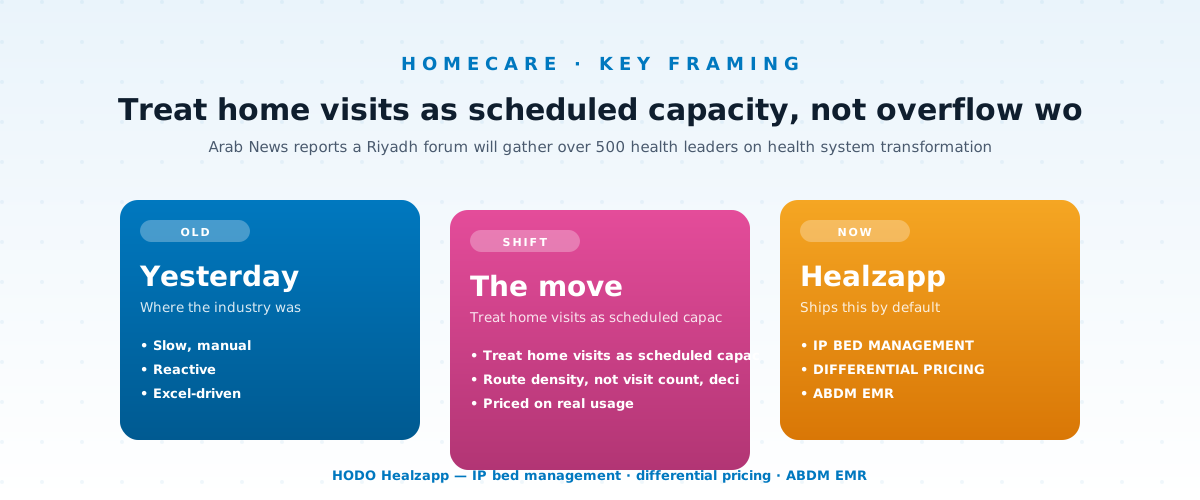
Treat home visits as scheduled capacity, not overflow work.
Home visits are capacity, not an overflow channel
Most polyclinics and labs in the region still treat home visits as an exception handled by whoever is free. That framing caps the service at whatever slack exists in the clinic roster, which is close to zero on a busy morning. The operators who make home care profitable do the opposite: they treat the home as a scheduled service line with its own capacity plan, its own staff allocation and its own performance numbers.
Practically, that means home slots sit in the same appointment system as clinic slots, not in a parallel list. A phlebotomist's day is planned as a route with named time windows, not a queue of callbacks. A doctor's home consultation block is protected in the roster the same way an OP session is. When a home slot and a clinic slot compete for the same clinician, the conflict is visible before the patient is confirmed rather than at 8 a.m. on the day.
The second consequence is measurement. A home service run as an exception generates no comparable numbers. Run as a service line, it produces the figures that actually decide expansion: visits completed per clinician per day, first-attempt success rate, average travel minutes between stops, cancellations after dispatch, and revenue per route. Those are the numbers a Gulf operator needs before opening a second city, and they are only available if home work was booked and closed inside the same system as everything else.
The arithmetic of a home visit
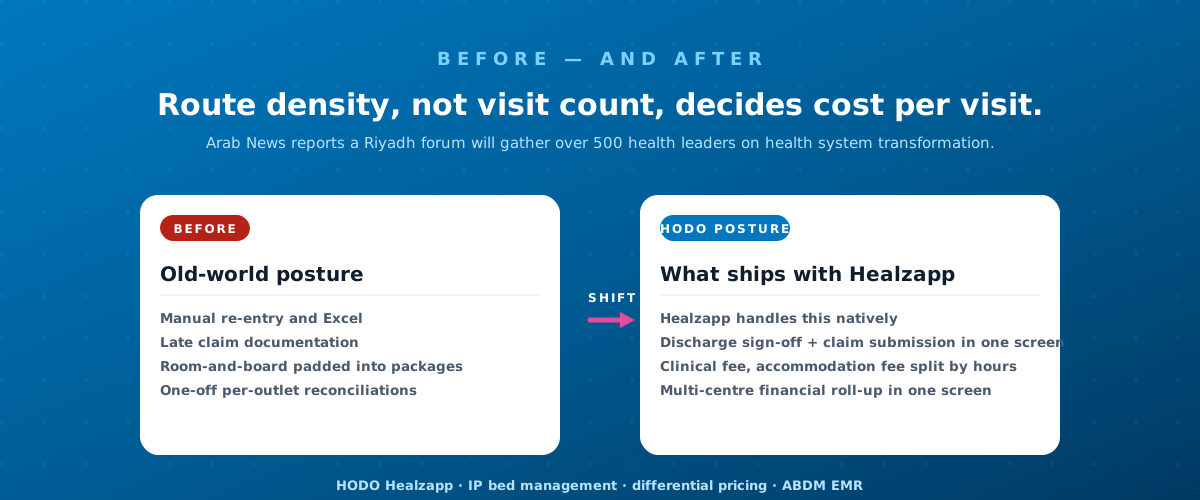
Home care economics are decided by route density, not by visit volume. A phlebotomist who completes six collections in a day at forty minutes of travel per stop and one who completes eleven at fifteen minutes of travel carry roughly the same salary cost; the cost per collection differs by nearly half. Every planning decision that increases stops per hour, clustering bookings by district, holding a same-day window open for infill, sequencing a route rather than dispatching first-come-first-served, moves the margin more than any pricing change will.
Gulf geography makes this sharper than it is in most Indian cities. Dubai, Abu Dhabi, Riyadh and Doha combine long arterial distances with concentrated residential clusters, so a badly sequenced route can spend more time on highways than at doorsteps, while a well-clustered one can be genuinely efficient.
The practices that hold up are unglamorous. Book into district-based windows rather than open time preferences. Confirm the address and access instructions at booking, not at dispatch. Track the cost per visit monthly against a target, and treat a rising figure as a routing problem before it is treated as a pricing problem.
Chain of custody starts at the doorstep
For lab-at-home work, the operational risk is not collection, it is everything between the doorstep and the analyser. A sample that leaves a home without a barcode already attached is a sample whose identity depends on handwriting and memory. Labels applied later at the lab bench are the single most common source of home-collection re-draws, and a re-draw in home care costs a second full visit, not a second tube.
Barcoding at the point of collection, with the requisition and patient identity bound to the tube before the collector leaves, removes that class of error. It also gives the lab something useful: a timestamp for when the sample was drawn, which is what makes turnaround time measurable across home routes and comparable with walk-in work. Without it, TAT reporting for home collection is guesswork, and operators cannot tell whether a delay came from the route, the courier leg or the bench.
Delivery closes the loop. In GCC markets where patients expect a report on their phone in the same conversation thread in which they booked, automated report delivery over WhatsApp, SMS or email is not a convenience feature, it removes the call-back volume that otherwise lands on a small coordination team. Every report chased by phone is a labour cost attached to a visit that was already completed and billed.
Route density, not visit count, decides cost per visit.
Licensing and billing look different in the Gulf
A home-visit service in the UAE, Saudi Arabia or Bahrain answers to licensing and insurance structures that have nothing in common with the Indian model. Provider and clinician licences are regulated at emirate or national level, insurance is predominantly private with mandatory cover schemes, and eligibility is checked against payer systems before service rather than reconciled afterwards. Any platform that assumes an Indian scheme or registry layer is the wrong fit, and any workflow that checks coverage after the visit will produce a rejection queue nobody has time to work through.
The operational rule that follows is simple: eligibility and payment mode are settled before the vehicle leaves. Cash, card, insurance co-payment and corporate account all behave differently, and each needs a clear rule about what the collector or doctor does at the door. Multi-currency and GCC billing patterns matter for operators working across more than one country, as do differential rates for corporate contracts, since home care for a company's staff is usually priced separately from retail walk-in work.
What this means for HODO customers
Home care in the Gulf is a scheduling, custody and billing problem long before it is a clinical one. Healzapp keeps home and clinic demand in one Appointments book so capacity conflicts surface before confirmation, carries Billing (incl. multi-currency / GCC patterns) with Differential pricing for corporate and partner rates, and gives patients a Patient Health App plus WhatsApp/SMS report delivery so completed visits do not come back as phone calls. Teleconsultation covers the follow-up that does not justify a second trip, and Multi-outlet scale-up with one-click new-centre setup makes a second city a configuration step rather than a rebuild.