Arab News reports that a forum in Riyadh will gather more than 500 health leaders to discuss regional health system transformation. Agendas of that kind are written at the level of policy, payers and national platforms, but the operational consequence lands hardest one layer down, on diagnostic labs that sit at the end of every care pathway anyone redesigns. For a lab chain in Saudi Arabia, the UAE, Qatar or Bahrain, the useful question is not what gets announced on stage, it is who will be sending samples eighteen months from now, and on what commercial terms.
Transformation agendas turn labs into network nodes
Every consolidation trend discussed at regional health forums, insurer-led networks, hospital groups absorbing clinics, national digital health platforms, corporate health contracts, has the same downstream effect on diagnostics. Walk-in retail volume becomes a smaller share of the book, and contracted volume from other institutions becomes a larger one. A standalone lab that billed mostly individuals five years ago is now billing polyclinic groups, insurance networks, corporate HR departments, referring specialists and smaller labs that outsource specialised panels.
That shift changes what the lab actually is. Sample throughput still matters, but it stops being the constraint that decides profitability. The constraint moves to the network layer: how many partners the lab can onboard without adding back-office headcount, how accurately each partner is priced, how quickly a partner can see results without telephoning the lab, and how much reconciliation work each partner generates at month end. Chains that grow partner counts faster than they grow partner administration end up with revenue that looks healthy and margins that quietly compress.
This is why forum-level talk about integration should be read as a procurement signal rather than a headline. Integration means more institutional counterparties per lab. A lab running partner relationships on spreadsheets, email attachments and a shared inbox can handle perhaps a dozen of them. It cannot handle sixty.
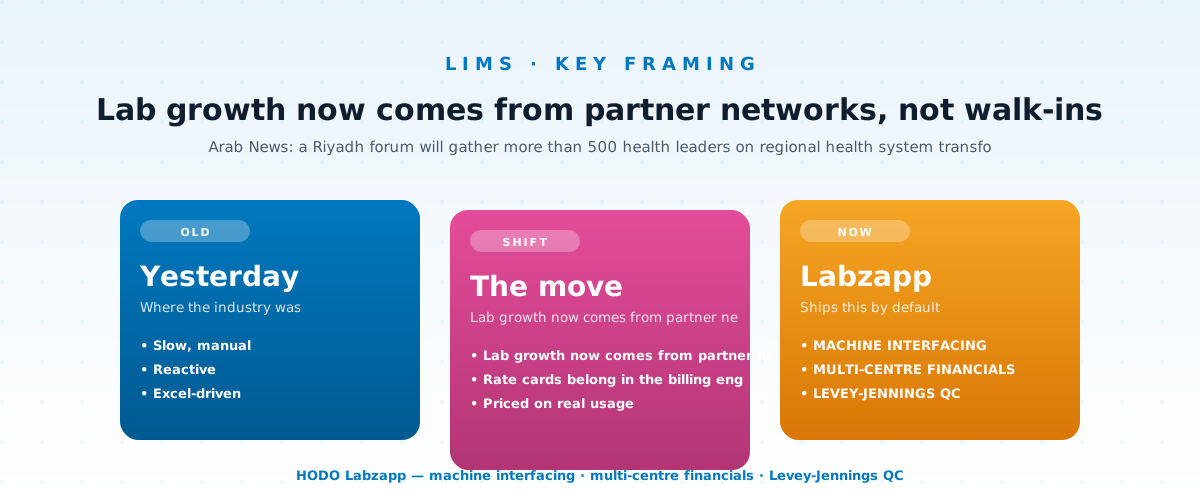
Lab growth now comes from partner networks, not walk-ins.
Most partner revenue is priced once and never revisited
Partner pricing in Gulf lab chains is usually set during a negotiation, recorded in a contract PDF, entered manually into a billing screen, and then left alone. Two years later nobody can say reliably which partner is on which rate card, which panels were discounted as a bundle, or whether the reagent cost of a high-volume outsourced test has moved past the price agreed for it.
The fix is structural rather than analytical. Differential pricing has to live inside the system that raises the bill, applied per partner and per test, so that a rate revision is a configuration change rather than a retraining exercise for the billing desk. Once that exists, cost per test can be compared against realised price per partner instead of against a list rate nobody pays. Chains that run this comparison quarterly usually discover two or three partners whose volume is genuinely unprofitable at current rates, and one or two whose rates are below what the market now bears.
The same discipline applies to corporate contracts and insurance-linked panels, where the volume is attractive but the price is fixed for the contract term. Knowing the true cost per test before signing a two-year corporate deal is a different exercise from knowing it afterwards.
Outsourcing works only when the sample trail survives it
Almost every lab chain in the region both sends and receives outsourced work. Specialised histopathology, molecular panels and certain immunoassays go to a reference partner; in return the lab picks up routine or regional volume from smaller centres. The commercial logic is sound. The operational risk is that a sample leaving the building also leaves the record.
Barcoded samples and partner-lab integration with anonymised sample tracking exist precisely for this. The barcode stays with the specimen across custody changes, the partner lab sees only what it needs to process the test, and the originating lab can answer a patient or a referring doctor asking where a report is without making three phone calls. Anonymisation matters more in the GCC than operators often assume, because outsourcing partners are frequently competitors in the retail segment as well.
Turnaround time reporting should be measured across the whole journey, not just the in-house portion. A chain that reports a four-hour internal TAT while its outsourced panels routinely take six days is reporting a number its customers do not experience. Partners and clinic groups increasingly ask for TAT evidence during contract renewal, and the number they want is end to end.
Referring doctors and corporate partners should not need the phone
The cheapest administrative reform available to most lab chains is removing the lab from the middle of routine information requests. A referring specialist wanting yesterday's result, a clinic manager checking a batch of pre-employment screenings, a corporate HR coordinator chasing fifty employee panels, each of these becomes a phone call or an email thread that occupies a staff member for several minutes and produces nothing billable.
Referral-doctor and corporate-partner portals convert those interruptions into self-service. Automated report delivery over SMS, WhatsApp and email does the same for individual patients, which in Gulf markets is often the expected channel rather than a convenience. The measurable outcome is not customer satisfaction in the abstract; it is the number of inbound calls per hundred samples, which is a metric most labs have never counted and which usually falls sharply once portals are live.
Franchisee and collection-partner models put the same pressure on the system from another direction. A franchise network needs its partners to see their own volume, their own settlement position and their own pending samples, without the head office producing reports by hand each week.
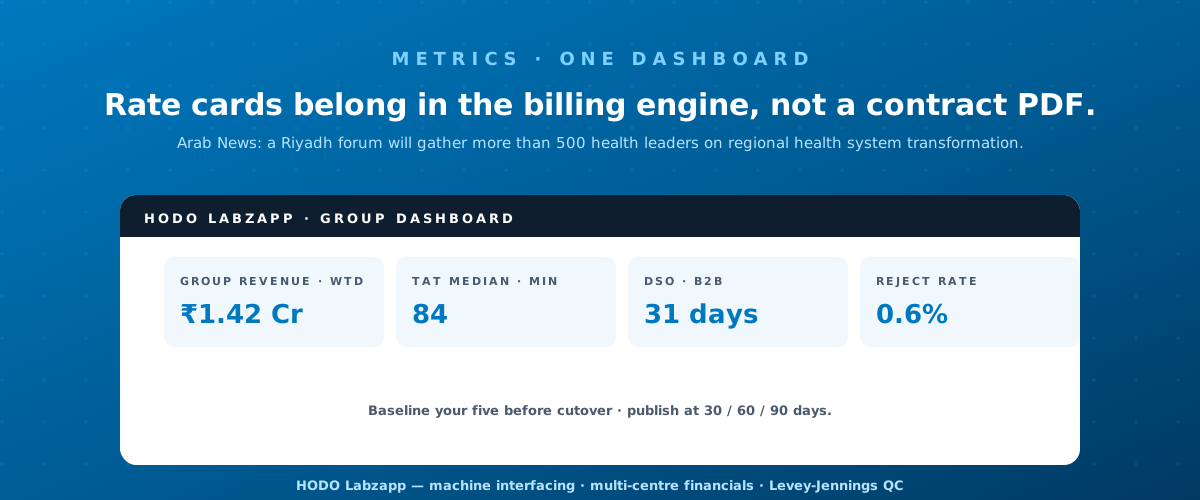
Rate cards belong in the billing engine, not a contract PDF.
Quality evidence is becoming a commercial document
Accreditation in the region, ISO 15189 and the national licensing frameworks that reference it, has moved from a differentiator to a baseline expectation in institutional tenders. What still differentiates is the ability to produce quality evidence on demand rather than during an audit scramble. Levey-Jennings QC charts maintained continuously, instrument-level records from machine interfacing, and multi-centre financials that reconcile against the same dataset are the artefacts that make a tender response credible.
There is a second reason to keep this data clean. When a chain opens a new centre or acquires one, the speed of integration depends almost entirely on whether the existing configuration, test masters, partner rate cards, QC rules, report templates, can be replicated rather than rebuilt. Chains that treat each new outlet as a fresh implementation spend their expansion budget on setup rather than on volume.
What this means for HODO customers
A lab chain preparing for the consolidation that regional health forums keep describing does not need a new strategy deck. It needs the network layer of its operations to be systematic. In Labzapp, that layer is concrete: partner-lab integration with anonymised sample tracking keeps custody and confidentiality intact when work moves between labs; differential pricing per partner holds rate cards inside the billing engine instead of inside a contract folder; and referral-doctor and corporate-partner portals plus TAT reporting take routine status chasing off the front desk and turn turnaround into a number a lab can put in front of an institutional buyer.