Computer Weekly reports that the Middle East's AI race has a people problem, the region is funding AI ambition considerably faster than it can staff it, and the binding constraint is trained operators rather than models, chips or budgets. For diagnostic and pathology labs across the UAE, Qatar, Kuwait, Oman and Bahrain, that finding lands very close to the bench. Long before a lab chain needs a data scientist, it is usually short of the technologists, phlebotomists and report-verification staff its current volume already demands.
The shortage shows up on the bench first
Regional AI strategy documents talk about imaging algorithms, predictive triage and payer analytics. Lab operators live one layer below that. A mid-sized Gulf lab chain running three or four collection centres and one processing hub typically depends on a handful of licensed technologists, and replacing any one of them is a three-to-six month exercise once licensing, credential verification, visa processing and onboarding are counted. Until that seat is filled, the work does not pause, it gets absorbed by whoever is already on shift.
That absorption is invisible on a P&L and very visible in turnaround time. A senior technologist covering two benches will still clear the workload, but verification queues lengthen in the evening, critical values get called later, and the reports that were promised by 6 pm go out at 9 pm. Nobody logs this as a staffing failure; it is logged, if at all, as a bad week.
This is also why AI pilots stall in labs that genuinely want them. An algorithm evaluation needs clean historical data, somebody to define the acceptance criteria, and somebody else to run the parallel comparison for six weeks. In a lab where the same three people hold the operational load, that project has no spare hours to draw on. The sequencing question is therefore not "which AI tool" but "which hours are currently being spent on work that does not require a licensed professional".
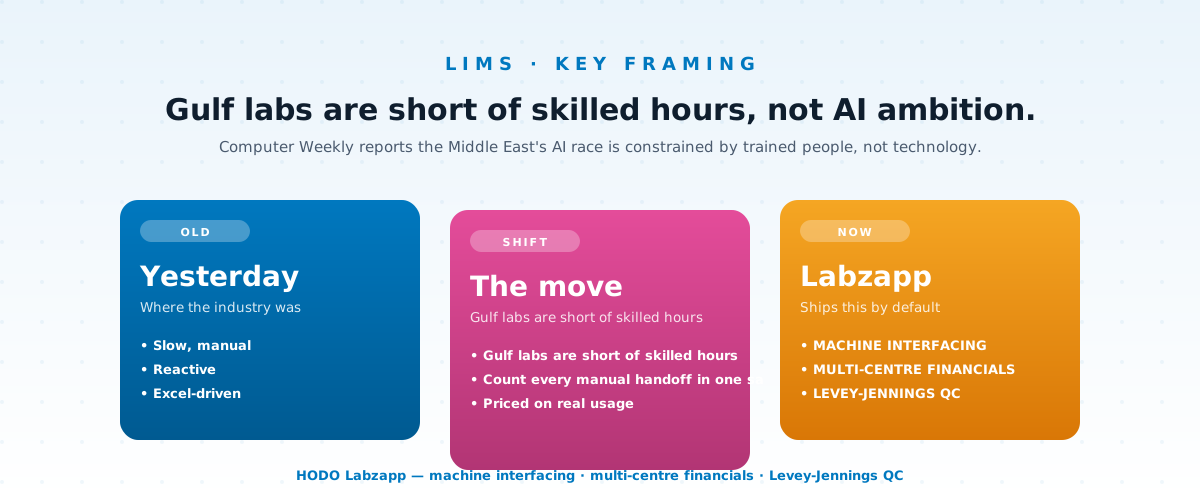
Gulf labs are short of skilled hours, not AI ambition.
Count the manual handoffs in one sample's journey
The most useful audit a Gulf lab can run this quarter costs nothing. Take one routine sample, a fasting lipid profile collected at a satellite centre at 7.30 am, and write down every point at which a human moves information from one place to another by hand.
A common list looks like this. Reception registers the patient and writes the test on a requisition slip. A phlebotomist labels the tube with a handwritten ID. The tube travels to the hub, where a technologist re-registers it in the system because the centre's entry did not carry across. The analyser produces a result on its own screen, and somebody types that value into the report. A supervisor verifies. A front-desk staffer prints the report, then photographs it and forwards it on a personal phone because the patient asked for it on WhatsApp. Somewhere in that chain a corporate client calls to ask where three of their pre-employment reports are, and a staff member spends fifteen minutes finding out.
Each of those steps takes between one and eight minutes and carries a transcription risk. None of them requires clinical judgment. In aggregate across a few hundred samples a day, they consume more skilled-hour capacity than most operators expect, and they are precisely the hours that a hiring freeze, a resignation or a licence renewal delay takes away first.
Automation changes what staff do, not how many you need
The honest framing is not headcount reduction. Gulf labs are growing; most are trying to hire, not trim. The framing is that the licensed people already on payroll should spend their day on verification, QC review, difficult morphology and client conversations rather than on re-keying data that a machine already produced.
Barcoded samples remove the re-registration step at the hub and the handwritten-label risk at the centre. Machine interfacing removes the retyping of analyser output altogether, which also removes the most common source of silent report errors. Automated SMS, WhatsApp and Email report delivery removes the print-photograph-forward loop and, with it, the class of complaints that begin with "the report went to the wrong number". Phlebotomy and home-collection workflows give the field staff a defined sequence rather than a phone call and a memory.
The cumulative effect is that a lab running at, say, 350 samples a day can hold its promised turnaround through a staff absence instead of quietly slipping. That resilience is worth more in the Gulf market than a pilot algorithm, because reputation with referring clinicians and corporate accounts is built almost entirely on whether reports arrive when promised.
Multi-centre chains multiply the same problem
Operators running several centres, or a franchise network across two emirates, hit the staffing constraint twice over. Each new centre needs its own front desk, its own collection staff and its own supervisor attention, and the head office loses visibility in proportion to distance. The usual workaround is a daily WhatsApp group and a spreadsheet, both of which depend on one coordinator who eventually leaves.
The structural alternatives are already familiar to anyone running a network: franchisee management with consistent test masters and rate cards, differential pricing per partner so corporate and insurance agreements do not need manual invoice adjustment, and referral-doctor and corporate-partner portals so clients check status themselves instead of calling the lab. Partner-lab integration with anonymised sample tracking matters for the tests a Gulf lab sends out, histopathology, specialised endocrinology, molecular panels, where the outsourced portion is currently tracked in email threads.
Each of those removes a recurring call from the operational day. None of them is glamorous, and together they are what makes a fifth centre viable without a fifth coordinator.
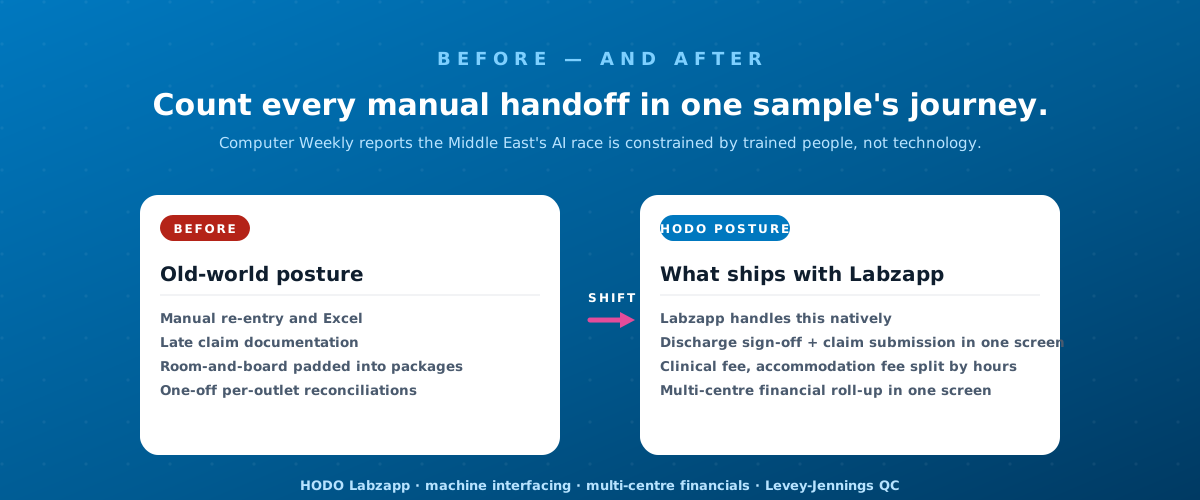
Count every manual handoff in one sample's journey.
Measure the things that hiring cannot fix
Before any AI conversation, a lab should be able to answer four questions with data rather than opinion. What is the median turnaround by department, and where in the chain do the hours actually go? What is the cost per test at each centre, including the courier and the rerun rate? How often does QC drift, and is it caught on the same shift? And which corporate accounts generate volume that the current staffing cannot absorb at the promised turnaround?
TAT reporting answers the first, multi-centre financials the second, Levey-Jennings QC the third, and the partner portals the fourth. A lab that has those numbers can make a defensible decision about where an AI tool would help, and, more often, will find that the immediate gain is in the handoffs, not the algorithms. That is the same conclusion the Computer Weekly piece reaches at national scale: the technology is available, the people to run it are not, and the organisations that cope are the ones that stop spending scarce expertise on clerical work.
What this means for HODO customers
Labzapp is built around the assumption that skilled staff are the scarcest input in a diagnostic operation. Machine interfacing takes analyser output into the report without retyping. Automated SMS/WhatsApp/Email report delivery closes the last mile without a staff member acting as a forwarding service. TAT reporting shows which step in the chain is consuming the hours, so the next hire, or the next automation, is chosen on evidence rather than on the loudest complaint. For networks, franchisee management keeps a new centre on the same masters and rate cards from day one.