Health Tech World's recent piece, “From AI pilots to patient impact: What healthcare needs to get right”, lands on a point that will be familiar to any polyclinic group in Dubai, Abu Dhabi, Doha or Manama: there is no shortage of AI demonstrations in healthcare, and a severe shortage of AI that changed a clinical day. The gap is rarely the model. It is almost always the operational layer underneath it — registration, scheduling, coding, claims, diagnostics and report delivery — that the pilot was never wired into.
Why most AI pilots never reach a second quarter
The pattern repeats across clinic groups in the region. A vendor arrives with a model for triage, documentation, no-show prediction or coding assistance. The pilot runs for six or eight weeks on a data extract, the output appears in a separate dashboard, and a doctor or receptionist is asked to check it alongside their existing work. Accuracy gets reported. Nothing in the daily workflow changed, so nothing in the operating numbers changed either. When the pilot window closes, the model and its findings leave with the vendor.
The failure is structural rather than technical. An AI output that cannot write back into the system of record is a suggestion, not a workflow. If a no-show prediction cannot release and refill the slot in the appointment book, someone has to act on it by hand — and at 60 to 80 outpatient visits a day per branch, nobody will. If a coding suggestion cannot attach itself to the claim before submission, it adds a step instead of removing one.
The practical test for any pilot is short: name the field it writes to, the person whose queue it shortens, and the number it is supposed to move. A pilot that cannot answer those three questions is a demonstration, and should be budgeted as one.
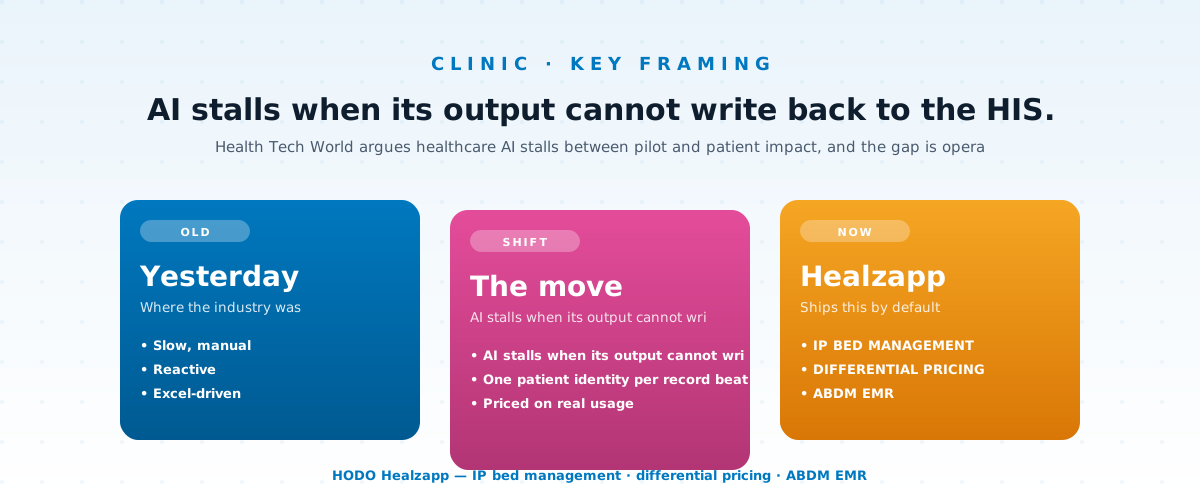
AI stalls when its output cannot write back to the HIS.
Usable data starts at the front desk, not the data team
Every downstream AI claim depends on what the reception counter captured. In a GCC polyclinic that means an Emirates ID or passport number, an insurance member ID and policy class, a nationality, a visit type and a referring source — recorded once, in structured fields, against a single patient record rather than a new record for every visit. Duplicate patient identities are the single most common reason a clinic group's own reporting disagrees with itself, and they quietly poison any model trained on that history.
Clinical history is the second layer. Free-text notes typed differently by each consultant are expensive to work with; a history that is already summarised and structured is cheap. This is why the AI question for a polyclinic is less about buying a model and more about whether the HIS already produces a readable patient story. Healzapp's EMR condenses history into a usable form at the point of consultation, and Patient Management plus Appointments keep one identity and one visit trail per patient across doctors and branches.
Groups that get this right find that several of the use cases they were planning to pilot — follow-up recall, package upsell, consultant load balancing — stop needing a model at all. They become reports.
Insurance and billing decide whether AI pays for itself
In the UAE and the wider Gulf, the clearest commercial case for automation sits in the revenue cycle. A polyclinic typically handles several payers, each with its own co-pay structure, pre-approval thresholds, exclusions and submission format, under DHA, MOHAP or equivalent local licensing and reporting obligations. Claim rejection and resubmission cycles are where margin leaks, and where staff hours disappear.
AI that flags a likely rejection before submission is genuinely useful — but only if the billing engine already holds payer-specific rules, tariff versions and package definitions. Without that, the flag has nothing to check against and the biller has to verify it manually, which is the work the flag was meant to remove. Healzapp's Billing module is built for GCC patterns including multi-currency handling, and Differential pricing lets each payer, corporate contract and walk-in tariff carry its own rate card rather than living in a side spreadsheet.
The metric to baseline before any pilot is first-pass claim acceptance rate, measured per payer and per branch, alongside days to collection. If a proposed AI project cannot be tied to one of those two numbers, it is competing for budget against something that can.
Diagnostics integration is the unglamorous unlock
Most polyclinics in the region run in-house lab and imaging alongside consultation, and that is where structured clinical data actually originates. When analyser output is typed into the system by a technician, the data arrives late, inconsistently and with transcription risk — which rules out anything downstream that depends on trend analysis or automated flagging. Machine Interfacing removes that step by pulling results directly from the analyser into the patient record in structured form.
The same logic applies at the other end of the visit. Report delivery is a throughput problem disguised as a service problem: every report a patient cannot access themselves becomes a phone call at reception, and reception is usually the busiest constrained resource in the building. Healzapp's WhatsApp/SMS report delivery and Patient Health App move that traffic off the counter, and the delivery log becomes evidence during a licensing or accreditation review.
None of this is AI. All of it is what AI needs. A group that has structured results, clean identities and digital delivery in place can evaluate a clinical decision-support or documentation tool in weeks; a group without them will spend the pilot building plumbing and then blame the model.
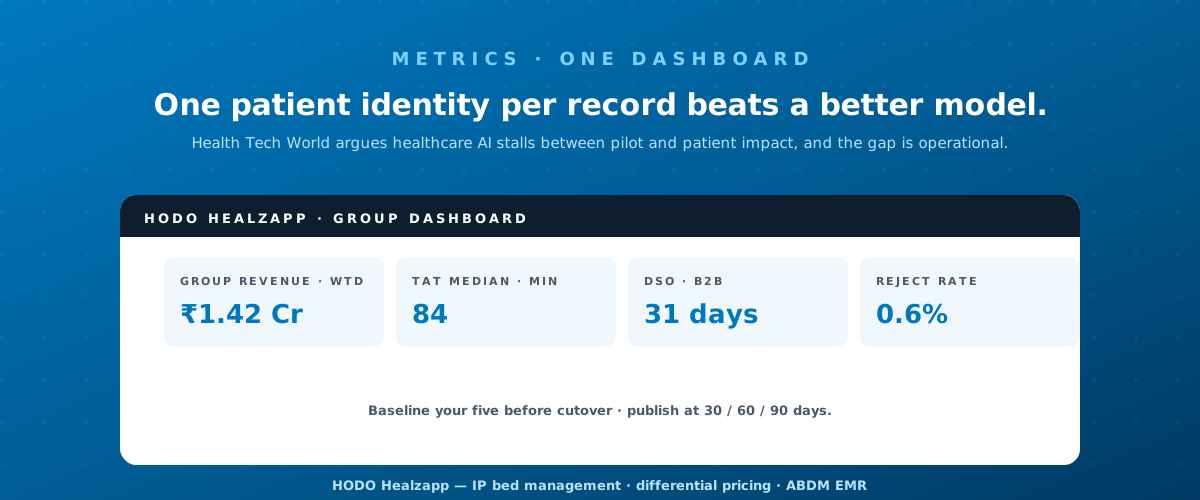
One patient identity per record beats a better model.
Rollout across branches is the real test
A single-branch success proves very little. The question for a multi-outlet polyclinic group is whether a change holds its shape when it reaches branch four or branch nine — whether the service master, tariff list, doctor roster and consent templates stay identical, or whether each centre quietly develops its own version. Divergent masters are what make group-level dashboards unreliable and make any AI rollout a per-branch integration project.
Standardised setup is the control for this. Healzapp's Multi-outlet scale-up with one-click new-centre setup carries configuration forward to a new location instead of rebuilding it, which keeps comparison across centres honest: same tariffs, same service codes, same visit definitions. TV Token Display and the shared appointment layer give each branch the same patient-facing flow, so waiting-time and consultation-duration numbers mean the same thing everywhere.
Governance matters as much as software. Before the next AI pilot, a group should be able to state its baseline per branch for average outpatient wait, consultations per doctor-hour, first-pass claim acceptance and diagnostic turnaround time. Those four numbers are the scoreboard. An AI project that does not move one of them has not reached patient impact, however well it demonstrated.
What this means for HODO customers
The Health Tech World argument translates directly into a sequencing decision for polyclinic operators in the UAE and GCC: build the operational record first, then add intelligence on top of it. A clinic HIS that already holds one identity per patient, structured analyser results, payer-specific tariffs and a delivery log is a platform an AI tool can plug into. One that does not is a data-cleaning project waiting to be mistaken for an AI project.
Three parts of Healzapp carry most of that weight. EMR (AI-condensed history) turns scattered consultation notes into a usable patient story at the point of care. Machine Interfacing brings lab and imaging results in as structured data rather than retyped text, which is the precondition for any trend-based or decision-support layer. Billing (incl. multi-currency / GCC patterns) with Differential pricing holds the payer rules that make revenue-cycle automation measurable instead of advisory. Add Multi-outlet scale-up with one-click new-centre setup and the same standard travels to the next branch rather than being reinvented there.