Big News Network reports that SEHA CLINICS has become the first healthcare provider in the MENA region to achieve American Accreditation Commission International Endoscopy Services Certification. The headline reads clinical, but almost everything an endoscopy certification actually tests is operational: how procedures are booked, how scopes and consumables are tracked, how device service history is evidenced, and whether any of it can be produced on demand. For polyclinics in Dubai, Abu Dhabi, Doha, Kuwait City and Manama, the useful signal is the shift itself, accreditation is moving from a facility-level badge to proof at the level of a single service line.
Service-line certification is a different audit from facility licensing
A DHA or MOHAP licence asks whether a facility is fit to operate: premises, staffing, scope of practice, equipment registration. A service-line certification asks a narrower and harder question, does this specific procedure pathway behave the same way every time it runs? That means the auditor is not reading policy documents so much as sampling cases. Pick twenty endoscopies from the last quarter and show the consent, the pre-procedure assessment, the sedation record, the operator, the device used, the lot numbers of what was consumed, the findings, the recovery note, and the follow-up.
Most polyclinics can produce each of those items. Very few can produce them as one linked record per case without someone spending two days assembling folders. That gap is the real reason service-line certifications stall in the region. The clinical standard is usually met in practice; the evidence is scattered across a scheduling sheet, a paper procedure register, a WhatsApp group, a sterilisation logbook kept by the nursing team, and a billing system that knows the charge but not the clinical context. Certification pressure is what forces that fragmentation into the open.
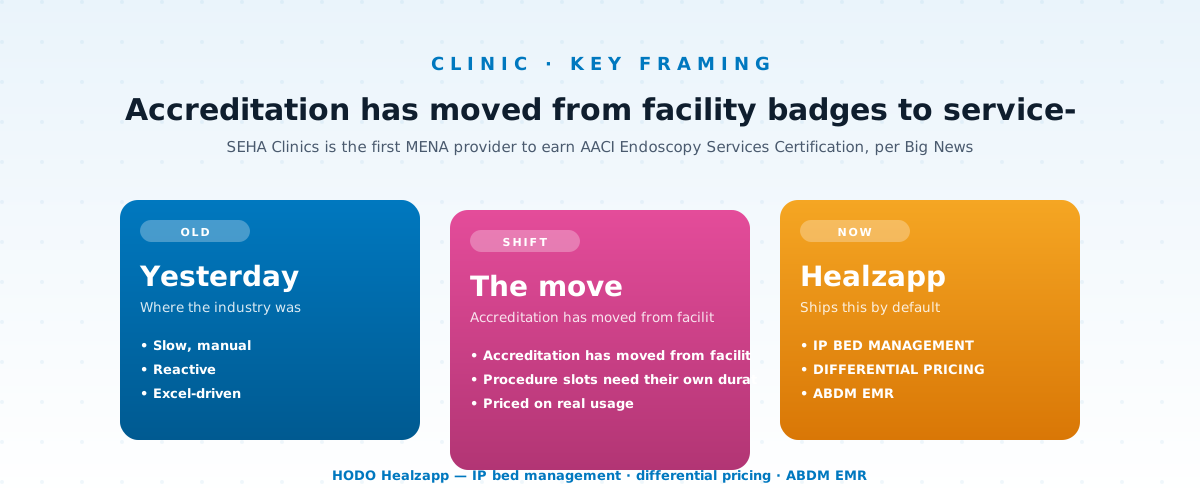
Accreditation has moved from facility badges to service-line proof.
Endoscopy is a scheduling problem before it is a clinical one
A day-care endoscopy list is the densest scheduling object a polyclinic runs. It consumes a procedure room, an operator, an assisting nurse, a sedation-capable clinician, a scope that may or may not be back from reprocessing, and a recovery bay, all for a slot that is routinely overrun by the case before it. Clinics that schedule endoscopy in the same flat appointment grid they use for consultations end up with a list that looks full and runs half-empty, or a list that looks reasonable and leaves patients fasting for three hours.
Certification exposes this, because a standard that requires documented pre-procedure fasting intervals and documented recovery observation times quietly requires the schedule to be real. If the recorded start time is the booking time rather than the actual time, the whole record set loses credibility. Procedure slots need their own duration, their own room and resource constraints, and their own turnaround buffer for reprocessing, separate from the OP consultation grid that fills the rest of the clinic's day.
There is a throughput argument here that has nothing to do with audits. Polyclinics running endoscopy as a profitable day-care line typically find that two or three cases per list are lost to resource collisions rather than to demand. Fixing slot modelling recovers those without hiring anyone. The certification just gives the project a deadline.
Scopes, consumables and the traceability chain
The single question that derails endoscopy audits is: which scope was used on this patient, and what had happened to that scope before. Answering it requires device identity to be captured at the point of the procedure, not reconstructed later. If the procedure record names the operator but not the instrument, the reprocessing log, however well kept, cannot be linked to a patient, and the traceability chain is broken in both directions.
The same applies to consumables. Biopsy forceps, snares, injection needles and valves move through a procedure room faster than most clinic inventory systems are configured to notice. If consumption is only recognised when stock runs out, the clinic has neither a cost-per-procedure figure nor a recall path when a supplier issues a batch notice. Both of those matter well beyond accreditation: endoscopy margins in the GCC are sensitive to consumable cost, and a clinic that cannot state its consumable cost per case cannot price a package honestly.
Device maintenance is the third leg. Scope processors, insufflators and light sources carry warranty terms and service contracts, and an auditor will ask for the last preventive maintenance date on equipment that touched a patient. That record usually lives with the biomedical vendor rather than the clinic, which is a weak position during an audit and an expensive one when a processor fails mid-list with no contract clarity.
The payer side: pre-approval, packages and procedure billing
In the UAE and the wider GCC, an endoscopy case is also an insurance case. Pre-approval is usually mandatory, the approved code set is narrow, and the gap between what was approved and what was performed is where rejections are born. A diagnostic gastroscopy that becomes a therapeutic procedure mid-case is clinically routine and administratively hazardous, the clinical record moves, the approval does not, and the claim comes back.
Polyclinics that handle this well treat the procedure as a billing object from the moment it is booked. The approval reference, the payer, the approved items and the patient's share sit on the same record as the clinical note, so the biller is not interpreting handwriting after the fact. Where the clinic runs cash and insurance side by side, or serves patients across multiple currencies and corporate contracts, the price list needs to differ by payer without the front desk maintaining a private spreadsheet of rates.
This is also where certification pays for itself commercially. A certified service line is a negotiating position with insurers and corporate accounts, but only if the clinic can report its own volumes, complication rates and turnaround cleanly. Accreditation without reporting is a wall plaque. Accreditation with reporting is a tariff conversation.
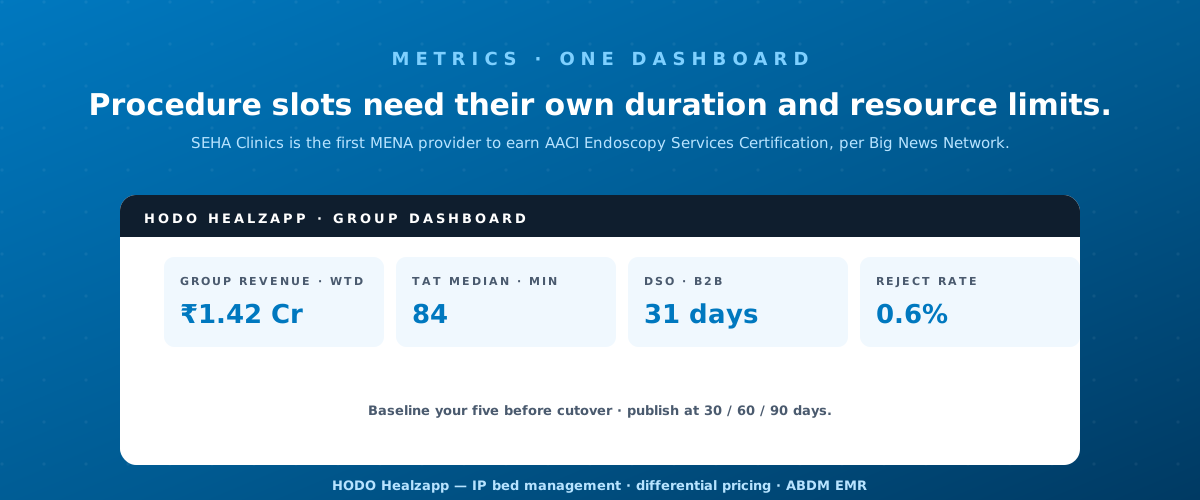
Procedure slots need their own duration and resource limits.
Replicating a certified service line across outlets
Groups that certify one branch almost always intend to extend the programme. The failure mode is treating the second branch as a fresh project, new slot templates, new price list, new procedure form, new consumable masters. Six months later the two branches document the same procedure differently, and the group has two audits instead of one.
The alternative is to treat the certified configuration as the asset: the procedure definitions, the resource constraints, the consumable masters, the payer mappings and the report formats travel to the new centre as a template, and local variation is limited to what the local regulator actually requires. That is a software decision made early, not a process decision made later.
What this means for HODO customers
Healzapp carries the endoscopy service line as an operational object rather than a calendar entry. OT holds the procedure record, operator, assisting staff, timings, findings, linked to the patient rather than to a standalone register, so a sampled case assembles itself. Inventory tracks consumable issue against the procedure, which produces a defensible cost per case and a usable recall path. Warranty+AMC asset tracking keeps processor and scope service history, contract dates and warranty status inside the clinic's own system instead of the vendor's inbox. Appointments models procedure slots with their own durations and resource constraints, and Billing carries payer, approval reference and differential pricing on the same record the clinician is writing into. For groups extending a certified line, Multi-outlet scale-up with one-click new-centre setup moves the configuration rather than rebuilding it.