The Free Press Journal reports that complaints about "ghost pathologists" in Maharashtra — reports carrying a registered pathologist's signature although the pathologist was never on the premises — have pushed the Quality Council of India to examine tighter security norms for diagnostic laboratories, including biometric access at reporting workstations. For accredited labs and growing lab chains, this is not a clinical story. It is a records story, and it lands on whoever owns the LIMS.
A records failure, not a clinical one
The allegation pattern is familiar across the country. A collection centre or a mid-sized pathology lab runs without a qualified pathologist on site, and signed reports go out using credentials belonging to a registered pathologist who may be attached to four or five other labs at the same time. The patient receives a report that looks compliant. When an inspector arrives, there is no way to establish who actually examined the slide or verified the analyser output. QCI's interest in biometric access follows directly from that gap: if the signatory has to be physically present to authenticate, the signature starts to mean something again.
The operational point for lab owners is less about the ethics and more about evidence. A lab that genuinely has its pathologist on site still has to prove it, and a surprising number cannot. Sign-off in many Indian labs is still a stamp on a Word template or a PDF assembled outside the LIMS, with no record of which user released it, from which terminal, at what time. Once an inspector, an insurer or a consumer court asks that question, a lab with clean practice and poor records sits in the same place as a lab with no pathologist at all.
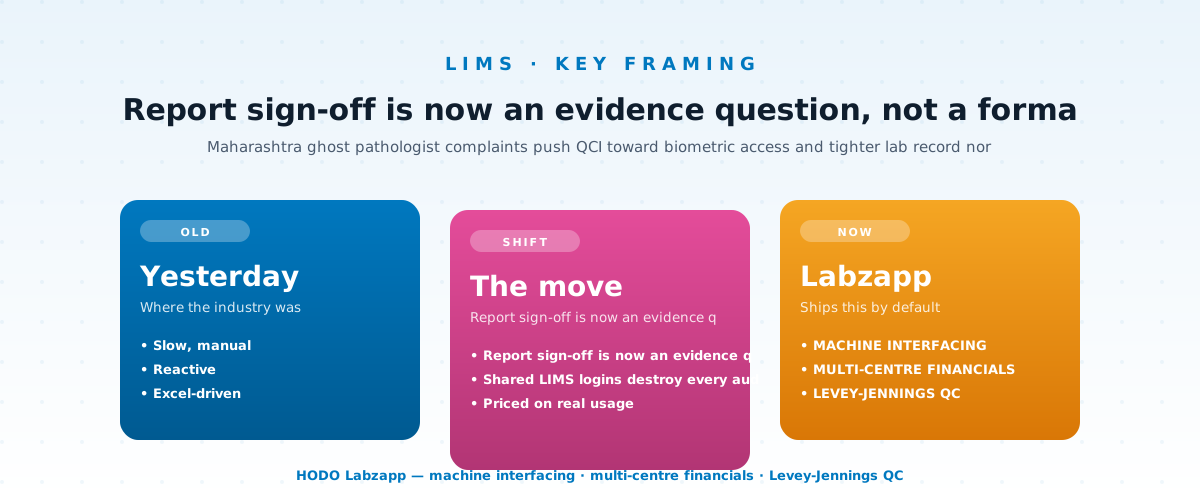
Report sign-off is now an evidence question, not a formality.
Biometrics locks the door; the LIMS closes the loop
Biometric access control at the entrance or at a reporting terminal answers one narrow question: was a particular person inside the building at a particular time. That is useful, and it is the sort of control that is easy for a state authority to mandate and inspect. It does not, by itself, link that presence to the 340 reports that went out that day. The linkage has to come from the laboratory information system.
What closes the loop is a chain in which each sample has a unique identity from registration onwards, each result arrives from the analyser rather than being typed in from a printout, and each release event is attributed to a named user with a timestamp that cannot be edited afterwards. Labs that already work this way will find a biometric mandate largely administrative. Labs that work on shared logins — one "pathology" user known to the whole reporting room, one "reception" user for the front desk — will find that biometrics at the door proves nothing about what happened at the keyboard. Shared credentials are the single most common finding behind a weak audit trail, and they cost nothing to fix except the inconvenience of issuing individual users and enforcing role-based rights.
The sign-off chain to build before the rule arrives
A defensible chain in a mid-sized lab has six links, and all six are ordinary LIMS discipline rather than new investment. Registration generates a barcode so the tube on the bench and the record on screen are the same object. Accessioning records who received the sample and when. Analyser results enter the system through an interface, so the value in the report matches the value the machine produced. Technical validation is attributed to the technologist who performed it. Authorisation is a separate, named act by the pathologist or radiologist, with the credential tied to one human being. Amendments after release are versioned, with the reason and the author retained.
That last link is where most disputes actually sit. Reports get corrected — a transposed value, a wrong patient on a shared surname, a critical result phoned in before the printed copy. If the corrected report simply overwrites the first one, the lab has destroyed the only document that would have explained its own behaviour. Turnaround data belongs in the same frame: a report released nine minutes after the sample reached the lab is a provable impossibility for a histopathology slide, and TAT records surface exactly that pattern before an inspector does.
Outsourced tests are where the trail usually breaks
Most standalone labs and lab chains in India outsource a meaningful slice of the menu — special histopathology, molecular panels, hormone assays that do not justify an in-house analyser. The referring lab prints the report on its own letterhead. The question a regulator will now ask is simple: who signed it, where, and under which registration. If the answer involves a courier docket, a WhatsApp message and a scanned PDF, the trail is broken at the handover.
Fixing it is mostly a matter of routing outsourced work through the same system that handles in-house work, so that the partner lab receives the sample under a tracked identity, returns the result against that identity, and the final report carries the correct attribution instead of an implied one. Anonymised sample identities matter here for a commercial reason as well: a referring lab that sends patient-identified samples to a partner lab is handing over its own customer list. Keeping the partner's rate card, the partner's sample log and the partner's signatory separate from the parent lab's reporting is as much a business control as a compliance one. Labs that treat outsourcing as an informal arrangement between two owners tend to discover during an assessment that they cannot produce a single reconciled list of what left the building.
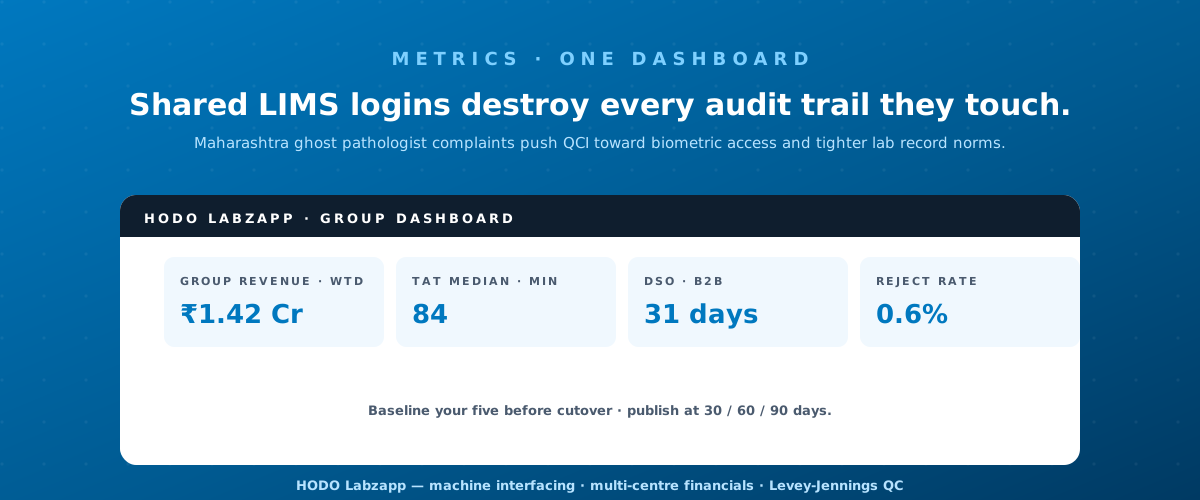
Shared LIMS logins destroy every audit trail they touch.
Franchise and multi-centre chains carry more exposure
The risk multiplies with outlets. A chain running twelve collection centres and two processing labs has twelve front desks registering patients, several technologists validating, and possibly one pathologist covering more scope than the roster suggests. Each new franchise adds a letterhead that carries the brand's accreditation but not always the brand's discipline. The Maharashtra concerns will push state authorities to ask which centre a report originated from and which qualified person authorised it — a question that is trivial when every centre works on one instance of the same system and nearly unanswerable when three outlets maintain their own spreadsheets.
Internal quality evidence sits alongside this. Levey-Jennings QC charts, instrument maintenance records and calibration logs are the second half of what an NABL assessor looks at after the sign-off trail, and they are the records most often reconstructed the week before an assessment. Labs that generate them continuously have an easier conversation. There is also a cost angle that owners underrate: a single consumer dispute over a disputed report, or a suspension of a centre's operations during an inquiry, costs far more than the per-user licensing a lab avoids by keeping shared logins alive.
What this means for HODO customers
Labzapp was built around the assumption that a report must be traceable to a sample, a machine and a person. Barcoded samples give every tube one identity from registration to archive, and machine interfacing removes the manual transcription step where values and attribution both go missing. Partner-lab integration with anonymised sample tracking keeps outsourced tests inside the same trail instead of a courier register, and TAT reporting exposes impossible turnaround patterns before an assessor or a court does. For multi-outlet chains, franchisee management and multi-centre financials keep every centre reporting on one system rather than twelve local habits. Biometric access, if and when it is mandated, then becomes one more control on top of a trail that already holds together.