Business Standard reports that Google has partnered with the National Health Authority (NHA) to deploy AI that helps digitise medical records under the Ayushman Bharat Digital Mission. For India's ~100-bed hospitals and multi-outlet lab chains, this is less a headline and more a schedule change: the ABDM stack is about to get its first real content layer, and hospitals still running paper OP files or PDF-only EMRs will feel the gap first.
What the Google–NHA deal actually says
The reported partnership is narrow but consequential. Google's models will assist NHA in converting scanned prescriptions, discharge summaries and lab reports, much of it handwritten or half-structured PDF, into machine-readable data that can plug into an ABHA-linked longitudinal record. NHA gets scale on OCR and clinical entity extraction that it could not build in-house on a policy budget; Google gets a controlled healthcare corpus footprint in the country. Neither side has published a rollout calendar, but the direction of travel is clear: ABDM's health record locker is moving from an empty envelope to a populated one.
For a ₹200-crore chain running ~100 beds per unit, this changes the compliance conversation. Until now, ABDM integration mostly meant issuing ABHA IDs at registration and publishing consent artefacts. If NHA's own AI can read anything you push, the burden shifts to what you push, the structure, completeness and timeliness of the record leaving your HIS. That is a software problem, not a policy one.
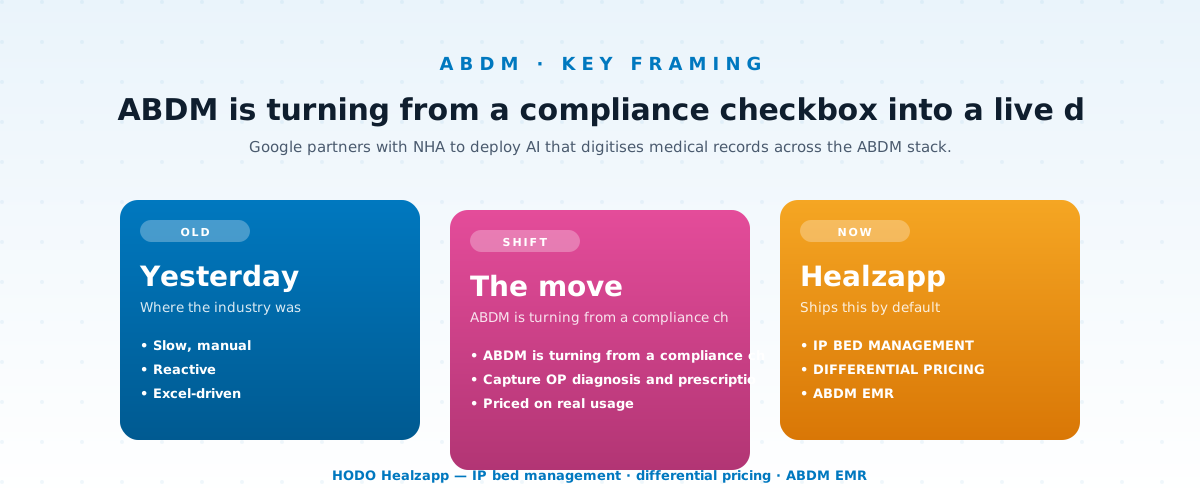
ABDM is turning from a compliance checkbox into a live data channel.
Why digitisation has stuck at India's 100-bed layer
Tertiary hospitals digitised because JCI and NABH accreditation demanded it, and because their case mix rewarded a full EMR. Single-doctor clinics never needed to. The 100-bed layer sits in the middle and has been the slowest to convert, the ROI on a heavy HIS is real but not obvious, IT teams are thin, and the incumbent vendor is usually a legacy Windows client bolted onto an on-prem SQL box that no one wants to touch.
The result across Tier-2 and Tier-3 India: OP notes stay on prescription pads, discharge summaries get typed into Word, TPA claims move by email attachment, and the lab result flows back on WhatsApp. None of this reaches ABDM in a form the new AI layer can enrich. The Google–NHA project widens the penalty for staying there: every hospital that does push clean, structured records will start showing up in ABHA search results as a digital-first provider, and referring doctors will notice.
What changes for OP throughput and TPA cash cycles
The operational payoff of a populated ABDM record is not clinical, it is throughput and cashflow. When a returning patient's prior labs, prescriptions and imaging are pulled into the consultation screen from ABHA rather than re-collected, OP consultation time drops by three to five minutes per visit. Across a 30-doctor OP floor doing 1,200 visits a day, that is a room's worth of capacity recovered without hiring.
The TPA and PMJAY side is where the treasurer notices. Claims that ship with structured EMR data, ICD-coded diagnoses and machine-verified investigations get pre-authorised faster and rejected less. Hospitals still faxing scanned documents to insurers are absorbing an avoidable 45-to-60-day working capital gap. Once the NHA-side AI can validate record content, insurers will start asking for the same structure, and the hospitals ready with it will get paid first.
The lab-chain angle: orders, results, and the ABHA handshake
Multi-outlet lab chains have a specific opportunity here. A lab that can receive an ABHA-authenticated order from any hospital or GP, run it, and post the report back into the patient's health locker becomes discoverable across the whole ABDM network, not just its own referral panel. That is a distribution channel change, not a marketing one.
The requirement is boring plumbing: barcoded sample tracking that survives the collection-to-processing-to-reporting chain, machine interfacing so results are not retyped, and a report format that carries LOINC codes rather than only free text. Chains still relying on Excel worklists and PDF reports will find their reports rejected by the AI enrichment layer and quietly deranked in ABHA search. The chains that fixed this two years ago will look like they suddenly grew.
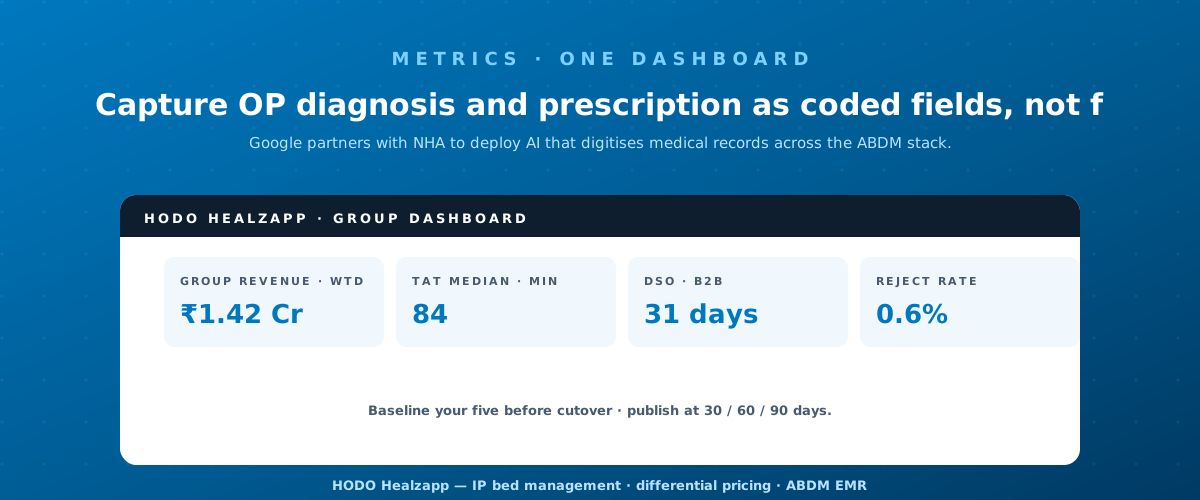
Capture OP diagnosis and prescription as coded fields, not free text.
What to fix in your HIS before the AI layer lands
Three things matter more than the rest. First, registration must issue and verify ABHA at the counter, not as a batch job at month-end, otherwise the record never links. Second, the OP consultation screen has to capture diagnosis, prescription and investigation as coded fields, not as a single free-text note; the AI layer can enrich structure but cannot invent it. Third, discharge summaries must be signed and pushed within 24 hours of discharge, not held for a week for consultant review.
None of this is new NABH guidance, it is just now enforced by a downstream reader that never gets tired. Hospitals whose HIS treats ABDM as a compliance checkbox rather than a live data channel will spend the next twelve months rewriting workflows they thought were done.
What this means for HODO customers
Healzapp customers already have the surface area for this transition. ABDM-compliant EMR (India) handles the ABHA linkage and consent trail at registration and at every clinical touchpoint, so records leaving the HIS are already in the shape the NHA-side AI expects. The EMR (AI-condensed history) module summarises pulled prior records into the consulting doctor's screen, so the throughput gain from ABDM lookup actually reaches the OP room instead of getting lost in scroll fatigue. For chains scaling into new towns, Multi-outlet scale-up with one-click new-centre setup means the compliance work does not have to be redone per unit. Lab-chain arms on Labzapp pair the same discipline with Machine Interfacing and WhatsApp/SMS report delivery, so the ABHA-posted report and the patient-facing report leave the analyser as one event.