
ETV Bharat reported on 29 June that the government is preparing to launch an affordable cloud-based Hospital Management System aimed squarely at small clinics. For owners running 50-500 bed hospitals, multi-outlet chains, or diagnostic networks, the news is less about direct competition and more about a floor shift: basic digitisation is about to become table stakes for even the two-doctor neighbourhood clinic, and the referral network mid-size hospitals depend on will start operating on structured data almost overnight.
The stated target of the new offering is the small clinic — the segment that has, until now, stayed on paper prescriptions, register-book billing, and WhatsApp for report delivery. A subsidised cloud HMS shifts that baseline. Within 12-18 months of rollout, a large chunk of the tier-2 and tier-3 clinic base is likely to hold at least a Health ID for every patient, a digital OPD register, and a rudimentary EMR.
That does not threaten a 200-bed multi-specialty hospital in any direct way. What it does is remove the current excuse — "our referring clinics do not have data anyway" — that many mid-size operators quietly rely on to defer their own digital projects. When the feeder network digitises, the receiving hospital's inefficiencies become visible and measurable, first to the referring doctor and shortly after to the patient.
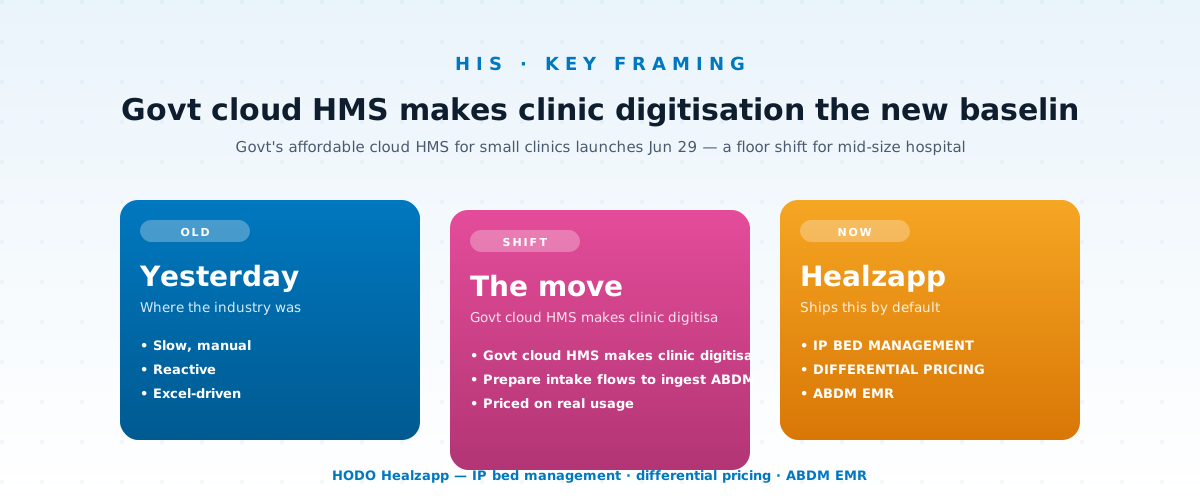
Roughly 40-60% of OP footfall at a mid-size hospital comes through referral clinics, GPs, and standalone diagnostic centres. Today, most of that patient context arrives as a scribbled note, a folded prescription, or a phone call from the referring doctor. If the government's HMS rides on ABDM rails — and it almost certainly will, given the policy direction — those same referrals will start arriving as linked Health IDs with a full prior encounter log attached.
Hospitals whose HIS can accept, parse, and route that inbound record into the consulting doctor's EMR window will save 4-8 minutes per patient at intake. Hospitals still asking the patient to re-narrate history will look, and feel, dated. Front-desk throughput and OP consultation TAT will diverge sharply between the two categories over the next two financial years.
Every finance head and MD will, sooner or later, be asked the same question by a board member: the government is giving away a cloud HMS — why the vendor spend? The answer is straightforward but needs preparing. A lightweight cloud HMS solves single-clinic OPD and basic billing. It does not solve IP bed management across four wards, OT scheduling, pharmacy stock reconciliation with Tally, machine interfacing to lab analysers, or TPA claim workflows where a stuck pre-auth blocks discharge for six hours.
Mid-size hospitals lose money not on OP registration but on IP throughput, insurance receivables, and pharmacy leakage. A tool built for a two-doctor clinic will not touch any of those loss centres. The procurement conversation is worth having in that exact language, before someone else frames it as "expensive vendor versus free government option".
A government-issued HMS will be ABDM-native by design. Health ID creation, consent artefact generation, and discharge summary sharing will be built into the primary workflow, not offered as a paid add-on. Hospitals still running a legacy HIS with a bolted-on ABDM adapter will notice the gap first in three places: consent-based record fetch times, HFR and HPR registration completeness, and NDHM analytics reporting depth.
The regulator's expectation of compliance depth will rise as the baseline rises. What was acceptable in 2024 — Health ID capture with partial linkage — will not clear audit in 2026. Operators who treat ABDM as a checkbox rather than a workflow will spend the next 18 months in reactive remediation, paying integrators to close gaps that the newer stacks solve out of the box.
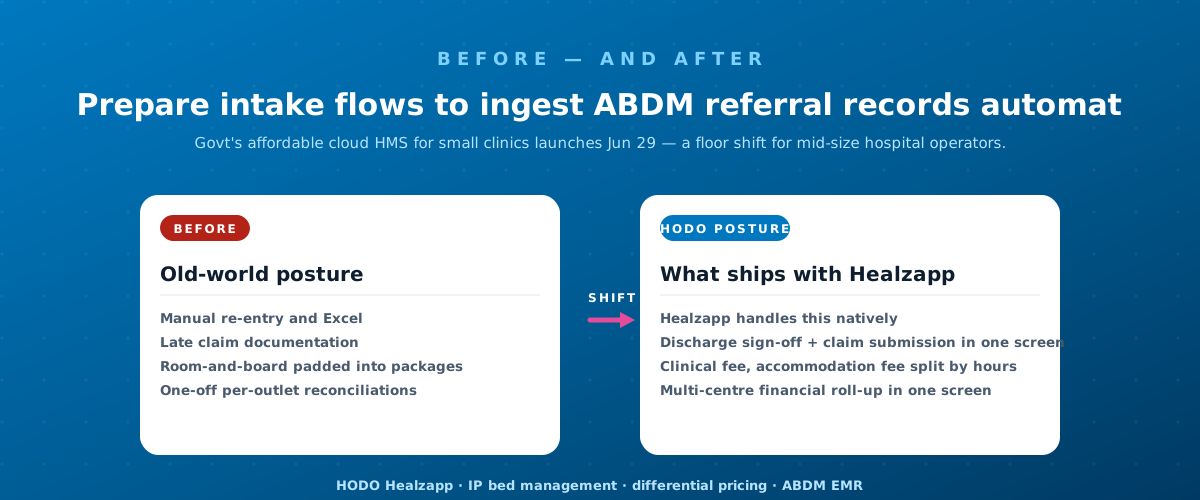
A single-clinic cloud tool, government-issued or otherwise, does not solve the operational problems of a chain running five, twelve, or forty outlets. Consolidated MIS, per-outlet differential pricing, unified patient records across centres, corporate and TPA partner logins, franchisee P&L reporting, and new-centre onboarding without a three-week IT project — none of these are in scope for a tool aimed at solo practitioners.
For diagnostic and pathology chains, the gap is even wider: barcoded sample tracking, machine interfacing to analysers across outlets, Levey-Jennings QC, and partner-lab integration with anonymised sample routing are non-trivial engineering problems. A subsidised cloud tool will not attempt them. Chain operators should stop worrying about the government's move and start using it as a talking point when the board asks about the IT budget.
The centre of gravity of the Indian healthtech market is about to shift from "is this hospital digitised" to "is this hospital operating on ABDM-grade data end-to-end". Three parts of the Healzapp stack become more visible in that world. The ABDM-compliant EMR means inbound referrals from newly-digitised clinics land inside the consulting doctor's screen without a re-narration step at the front desk. The Multi-outlet scale-up with one-click new-centre setup means opening outlet number six or twelve is a configuration change rather than an IT project — a capability the government's small-clinic tool will not target. And the B2B Referral / Outsource Lab / Corporate-partner logins keep referring GPs, panel companies, and outsourced labs inside a single workflow, instead of pushing them onto whichever free tool they adopt this quarter.
See how Healzapp handles this — book a 30-min demo.
See how Healzapp, Labzapp and EReazy fit your speciality in a free 30-minute demo.
Book a Free Demo