Gulf Business carries an interview with Teleperformance's Augusto Martinez Reyes on how AI is remaking customer operations across the Gulf, and his framing is the useful part: the interesting question is no longer whether a model works, but whether a pilot can survive contact with daily volume. For healthcare founders and operators in the UAE and the wider GCC, that is the whole problem in one sentence. Very few clinic groups, lab networks or homecare operators are short of AI tools. What they are short of is AI that still works in month nine.
Why the pilot-to-production gap is so wide
Pilots are built to impress. Production is built to be boring. A pilot runs on clean inputs, a motivated champion and the quiet knowledge that someone is watching the output. Production runs through staff turnover, mixed Arabic and English conversations, the evening shift, the insurer who wants pre-approval for a test that three other insurers wave through, and the patient who replies to a WhatsApp message four days later.
A typical failure looks like this. A Dubai polyclinic pilots an AI assistant to draft post-visit follow-up messages. For three weeks it performs well, because the operations manager reads every draft before it goes out. She takes two weeks of leave, nobody else owns the queue, and the tool quietly stops being used. When she returns, the pilot is written off as "not reliable enough", and the real diagnosis is missed. The model was fine. What was missing was an owner, an escalation rule and any record of what the tool had learned during those three weeks.
That last point matters most. Most healthcare AI pilots leave no residue. The prompts, the corrections, the edge cases staff discovered, all of it evaporates when the pilot closes. The organisation runs the experiment, pays for it, and keeps nothing. Doing it again next quarter starts from zero.
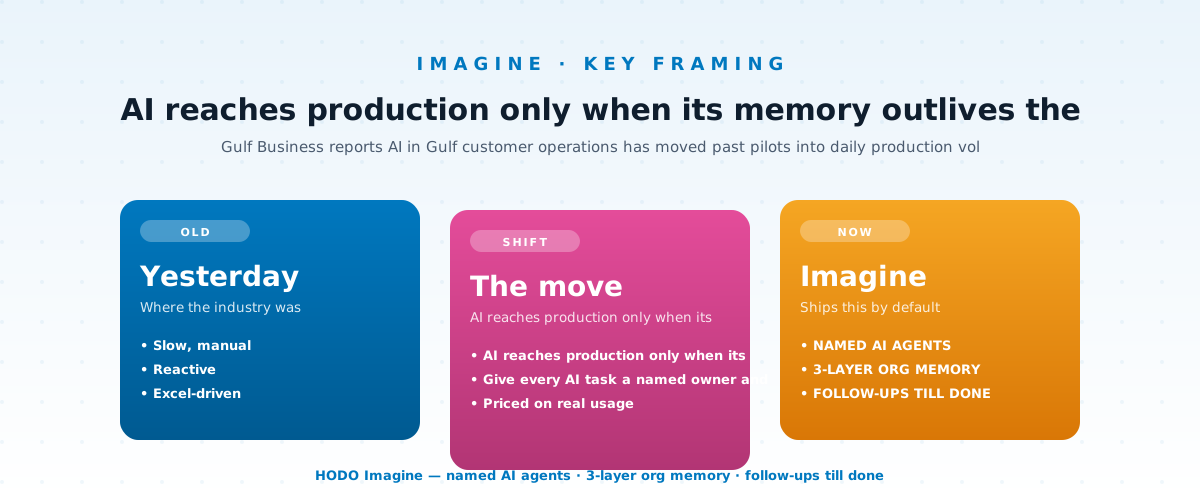
AI reaches production only when its memory outlives the pilot.
Customer operations is where healthcare AI gets judged first
The Gulf Business piece locates the shift in customer operations rather than in clinical decision-making, and that lines up with where healthcare operators in the region actually feel pressure. Count the patient-facing admin load in a 12-doctor polyclinic in Abu Dhabi or a five-branch lab chain in Doha: appointment confirmation and rescheduling, insurance eligibility questions, package price quotes, report chasing, home-collection time windows, no-show recovery, post-visit follow-ups in two or three languages, and the standing stream of "has my result come?" messages.
This work is spread across WhatsApp, phone calls and the front desk, it consumes a large share of non-clinical staff hours, and its failures are highly visible to patients. A missed report, a wrong price, a promised call-back that never happened, these shape reviews and referrals far more than any clinical nuance.
It is also the cheapest place to prove AI value, because the metric is close to hand: cost per patient interaction, and how many interactions close without a human touch. Clinical AI is slower to validate, heavier to govern and harder to explain to a licensing authority. Customer operations gives a founder or clinic owner in the GCC a defensible digital advantage inside a quarter rather than inside a funding cycle, which is precisely the sequencing Martinez Reyes describes in non-healthcare Gulf sectors that are already past the pilot stage.
Production runs on memory, not better prompts
When a pilot underdelivers, the instinct is to rewrite the prompt. The binding constraint is usually memory. A general-purpose chat tool starts every conversation empty. Staff re-supply the same context each time: the current price list version, which insurer needs pre-approval, how the clinic words a delayed-report apology, what was promised to this patient last week. The knowledge exists, but it lives in whoever happened to be typing.
This is the gap imagine is built for. Its 3-layer memory, today, this week, forever, separates immediate operational context from the current week's open threads and from durable organisational knowledge that accumulates over months. The practical effect in a Gulf clinic or lab, where expatriate front-office turnover is high and handovers are short, is that the way the organisation handles a delayed report or a rejected claim does not resign along with the receptionist who worked it out.
It is worth being precise about what this is not. imagine does not replace Microsoft 365, Copilot or ChatGPT. Those tools answer questions well and forget them immediately. imagine is the layer that connects them and holds the memory, so the same question does not get three different answers from three different staff members on three different days. That continuity is the difference between a clever tool and an operating system for the organisation.
Give the work an owner, not a chat window
Production AI needs an org chart. "We use AI for patient follow-ups" is a pilot sentence. "A named agent owns report-delivery follow-up, reports to the operations lead, and escalates anything still open after 24 hours" is a production sentence. imagine's model of named AI agents with jobs, memory and reporting lines exists to make the second sentence writable, and auditable.
Two consequences follow. First, brand voice consistency stops being a matter of who drafted the message. A clinic that speaks to patients in a particular register, formal Arabic with some patients, plain English with others, never over-promising a result time, can hold that register across channels and shifts instead of hoping each new hire absorbs it. Second, follow-ups actually close. The task that kills pilots is not the hard task; it is the half-finished one. A patient asked for an insurance pre-approval update on Tuesday, nobody replied, and by Friday the appointment is gone. Agents that chase until a task is closed convert AI from a drafting aid into throughput.
Founders should draw this the way they draw a staffing plan: which jobs, whose line, what escalation threshold, what the agent is not allowed to decide alone. Clinical advice, pricing exceptions and anything touching a licensing obligation stay with people.
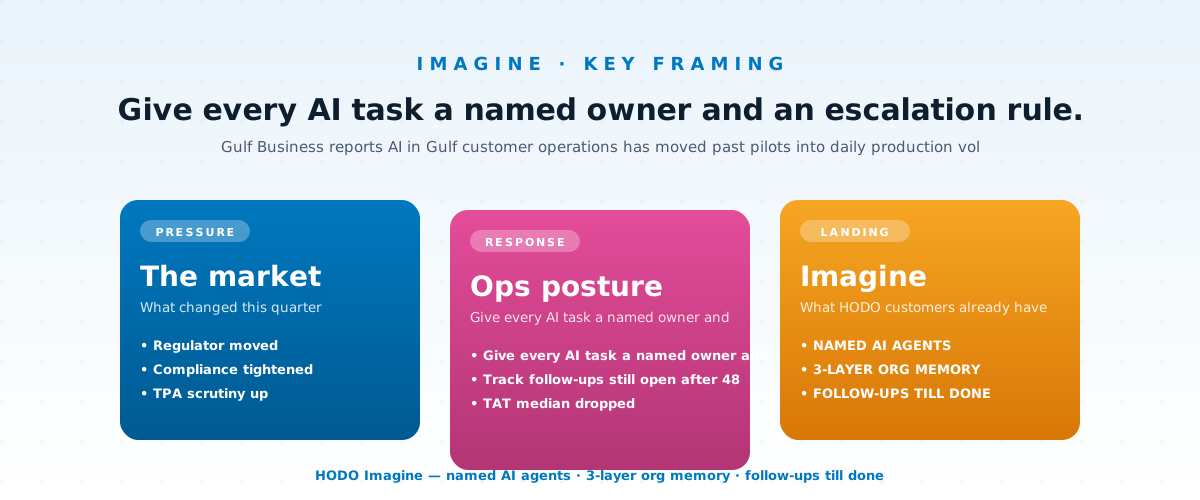
Give every AI task a named owner and an escalation rule.
What to measure in the first 90 days
Pick metrics that a pilot cannot fake. Four hold up well for GCC clinics, labs and homecare operators. One: the share of routine patient interactions closed without a human touch, tracked weekly rather than as a launch-day figure. Two: median time from report ready to report delivered, which exposes whether follow-through is real. Three: the count of open follow-ups older than 48 hours, which is the single best early-warning indicator that AI-assisted operations are drifting back to manual. Four: onboarding time for a new front-desk hire, a useful proxy for whether organisational knowledge now sits in the organisation or still sits in people.
Avoid vanity counters. Messages generated, queries answered and prompts run tell you about activity, not about resolution. Also keep an audit trail of what an agent told a patient and when, alongside who owned the task. In markets with DHA- and MOHAP-style oversight, the ability to reconstruct a patient conversation six months later is not a compliance luxury; it is what lets an operator expand AI into more sensitive workflows without fresh argument each time.
What this means for digital transformation
The Gulf's non-healthcare sectors are past the pilot stage because they treated AI as an operating change rather than a tool purchase. Healthcare operators and founders in the region can take the same route on the administrative side, where the measurement is honest and the risk is contained. The three capabilities that decide whether it holds are named AI agents with jobs, memory and reporting lines, 3-layer memory (today / this week / forever) so organisational knowledge compounds instead of walking out the door, and follow-ups until tasks close, which is what turns AI output into finished work. Add brand voice consistency and the patient experience stops depending on which shift answered.
See how imagine turns AI into organisational intelligence, explore imagine.