News of Bahrain reports that Kanoo IT is backing healthcare innovation in the Kingdom, extending an established enterprise technology business further into clinical settings. For polyclinic operators across Bahrain, the UAE, Qatar and Kuwait, the headline matters less than the pattern behind it: regional IT houses are now treating healthcare as a core vertical rather than an occasional project. That changes the conversation an owner has when the clinic's practice management system finally comes up for replacement.
A regional IT house entering healthcare is a supply-side signal
An established enterprise technology business does not open a healthcare practice on sentiment. It does so when the pipeline is visible — when enough clinics, polyclinics, day-surgery units and small hospitals in a market are replacing core systems in the same window. Bahrain is compact enough that a shift like this is easy to read, and the rest of the Gulf tends to follow the same curve a year or two apart. Across Dubai, Abu Dhabi, Doha and Kuwait City the same generational change is under way: first-generation billing packages installed a decade ago are being retired, and owners who once bought a cash-counter tool are now buying a clinical and financial system of record.
The practical effect for an operator is more choice and more noise. Integrators, regional resellers, global HIS vendors and local startups all arrive with similar slide decks. Feature lists converge; what separates them is whether the system matches how a multi-doctor outpatient clinic actually runs in this region — insurance mix, language mix, walk-in ratio, visiting-consultant sessions, and the licensing regime of the emirate or kingdom in question. A buying decision made on brochure parity usually produces a two-year implementation and a quiet rollback. A decision made against the clinic's own throughput numbers rarely does.
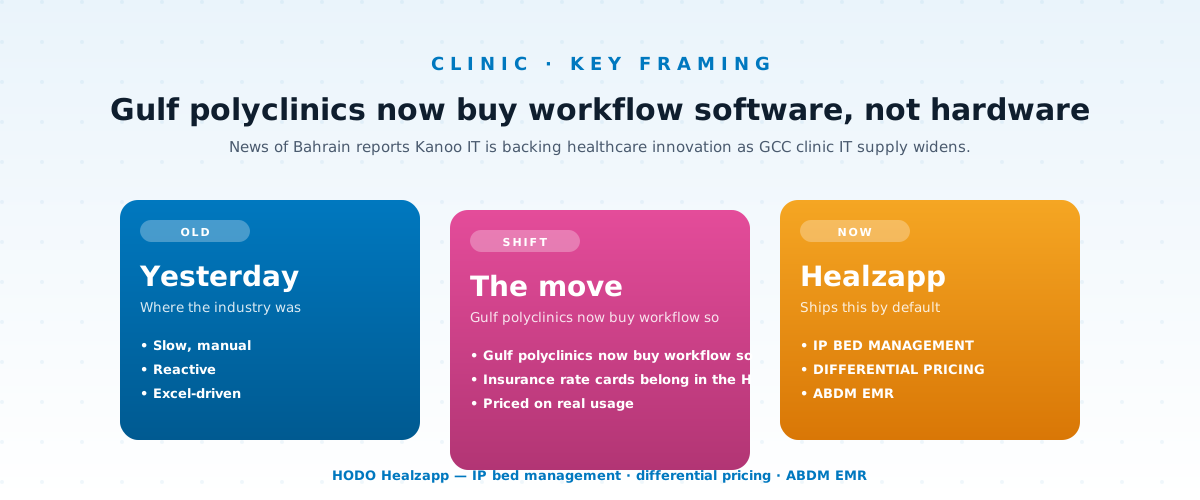
Gulf polyclinics now buy workflow software, not hardware.
The bottleneck in a six-room polyclinic is rarely hardware
Owners tend to describe the problem as "our system is slow". Watched for a day, the constraint is almost always handoffs. Registration takes four minutes because the receptionist retypes an Emirates ID or CPR number that already exists in the database. A patient waits twenty minutes past the appointed slot because nobody at the desk can see that the consultant is still with the previous case. The pharmacy counter asks for a printed prescription because the clinical note has not been finalised. None of these are hardware problems, and none are solved by a faster server.
The measurable version of this is time-to-consult: the gap between a patient arriving and being seen. Most polyclinics do not track it, so improvement stays invisible. Clinics that do track it usually find that a third of the average wait sits in registration and queue management rather than in clinical time. A single patient record that the desk, the nurse, the doctor and the pharmacy all read from removes most of the retyping. A display showing the current token and room removes most of the "how long more?" interruptions at the counter — interruptions that cost the receptionist more throughput than the queries themselves are worth. Front-desk capacity, not consultation capacity, is what caps a busy morning session in most clinics of this size.
Insurance and billing are the GCC-specific stress test
The sharpest difference between a Gulf polyclinic and an Indian clinic of the same size is payer mix. A Dubai or Manama clinic may run cash, several insurers, corporate accounts and package pricing in the same session, each with its own co-pay rule, approval requirement and rate card. When those rules live in a billing clerk's head or a side spreadsheet, two things follow: the counter slows while eligibility is checked, and rejections surface weeks later when the claim is already aged.
The system-level answer is to encode the rate card rather than the invoice. Each payer, corporate contract and package carries its own price for the same service code, applied automatically at the point of billing. Reconciliation then becomes a report instead of an investigation, and the clinic can answer a question most polyclinics cannot: which payer actually contributes margin after rejections and delay, and which one only contributes volume. That number tends to reorder priorities. Operators frequently find that one high-volume contract carries a realisation rate low enough to be worth renegotiating or dropping outright.
Multi-currency handling matters as well for clinics serving transient and expatriate populations, as does a clean corporate-partner view — so an employer or insurer can be given visibility into its own employees' billing without being given access to the clinic's full ledger.
Scheduling across doctors who are not all full-time
Polyclinics rarely run a uniform roster. A typical clinic might have two full-time general practitioners, a dermatologist on three evenings, a visiting orthopaedic consultant on alternate Saturdays and a physiotherapist on fixed slots. Scheduling that mix by WhatsApp message and a wall chart produces predictable failures: double-booked rooms, consultants arriving to an empty session, and no reliable record of which slot was cancelled by the patient versus released by the clinic.
The metric worth managing is room utilisation per session rather than daily footfall. Footfall flatters a clinic; utilisation exposes it. A room running at 55 per cent through a Tuesday evening session has either an advertising problem or a scheduling problem, and the two call for opposite responses. Appointment data that distinguishes no-shows, patient cancellations and clinic-side releases tells the owner which one is in play before money is spent on the wrong fix.
Teleconsultation has settled into a narrower but real role in the region — follow-ups, report explanations and repeat prescriptions for stable patients. It works when it shares the same calendar and the same record as the physical visit, and it fails when it runs as a separate app with its own notes. Letting patients book, reschedule, view reports and receive them over WhatsApp also removes a surprising volume of inbound calls from a desk that is already the constraint.
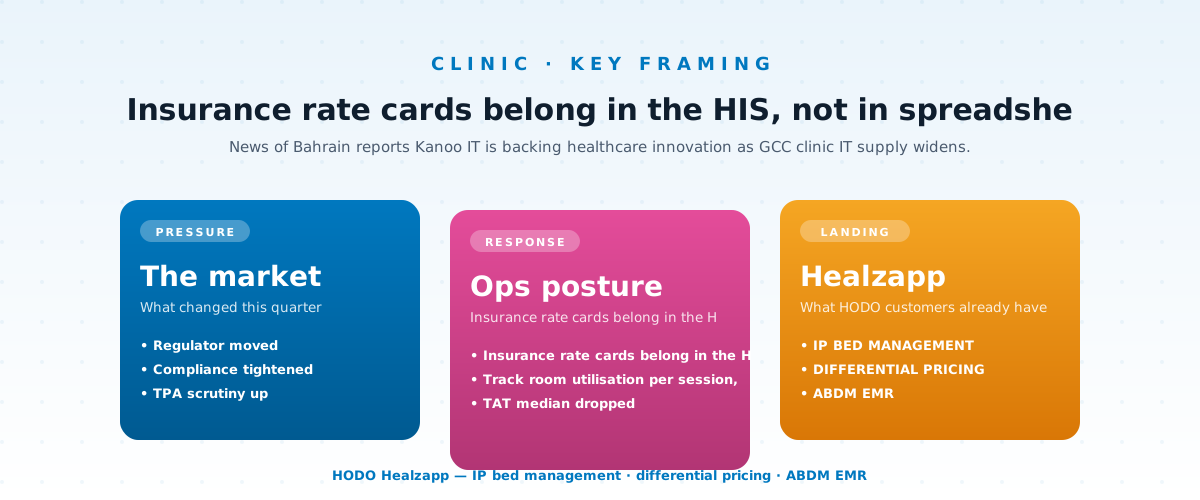
Insurance rate cards belong in the HIS, not in spreadsheets.
Records, licensing and the question an inspector actually asks
Licensing authorities in the region — DHA, MOHAP and their counterparts in Qatar, Kuwait and Bahrain — are less interested in the elegance of a clinic's software than in whether the record is complete, attributable and retrievable. The common failure is fragmentation: clinical notes in one system, lab results on an analyser printout, imaging in a shared folder, consent on paper. Reassembling one patient's history for an inspection or a medico-legal query then takes days of staff time.
Direct machine interfacing closes the largest part of that gap. Results moving from analyser to record without transcription remove a known error source and compress turnaround within the same visit, which is the difference between a patient waiting for a result and a patient returning for it. Condensed clinical history solves a different problem: a consultant seeing a returning patient after eleven months needs the relevant two paragraphs, not forty pages of chronological notes.
Growth raises the stakes. The second and third branch is where fragmentation turns into a governance issue, because each new outlet invents its own local practice unless the system standardises it from day one. Any operator planning a second location should ask how long it takes to stand up a new centre on the system, because that number quietly sets the pace of expansion.
What this means for HODO customers
A thickening supplier market in the Gulf is a reason to buy carefully, not quickly. The evaluation worth running is narrow and numeric: time-to-consult at the front desk, realisation rate per payer, room utilisation per session, and how many days it takes to open the next branch on the same system. HODO Healzapp is built around those four numbers for clinic and polyclinic operators in the UAE and the wider GCC. Billing (incl. multi-currency / GCC patterns) holds each payer, corporate contract and package at its own rate, so the counter stops improvising and reconciliation becomes a report. Appointments handles mixed full-time and visiting-consultant rosters with per-session visibility, including teleconsultation slots on the same calendar. Multi-outlet scale-up with one-click new-centre setup keeps the second and third location from becoming three separate clinics sharing one brand.