Medical Buyer reports that the National Health Authority is exploring collaboration with the UAE on digital health and health data research. The operational reading for an Indian diagnostic lab is narrow and specific: national health data is being positioned as a research asset, and pathology results are the single largest structured contributor to that pool. Whether a four-centre lab chain can participate in such work — or can only be audited against it — is decided by how its LIMS records one result today.
Why a government data pact lands on the lab bench
Research collaborations do not reach labs as memoranda. They arrive as requests. A state programme asks for de-identified HbA1c distributions across a district. A 100-bed referral hospital asks for thyroid positivity rates by age band before it renegotiates its outsourcing rate. A CRO running a multi-centre trial asks for sample volumes with turnaround evidence attached. An NABL assessor asks how a reported value can be traced back to the instrument that produced it.
Most lab chains answer these in the same way: a senior technologist spends a day and a half pulling exports, pasting them into a spreadsheet, cleaning test names by hand, and producing a number nobody can reproduce next quarter. That is two problems at once. The first is cost — a scarce technical person doing clerical work, at a labour rate the lab never books against any test. The second is credibility. If the same question asked twice returns two different answers, the lab is not a data participant; it is a data liability.
Labs that can answer in an hour are not working harder. They structured the record at the point of collection, and every downstream request is a query rather than a reconstruction project.
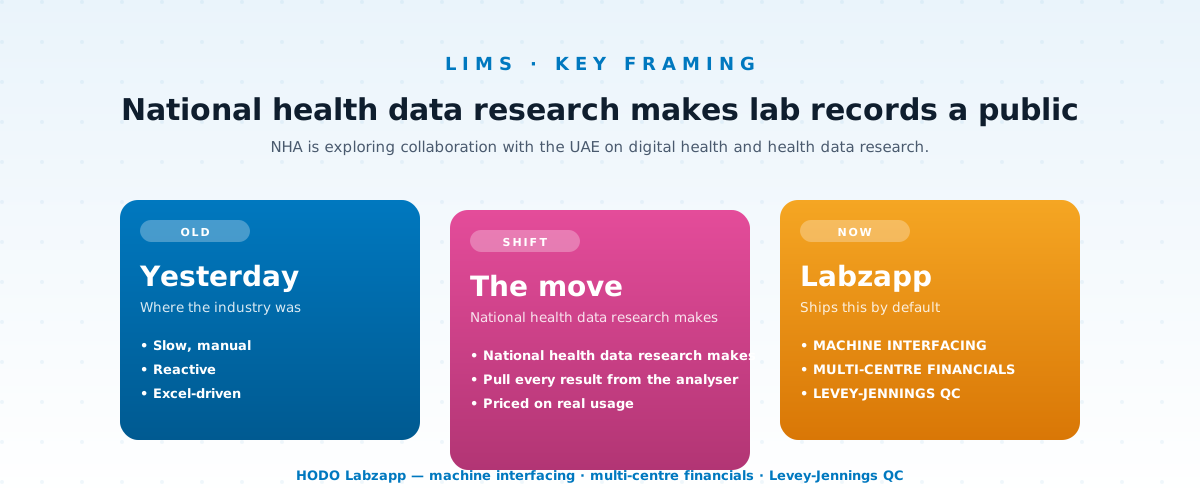
National health data research makes lab records a public asset.
Research-grade data begins at the analyser
The gap between a readable report and a usable dataset is almost always transcription. When a technologist reads a value off an analyser screen and types it into the LIMS, four things are lost: the instrument identity, the exact result timestamp, the unit as the analyser expressed it, and the audit link between sample and measurement. What remains is a number that looks right on a PDF and cannot be defended in an audit or pooled into a study.
Direct machine interfacing closes that gap, and it is worth measuring the gain in ordinary operational terms rather than research terms. Interfaced results remove the second pair of eyes that labs currently use for verification, which is real staff time per shift. They remove the re-test cycles caused by typographical errors in critical values. They cut the reporting queue at peak hours, when a 300-sample morning run is exactly when manual entry backs up and TAT breaches start.
Barcoded samples do the same work on the identity side. A barcode applied at collection — at the centre or at the patient's home — carries the sample through aliquoting, analysis and archival without a handwritten label being read twice. For research use, that single identifier is what makes a result joinable to anything else: a prior visit, a referring doctor, a package, a repeat test six months later.
De-identification is a workflow, not an export step
The most common mistake in sharing lab data is treating de-identification as something done at the end — delete the name column, mask the phone number, send the file. It does not survive scrutiny. A date of birth plus a pin code plus a rare test is often enough to re-identify a patient, and a masked export gives the lab no record of what left the building, for whom, or under what consent.
The workable pattern is to separate the clinical record from the identity record inside the system, so that any outbound dataset is assembled from the de-identified side by default. Indian labs already run a version of this when they outsource. A sample sent to a partner lab for a specialised assay should travel with a code, not a patient name — the partner needs the specimen type, the test, and the clinical context, nothing more. Labs that have built outsourcing this way already have the plumbing for research sharing; labs that email patient details to partner labs have a disclosure problem long before any research question arrives.
Two operational habits follow. Keep a log of every dataset released, with requester, purpose, date range and field list. And decide once, at the policy level, which fields are never shared, rather than leaving that judgement to whoever runs the export that week.
Quality control is the evidence layer
Research use raises a question most labs answer informally: was the analyser in control when this result was produced? A result without contemporaneous QC evidence is not wrong, but it is not citable either, and increasingly the same standard is being applied by hospital empanelment committees and corporate clients, not only by researchers.
Levey-Jennings charts maintained inside the LIMS — rather than in a parallel register that the QC in-charge updates weekly — make this answerable by date and by instrument. The operational benefit arrives earlier than any research benefit. Drift shows up as a trend before it shows up as a complaint, reagent lots can be compared against each other, and repeat-test spend becomes visible as a number instead of a vague sense that one analyser is troublesome. For a chain running the same test across four centres, inter-centre comparison is the only honest way to tell whether a positivity difference is epidemiology or calibration.
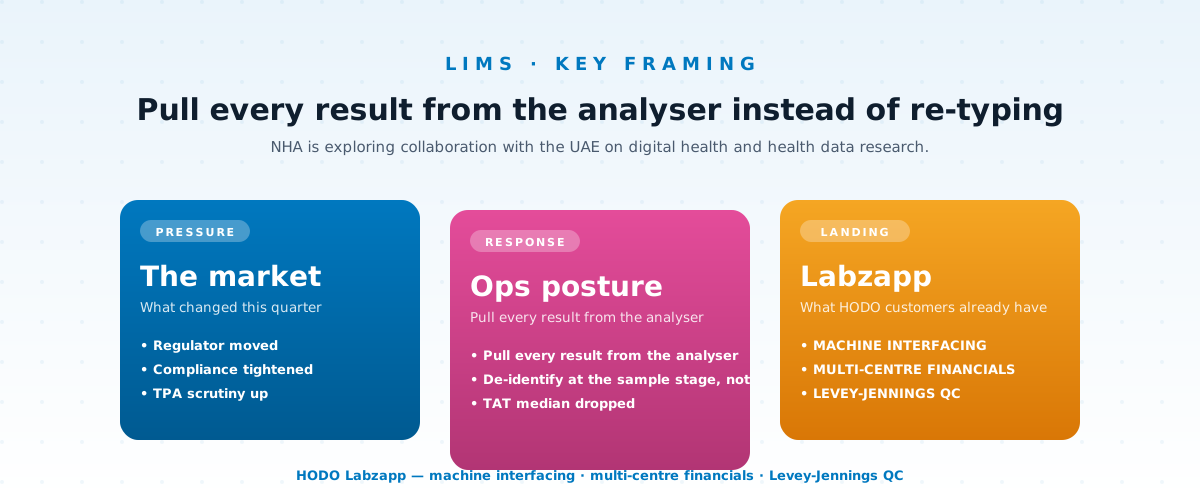
Pull every result from the analyser instead of re-typing it.
What cross-border collaboration changes for Indian labs
An India–UAE arrangement on digital health does not place a compliance burden on a lab in Kochi or Indore. What it changes is the shape of requests. Labs with Gulf-facing referral arrangements, NRI patient panels, or GCC partner labs will be asked for data in formats set by the counterparty rather than by domestic habit: coded tests, explicit units, turnaround evidence, and a clear statement of what has been de-identified.
That is also where commercial upside sits. A lab that can show TAT by test and by centre, with QC behind it, negotiates partner contracts from evidence. Differential pricing per partner only works when the cost and turnaround picture per partner is visible. The chains that treat structured data as an operating asset tend to find it pays for itself in rate negotiations well before it pays off in research.
What this means for HODO customers
Participation in any health data research programme is a byproduct of ordinary lab discipline, not a separate project. Barcoded samples and machine interfacing remove transcription from the result path, so every value carries its instrument and timestamp. Levey-Jennings QC keeps the evidence layer attached to the data rather than filed separately. Partner-lab integration with anonymised sample tracking means outsourced and shared samples move by code, which is the same mechanism research sharing needs. TAT reporting turns turnaround into a number per test and per centre instead of an argument.