Digital Health News this week revisits the current trajectory of Health IT adoption across Indian hospitals, the mix of ABDM push, HIS replacement fatigue, and a widening gap between large tertiary chains and ~100-bed community hospitals. The headline numbers matter less than what the piece implies about the next 18 months of buying decisions at mid-sized hospitals and Indian diagnostic lab chains.
The adoption curve is uneven, and mid-sized hospitals are stuck
Tertiary chains in Bengaluru, Chennai, Mumbai and Hyderabad have already been through two or three HIS generations. Their problem now is integration debt: an EMR that does not speak to the LIMS, a PACS that lives on its own island, a pharmacy stack that reconciles to Tally once a quarter. The 100-bed community hospital sits in a different place on the curve. It typically runs a mix of paper, an old front-office billing package, a spreadsheet-driven pharmacy, and a lab that hand-keys results back into discharge summaries. The Digital Health News piece describes this gap in polite language; on the ground it shows up as a five-day discharge cycle, TPA claims that age past 90 days, and an OP counter that loses walk-ins by 11 a.m. because the queue is not visible. Adoption is not the question. What to adopt, in what order, without freezing three months of revenue during cut-over, that is the question the article leaves open.
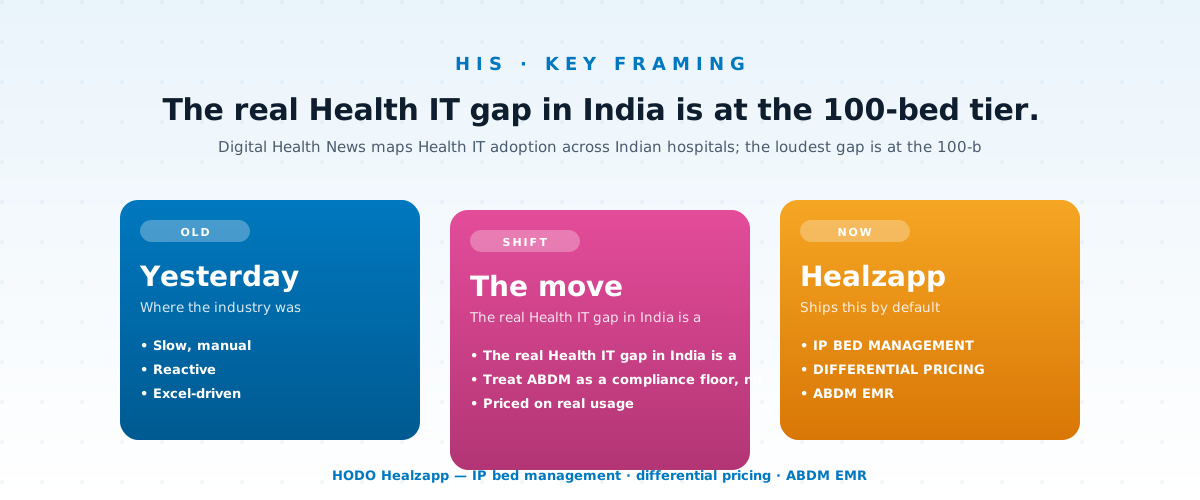
The real Health IT gap in India is at the 100-bed tier.
ABDM is a compliance floor, not a strategy
Every article on Indian Health IT eventually turns to ABDM, and this one is no different. The framing worth adopting is that ABDM compliance is a floor, not a strategy. Being one of the first cohorts of ABDM-integrated HealthTechs, being NRCeS-listed, being on the Telemedicine Registry, these are hygiene items for any HIS a 100-bed hospital signs in 2026. They do not change the P&L. What changes the P&L is what the HIS does once ABDM is a check-box: whether it condenses a returning patient's history into a usable clinical summary at the OP counter, whether it moves the pharmacy from a manual reorder cycle to consumption-driven, whether the billing counter stops re-typing insurance details for every visit. Buyers who mistake ABDM readiness for the whole roadmap end up replacing their HIS again in three years.
What replaces the legacy HIS at a 100-bed site
The practical replacement question at a 100-bed hospital is not which HIS has the best UI, it is which HIS will let the group run three outlets, then five, without doubling the IT team. Chains grow through acquisitions of nursing homes and specialty clinics, and each new centre arrives with its own tariff card, its own doctor mix, its own local corporates. The HIS either absorbs that reality in a week, or the group stalls at three outlets. This is where multi-outlet configuration, differential pricing per corporate, and same-day new-centre setup matter more than any single clinical module. The Digital Health News piece hints at this consolidation trend without naming it, but operators feel it in the diligence room every time a family-run hospital sells to a regional chain. A HIS that cannot open the fourth outlet on a Monday morning is the wrong HIS.
Lab chains and referral networks are the next pressure point
Indian diagnostic lab chains are running on a different clock. Cost per test at forty to eighty rupees for a routine panel does not survive a manual reporting flow. Barcoded samples, machine interfacing to the analyser fleet, automated report delivery over WhatsApp, these are not upgrades, they are the difference between a lab that clears 800 samples a day and one that stalls at 300. Hospitals that run in-house labs feel the same pressure from the referral side: a corporate hospital that cannot accept an outsourced sample with anonymised tracking loses that B2B revenue to a competitor who can. The article treats hospitals and labs as separate segments; the buying reality in India is that they are increasingly the same customer, and the HIS-LIMS boundary is where most integration projects fail.
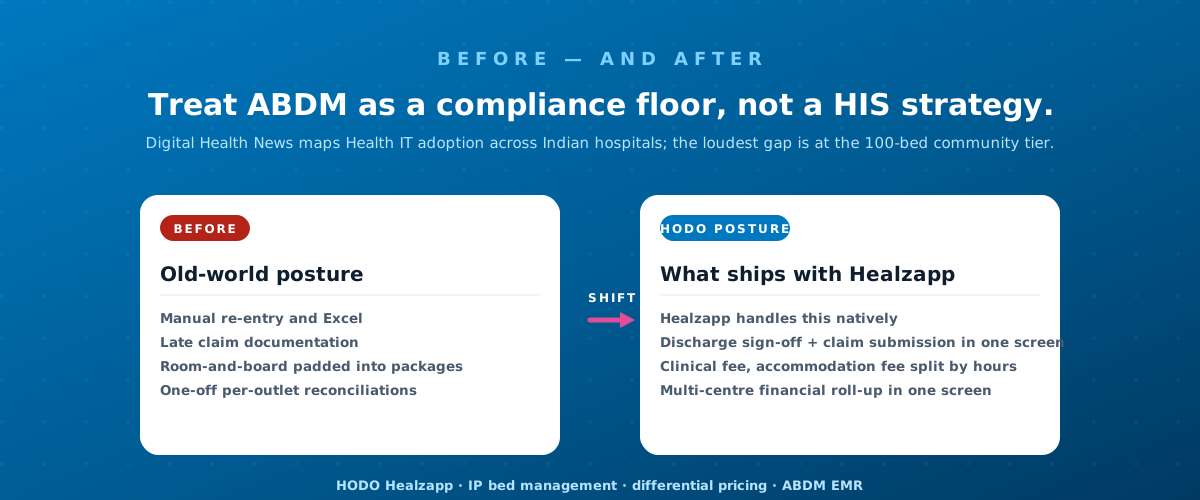
Treat ABDM as a compliance floor, not a HIS strategy.
TPA cash cycles and OP throughput are the real metrics
The two metrics that decide whether a 100-bed hospital survives its Health IT investment are TPA days-sales-outstanding and OP visits per doctor-hour. Neither shows up on an ABDM dashboard. TPA DSO improves when pre-authorisation, discharge summary, and claim submission run on the same record, not when they live in three systems reconciled at month-end. OP throughput improves when the front counter, the doctor's chamber, and the pharmacy pull from one queue with a visible token display, not when each screen operates in isolation. Digital Health News lists trends; operators should read the same trends as a list of P&L levers and pick the two that move their specific bottleneck first, then buy against those.
What this means for HODO customers
For ~100-bed hospitals and Indian lab chains reading the Digital Health News piece and wondering what the next HIS conversation looks like, three Healzapp capabilities are the practical anchor. ABDM-compliant EMR covers the compliance floor without the buyer having to project-manage the integration. Multi-outlet scale-up with one-click new-centre setup is what turns a two-outlet group into a five-outlet chain without a parallel IT hire. And B2B Referral / Outsource Lab / Corporate-partner logins keep the referral revenue inside the group instead of leaking to whichever competitor accepted the sample first. See how Healzapp handles this, book a 30-min demo.