Healthcare IT News, under the headline "Want healthcare AI to work? Start with clinicians", makes a point that keeps resurfacing across Middle East health systems: AI programmes hold when the people doing clinical work help shape them, and stall when a finished tool is handed down from a technology committee. Read as a clinical adoption note it sounds obvious. Read as an operating instruction, for a founder or a clinic group owner building an AI-based digital differentiator, it fixes the order of work.
Clinician-led is an organisational decision, not a courtesy
The default sequence in most healthcare AI projects is backwards. A vendor is selected, a licence is bought, a training session is scheduled, and adoption is then treated as a change-management problem. When usage drops off after six weeks, the diagnosis is usually "resistance". It rarely is. What actually happened is that the tool was built with no knowledge of how this particular clinic runs, who signs off a discharge summary, which insurer needs which document, how the Friday clinic differs from a Tuesday clinic, what the senior consultant will and will not accept in writing.
Starting with clinicians changes what gets built. A clinician-led scope does not begin with "what can the model do" but with "what does this person repeat every day that carries no clinical judgement". In a GCC polyclinic that list is fairly predictable: chasing pending investigation results, re-typing the same insurance justification for the tenth eligible patient, pulling together the referral letter, following up the patient who did not return for review, drafting the same three patient-instruction messages in two languages. None of those are clinical decisions. All of them consume consultant minutes that the clinic bills by the minute.
That framing also settles a governance question early. If AI is scoped to the administrative shell around clinical work rather than the decision itself, the licensing conversation with a DHA, MOHAP or Qatari regulator becomes far simpler, the audit question is about record integrity and traceability, not about clinical autonomy.
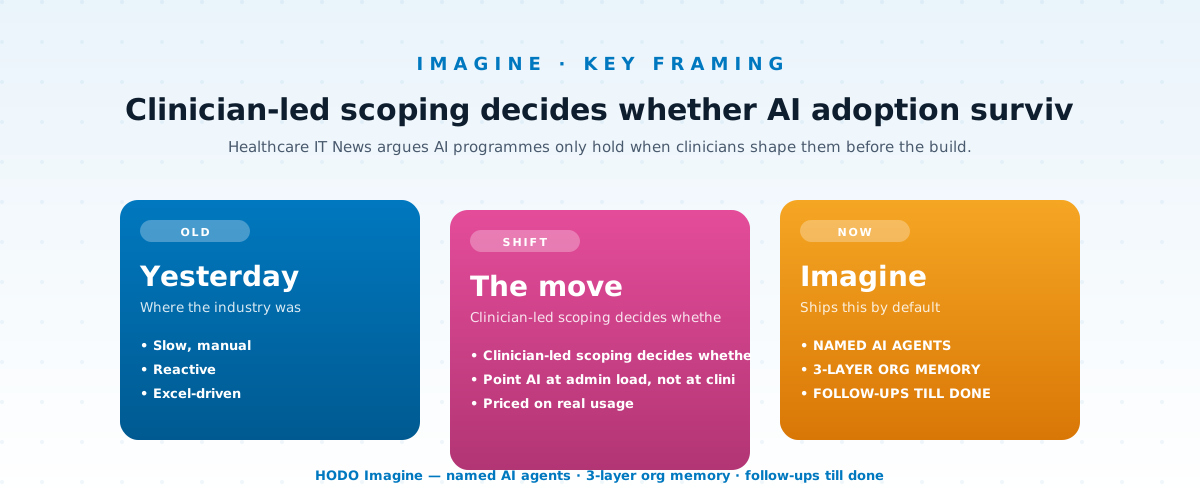
Clinician-led scoping decides whether AI adoption survives.
The failure pattern: pilots that never leave the demo room
Across clinic groups and founder-built platforms in the region, failed AI pilots tend to share three traits. First, the tool has no memory. Every session begins from zero, so the clinician re-supplies the same context, the clinic's protocol, the insurer's wording, the format the medical director prefers. The second time is tolerable. The twentieth time is slower than doing it manually, and that is the point at which usage quietly ends.
Second, the output does not sound like the organisation. A patient message generated in generic chatbot register, in a clinic whose brand is built on a particular tone with a particular patient community, has to be rewritten before it can go out. Rewriting is work. Work that is invisible in a pilot report shows up as abandonment in the usage logs.
Third, nothing closes. A tool can summarise, draft and suggest, but the follow-up, did the patient book the review, did the insurer respond, did the referral letter actually reach the receiving consultant, stays with a human who is already carrying a full list. AI that generates output but does not track completion adds a monitoring burden rather than removing one.
The common factor is not model quality. Current general-purpose models are more than adequate for administrative healthcare text. The gap is organisational: the tool knows language but knows nothing about this organisation, and it retains nothing between uses.
What clinicians actually ask for is memory
When clinicians are consulted before the build rather than after, the requests cluster around continuity. They want the assistant to already know the clinic's referral network, the standing instruction that a particular insurer rejects claims without a specific diagnosis code phrasing, the fact that a named patient family prefers Arabic, the medical director's rule about what goes into a discharge note. In other words they are describing institutional memory, not intelligence.
This is where the distinction between a chat tool and an organisational intelligence layer matters commercially. A chat tool's knowledge lives in whichever staff member is good at prompting it. When that person moves to another clinic, and in GCC healthcare, staff mobility is high, the knowledge leaves with them. An organisational intelligence layer holds the same knowledge as an asset of the organisation. The clinic that spent eighteen months teaching its AI how it works still owns those eighteen months after a resignation.
For a founder building a homecare, lab-at-home or clinic-ops platform, that distinction is also the defensible part of the product. Model access is a commodity that every competitor can buy this afternoon. Accumulated operational knowledge about how a specific network of clinics, phlebotomists and insurers actually behaves is not purchasable, and it compounds with use.
Designing AI teammates around existing reporting lines
Clinician-led design has a structural implication: the AI should sit inside the org chart, not beside it. Clinical teams already work through defined lines, the nurse escalates to the resident, the resident to the consultant, the coordinator handles insurer correspondence and reports to the practice manager. AI that ignores those lines creates ambiguity about who is accountable for an output, and in a licensed clinical environment ambiguity is the thing that stops a rollout.
The workable pattern is narrow, named roles with defined jobs and a defined supervisor. One agent owns insurer documentation and reports to the practice manager. One owns patient follow-up sequences and reports to the nursing lead. One owns internal reporting and reports to the founder. Each holds its own accumulated knowledge of its function. A clinician reviewing an output knows exactly which role produced it, on whose authority, and who to correct, and that correction sticks for every future instance rather than being re-taught per session.
This also produces the artefact that regulators and investors both ask for: an audit trail. Not a log of prompts, but a record of which role did which task, what it referred to, who approved it, and whether the task closed. Clinic groups running multiple branches across emirates find this is the difference between an AI story and an AI system.
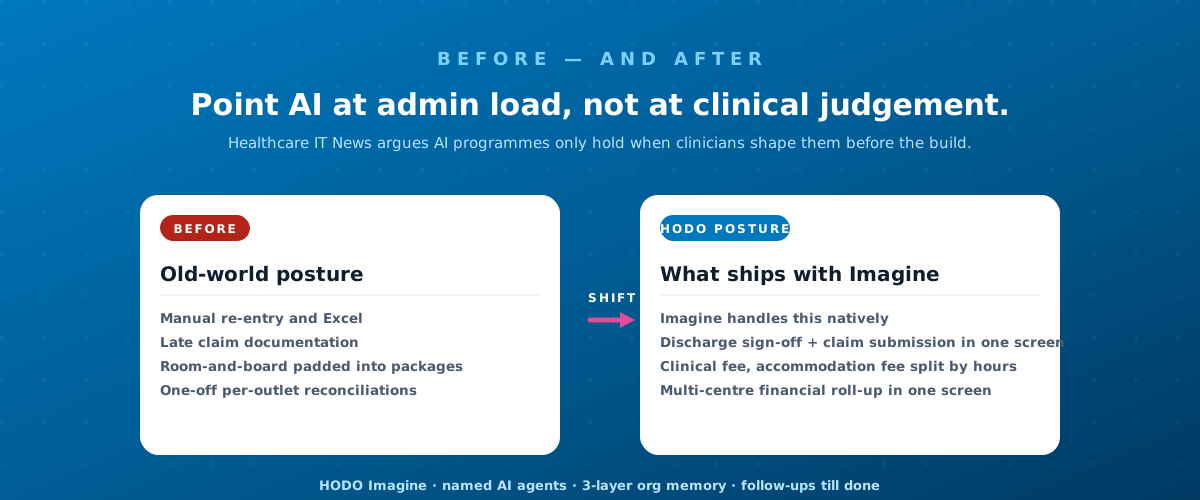
Point AI at admin load, not at clinical judgement.
What this means for digital transformation
The Healthcare IT News argument, translated into build order, is: consult the clinicians, scope AI to the administrative load around clinical work, and design for retention rather than cleverness. That is the design brief imagine is built against. Named AI agents with jobs, memory and reporting lines mean each function has an owner that sits inside the existing hierarchy rather than alongside it. 3-layer memory, today, this week, forever, means the correction a consultant makes once does not have to be repeated, and the organisation's operating knowledge compounds instead of resetting. Brand voice consistency keeps patient and insurer communication in the clinic's own register, so output does not need rewriting before it goes out. And because imagine runs follow-ups until tasks close, the pending claim, the unreturned review patient and the unacknowledged referral are tracked to completion rather than added to a clinician's mental list. imagine does not replace Microsoft 365, Copilot or ChatGPT, it connects them with memory that the organisation owns.
See how imagine turns AI into organisational intelligence, explore imagine.