
The Centre is preparing a consultation paper — expected within two months — that will rewrite significant portions of the hospital licensing and compliance regime, with an explicit brief to draw private capital into tier-2 and tier-3 cities. ETHealthworld reports that the overhaul intends to simplify licensing, cut duplicative filings and reduce the compliance burden that has historically made smaller-city hospitals uneconomic. For hospital owners already running a flagship in a metro, the window to plan the second and third outlet is opening now.
Signals from the ministry point at three obvious targets. First, registration and licensing under the Clinical Establishments Act and its state variants. Second, the overlapping paperwork demanded by pollution boards, biomedical waste rules, fire NOCs, drug licences, blood-bank rules and radiation safety. Third, the reporting overhead created by state-specific insurance and cashless schemes. The paper is expected to propose either a single-window mechanism or a mutually recognised state framework, so a hospital in Ranchi is not doing meaningfully different paperwork from one in Rajkot. None of this eliminates compliance — the substantive obligations around infection control, patient safety, pricing display and record-keeping are not going away. What changes is the marginal cost of setting up in a smaller city where a hospital owner cannot afford a five-person compliance cell. That marginal cost is precisely what has kept 100-200 bed proposals stuck in feasibility for years, and its removal is the actual reform, not the licence count.
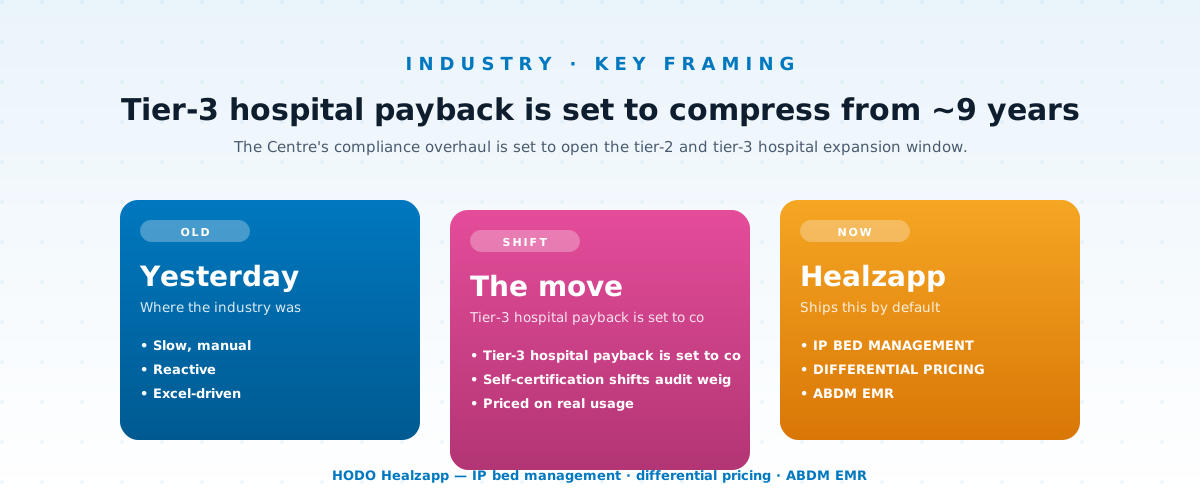
Once compliance overhead falls, the calculation shifts. A 120-bed unit in a tier-3 city that used to lose 14-18 months to approvals may open in under 10, which changes the pre-operative interest burden materially. Land, construction and equipment CAPEX per bed in tier-3 India already sits 30-40% below metro figures; what has kept promoters away is the operating drag of running a small compliance and MIS team for one facility. Chains with three to five outlets can amortise that drag; a first-time single-outlet owner cannot. If the overhaul goes through as briefed, the payback horizon on a tier-3 hospital compresses from 8-9 years to something closer to 6, at which point PE and family-office capital that has stayed on the sidelines starts moving. Hospital MDs should read this as a signal to firm up the pipeline of second and third outlets now — site identification, doctor contracting, and the choice of HIS and LIMS platforms — so that when the paperwork window opens, the operational side is not the bottleneck.
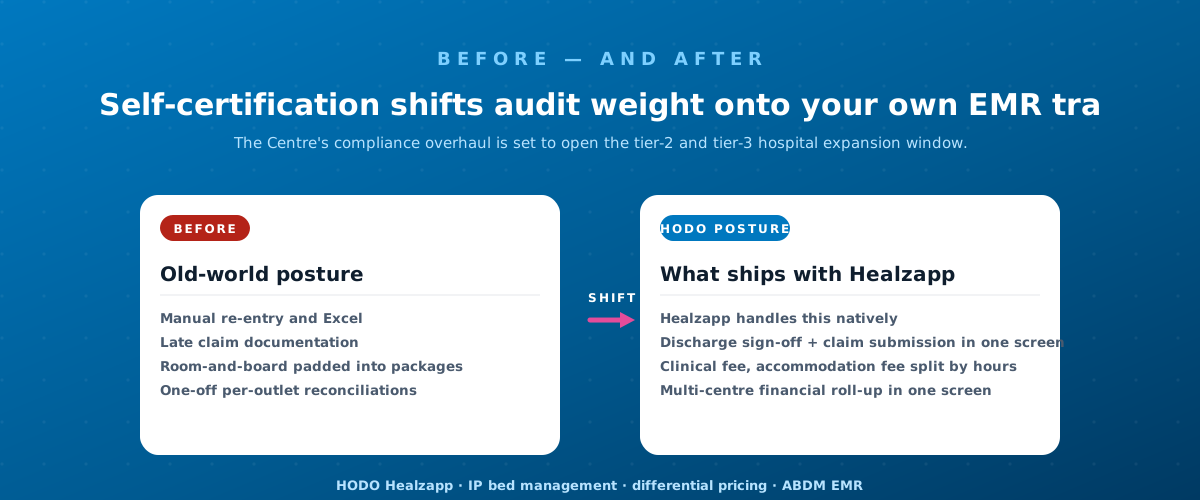
A common misreading of regulatory simplification is that hospitals can invest less in systems. The opposite is true. When state inspectors move from a filing-based regime to a random-audit or self-certification regime, the burden of proof shifts to the hospital's own records. That means EMR completeness, pharmacy stock reconciliation, biomedical waste logs, staff credential files and consent forms all have to be pullable on demand — not reconstructed the week before an audit. Multi-outlet groups have an additional problem: an inspector at outlet 4 will not accept that the head office in Trivandrum has the file. Each outlet has to hold its own audit trail while the group MIS rolls up to a single view. Hospitals that scaled on spreadsheets, ledger books and disconnected departmental software will struggle here. The compliance rulebook may be shorter, but the evidentiary bar for each item will be higher, and it will be enforced by data rather than by physical file inspection.
Parallel to the compliance overhaul, the ABDM stack continues to expand — health IDs, the Health Facility Registry, the Healthcare Professional Registry, and the Unified Health Interface for scheduling and payments. Tier-2 hospitals opening in the next 24 months will not have the option of adopting ABDM later; empanelment with PMJAY, most state schemes, and increasingly with private insurers, is being pinned to ABDM identifiers and consent flows. For hospital owners this collapses two decisions — HIS selection and ABDM readiness — into one. Choosing an HIS that is already ABDM-compliant and NRCeS-listed removes one item from the launch checklist and means every OP encounter, IP admission and discharge summary generated from day one is already emitting the linkage records that will be inspected in future audits. Retrofitting ABDM onto a legacy HIS after go-live is expensive and disruptive, and small-city IT teams are not the ones to attempt it.
Tier-2 and tier-3 hospitals live or die on insurance and TPA receivables. Compliance reform on the licensing side does not touch the pain of claim denials, chase cycles and the 60-120 day money that sits with payers. What it does is put more small hospitals into the empanelment funnel, which means TPAs and insurers will get pickier on documentation quality — pre-authorisation notes, discharge summaries, itemised bills, and prescription trails. Hospitals that submit clean claim files the first time will get paid inside 45 days; the rest will keep bleeding working capital. The operational implication is that billing, EMR and pharmacy have to speak to each other in real time, not through end-of-day exports. Owners planning tier-2 outlets should test the HIS on a realistic TPA workflow before signing, not on the sales demo.
For hospital owners planning the next outlet, three HODO Healzapp capabilities matter directly. Multi-outlet scale-up with one-click new-centre setup means the second and third units inherit the master configuration — item masters, price lists, user roles, ABDM linkage — instead of being built from scratch each time. ABDM-compliant EMR means every OP and IP record generated at the new outlet is already emitting the identifiers and consent artefacts that state and central audits will look for, and PMJAY and insurance empanelment paperwork is materially shorter. Machine Interfacing across lab analysers, radiology and pharmacy dispensing units closes the audit-trail gaps that hurt smaller hospitals when inspectors move from filings to evidence. Owners running a single flagship today should treat the next 90 days — while the consultation paper is drafted — as planning time, not waiting time.
See how Healzapp handles this — book a 30-min demo.
Source of the news hook: https://health.economictimes.indiatimes.com/news/policy/centre-readies-healthcare-compliance-overhaul-to-boost-hospitals-in-tier-2-tier-3-cities/132673235
See how Healzapp, Labzapp and EReazy fit your speciality in a free 30-minute demo.
Book a Free Demo