Zealthix has raised $1.1 million in seed funding to digitise India's healthcare ecosystem, reports BW Healthcare World. The round is modest by consumer-tech standards and entirely typical for Indian healthtech at seed stage, which is precisely what makes it worth studying. For a founder building a lab-at-home, doctor-at-home or clinic-software product, the useful question is not whether $1.1 million is a large cheque; it is what that cheque has to accomplish before the next one.
What $1.1 million actually buys in Indian healthtech
A seed round of this size in India typically covers 18 to 24 months of a team of eight to twelve people, a working product, and one or two proof-of-value deployments. It does not cover a national field sales force, a custom LIMS built from scratch, a patient mobile app and a compliance programme. Founders who try to fund all four from the same round usually arrive at the Series A conversation with a broad product and thin revenue.
The discipline that funding forces is sequencing. Digitising the healthcare ecosystem is a ten-year statement; the next 18 months have to reduce to one buyer, one workflow and one number that moves. For a lab-at-home operator that number is usually cost per home collection. For a doctor-at-home platform it is completed visits per doctor per day. For a clinic-software startup it is outlets live and monthly churn. The next investor will underwrite the number, not the mission statement.
There is also a cost-structure question that Indian healthtech founders face earlier than their peers in other SaaS categories. Buyers here are price-sensitive, procurement cycles run 60 to 120 days, and a ~100-bed hospital or a three-centre lab chain will not sign a per-seat contract at Western price points. Burn has to be sized against realised revenue per account, not the total addressable market slide.
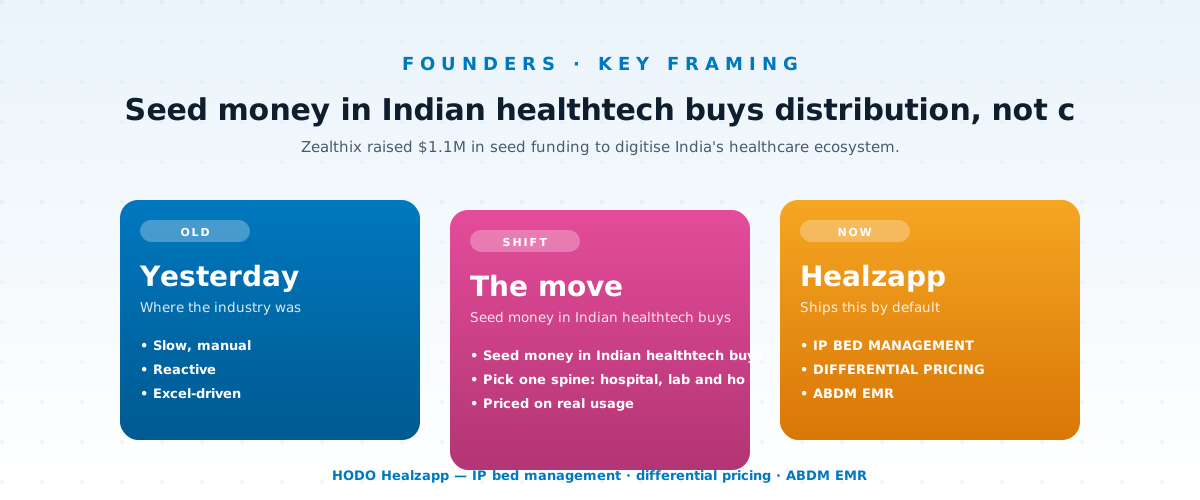
Seed money in Indian healthtech buys distribution, not code.
An ecosystem is three products wearing one name
The phrase "digitise the healthcare ecosystem" hides a hard architectural fact: hospitals, labs and home-visit operations run on different data models. A hospital system is organised around encounters, beds and billing episodes. A laboratory system is organised around samples, analysers and turnaround time. A home-visit operation is organised around routes, phlebotomists and chain of custody. Serving all three from one schema usually produces software that is adequate for none of them.
Founders who get traction pick a spine and treat the rest as integrations. A lab-at-home startup that gets barcoded sample tracking right from doorstep to analyser, then integrates with whichever hospital system the referring client already runs, ships faster than one that also decides to rebuild inpatient billing. The same logic runs in reverse for clinic software: appointments and teleconsultation are the spine, and the lab side is an interface rather than a rewrite.
The integration surface is where the engineering months actually go. Analyser interfacing, report delivery over WhatsApp and SMS, partner-lab handoffs with anonymised sample tracking, referral-doctor logins, accounting sync. Each one looks like a two-week task and behaves like a two-month one. Budgeting honestly for that work is a better use of a seed round than adding a fourth vertical to the roadmap.
Distribution decides the outcome, not feature count
Indian healthcare software has rarely been short of decent products. It has been short of distribution. A ~100-bed hospital replacing its information system is making a five-year decision involving the billing team, the lab, the pharmacy, accounts and at least one consultant who preferred the old screens. That sale does not close on a demo video.
Three go-to-market routes tend to work in this market. The first is channel: partnering with a player that already has outlets, franchisees or referral relationships and riding that footprint. The second is landing on a single high-frequency workflow, such as home-collection booking, report delivery or TPA claim filing, and expanding sideways once the operator trusts the system. The third is geographic density: winning one city cluster or one state so thoroughly that reference calls come from a hospital down the road.
Reference customers carry disproportionate weight here. A lab chain evaluating a new LIMS will call two peers before it calls the vendor's sales team. A funded startup with eight logos scattered across five states has weaker social proof than one with eight logos in the same district, and it costs considerably more to support. Density beats spread at seed stage on both counts.
Build the differentiator, licence the clinical core
Every healthtech founder eventually faces the build-versus-licence decision on the clinical core. Writing a compliant EMR, a billing engine that handles differential pricing, and a pharmacy inventory module is not intellectually hard, but it is a long tail of edge cases that consumes engineers who should be working on the thing customers actually pay for.
A reasonable test: does this module appear in the pitch deck as the reason customers choose you? If yes, build it. If it appears only because customers would refuse to buy without it, licence it or integrate. Routing logic for home visits, a partner marketplace, or a pricing engine tuned to a specific payer mix are differentiators. Pharmacy stock control and accounting integration are table stakes with known solutions.
Reference architecture helps even when nothing is licensed. Studying how an established platform models multi-centre financials, franchisee management, differential pricing per partner and turnaround-time reporting saves weeks of design argument. These are solved problems in systems already handling millions of patient visits, and re-deriving them from first principles is an expensive way to learn. Compliance sits in the same bucket: ABDM integration, NRCeS conformance and telemedicine registry listing are procurement checkboxes for Indian hospital buyers, not product differentiators. Treat them as a cost line with a deadline.
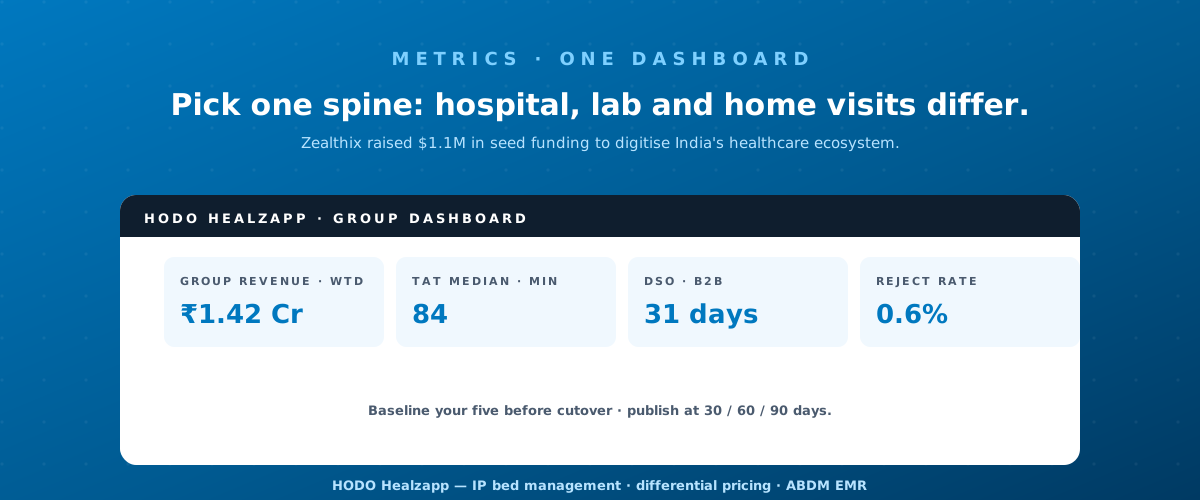
Pick one spine: hospital, lab and home visits differ.
The numbers the next round will ask for
Seed rounds are funded on the team and the story. The round after that is funded on cohort behaviour. Founders who spend the next 18 months instrumenting the right things arrive with answers; the rest arrive with a revenue chart and a long list of caveats.
Four numbers carry most of the weight. Net revenue retention by outlet, which shows whether customers expand from one centre to three. Time from contract to go-live, which is the best available predictor of how expensive scaling will be, since a 90-day implementation means a services business wearing SaaS clothing. Gross margin after support, counting the human cost of the WhatsApp group every Indian healthcare customer expects. And cost per unit of work delivered: per test, per visit, or per bed-day, depending on the vertical.
Home-visit operators should add route density and repeat-booking rate. Both determine whether unit economics improve with scale or simply replicate at scale, which is a different and much worse business. A lab-at-home operation running three collections per phlebotomist per day has a cost problem that no amount of funding fixes; one running seven has a franchise. None of this requires a data team. It requires the operational system to record it by default.
What this means for builders
Funding headlines are a weak signal. The reference architecture underneath them is a stronger one. For a founder deciding what to build and what to rent, three parts of HODO Healzapp map directly onto the decisions above. Multi-outlet scale-up with one-click new-centre setup is what turns a second or fifth location from a project into a configuration step, which is exactly the go-live-time metric the next investor will probe. B2B Referral / Outsource Lab / Corporate-partner logins cover the counterparty side that most early products defer, so referral doctors, corporate clients and partner labs work inside the system rather than over email. ABDM-compliant EMR handles the Indian compliance checkbox as configuration rather than a roadmap item competing with the differentiator.
The through-line is that seed capital is best spent on the part of the product nobody else can supply, and the rest is a procurement decision. See how Healzapp handles this, book a 30-min demo.