
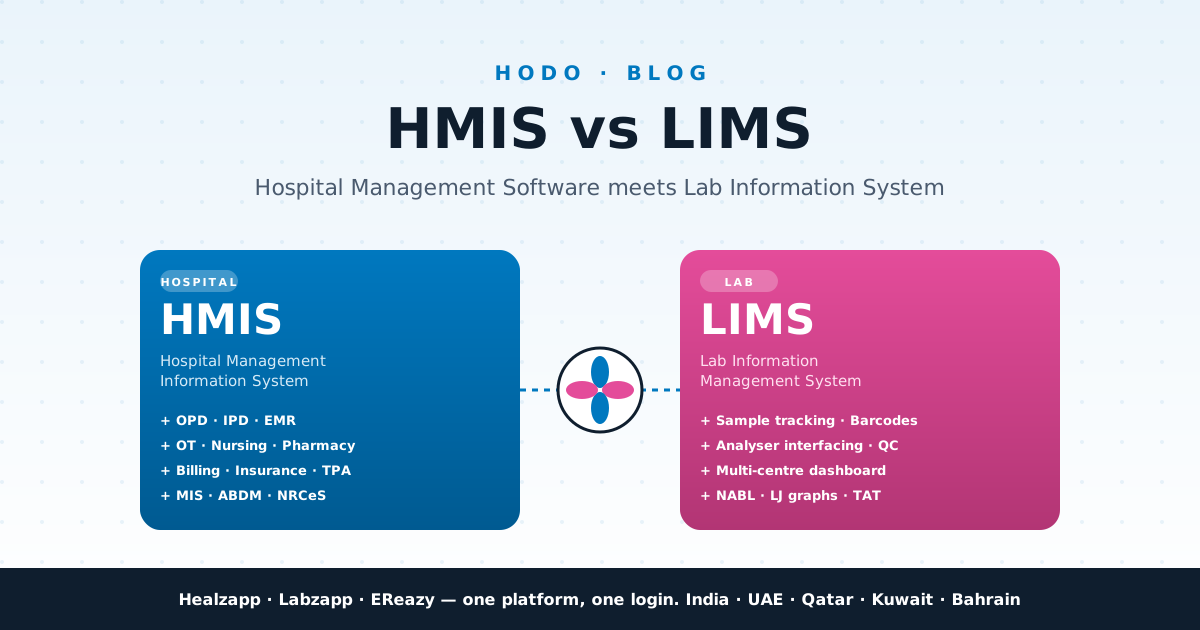
Run a hospital and your day is appointments, OPD queues, IPD admissions, pharmacy, billing. Run a diagnostic lab and it’s barcodes, machines, samples, validated reports, partner-lab settlements. Two different operations — but increasingly, they live under the same roof. This post breaks down HMIS (Hospital Management Information System) versus LIMS (Lab Information Management System), where they overlap, and why most growing healthcare businesses in India and the GCC end up running both.
A Hospital Management Information System (HMIS) — sometimes written as HIMS or simply HMS — is the software backbone that runs a hospital or clinic end-to-end. It is the system every member of staff opens first thing in the morning and closes last thing at night.
A modern hospital management software stack typically covers:
Without HMIS, a hospital runs on registers, spreadsheets, and people remembering who got billed for what. Once you cross 30 patients a day, the cost of NOT having a proper hospital information system shows up as missed bills, duplicate prescriptions, and angry insurance desks.
A Lab Information Management System (LIMS) — sometimes called LIS (Lab Information System) — is the software backbone for diagnostic labs and pathology centres. Where HMIS thinks in “patient visits”, LIMS thinks in “samples”.
Core lab management software modules:
A diagnostic lab without a LIMS hits a hard ceiling around 100 samples a day. Past that, transcription errors and lost samples eat your reputation faster than any new marketing can fix it.
| Dimension | HMIS / HMS | LIMS / LIS |
|---|---|---|
| Primary unit | Patient visit | Lab sample |
| Who uses it | Doctors, nurses, billing, pharmacy, admin | Phlebotomists, technicians, pathologists, partner labs |
| Hardware integrations | Bedside vitals devices, kiosks, token displays | Analyser machines (biochemistry / haematology / immunology) |
| Compliance focus | ABDM, NRCeS, NABH | NABL, ISO 15189, LJ graphs for QC |
| Critical KPIs | Bed turnover, OPD wait time, collection | Sample TAT, error rate, machine utilisation |
Twenty years ago, a hospital outsourced its lab work and that was that. Today, three forces push every growing healthcare business towards owning both systems on the same platform:
At HODO we run all three under one roof, and they share one database, one billing engine, and one login:
When a hospital runs Healzapp + Labzapp together, a test ordered in OPD flows straight to the lab, the analyser pushes the result back, the EMR auto-updates, and the patient gets a WhatsApp the moment it’s validated — with the lab and hospital billing rolled into one invoice at discharge. No manual hand-off, no missed entries, no duplicate billing.
All three terms refer to the same thing: Hospital Management Software that runs the operational and clinical workflows of a hospital or clinic. The terminology varies by region — Indian vendors often say HMIS or HMS, GCC vendors lean toward HIMS. The functionality is the same.
LIMS (Lab Information Management System) and LIS (Lab Information System) are used interchangeably. Strictly speaking, LIMS tends to imply a wider footprint — sample management, multi-centre logistics, financials — while LIS is the narrower clinical-data piece. In practice every modern lab management software covers both.
If the clinic only sends samples to an external lab, no — the HMIS sample-tracking module is enough. If the clinic runs an in-house lab (point-of-care testing, basic biochemistry, ultrasound reporting), a lightweight LIMS or the lab module inside the HMIS is the right choice.
Yes — and it should, if you run both. HODO’s Healzapp (HMIS) and Labzapp (LIMS) are built on a shared database so a test ordered in OPD shows up in the lab’s worklist instantly, and the validated report appears in the patient’s EMR + billing with no export-import step.
Yes. HODO serves India, UAE, Qatar, Kuwait, Bahrain and other GCC markets across 500+ outlets. The platform supports GCC-specific billing patterns (insurance gateways, multi-currency, multilingual reports) and is deployed in hospitals, clinics, diagnostic labs and vet labs.
Want to see how Healzapp and Labzapp work together on a single login? Book a free 30-minute demo built around your specific setup.
See how Healzapp, Labzapp and EReazy fit your speciality in a free 30-minute demo.
Book a Free Demo