The Free Press Journal reports that complaints about "ghost pathologists" in Maharashtra — reports going out under a registered pathologist's signature when that pathologist was never on the premises — have pushed the Quality Council of India to examine stronger security norms for diagnostic laboratories, including biometric access control. The obvious reading is about who sits at the reporting desk. The harder question for lab-at-home and home-collection operators is who stood at the patient's door, because that part of the chain happens well outside any building a biometric reader can guard.
The complaint is about identity, not test accuracy
Nothing in the Maharashtra pattern says the haemoglobin value was wrong. The allegation is that the person who authorised the report was not the person whose name and registration number appear on it. That is a records offence, and it is the kind of offence that survives a perfect analyser run. Regulators and accreditation bodies are therefore not asking labs to prove better science; they are asking labs to prove identity at each handover — who collected, who received, who ran, who verified, who released.
For a home-collection network, four of those five handovers already sit inside the lab. The first one does not. A phlebotomist arrives at a flat in Thane or Kochi at 6:40 am, draws three tubes, writes a name on a label, and drops the box at a hub two hours later. If that visit is reconstructed later from a WhatsApp message and a paper requisition, the lab has no defensible answer to a simple question: who drew this sample, and was that person authorised to do so on that morning? Biometric terminals at the reporting workstation do nothing for this gap. The gap is the point where a home-collection business is structurally more exposed than a walk-in centre, and it is the gap an inspector will find first.
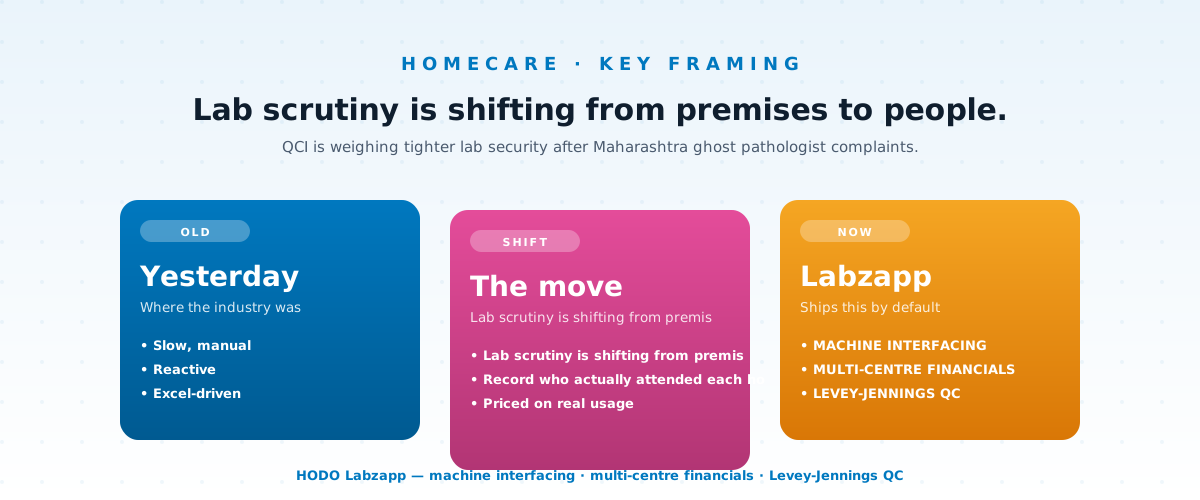
Lab scrutiny is shifting from premises to people.
Biometrics stops at the lab gate
Access control is a sound control for the building. It answers whether an unauthorised person opened a reporting session. It does not answer whether the sample that session signed off actually came from the patient named on the tube, or whether the collection was performed by a trained phlebotomist on the lab's rolls rather than a cousin with a spare kit and a bag of vacutainers.
Home-visit operators running fifteen to forty collections a day per route tend to discover this during a partner audit rather than a government inspection. A hospital or corporate client asks for the last ninety days of visit records for a particular employee cohort, and the operator produces a spreadsheet assembled after the fact. The spreadsheet is not evidence; it is a reconstruction, and everyone in the room knows it. What counts as evidence is a record created at the moment of the event, by the system, with the collecting staff member's login attached and a timestamp nobody typed in afterwards.
The practical fix is to push sample identity to the doorstep instead of the bench. When the tube is barcoded in front of the patient and that barcode is bound to a visit, a staff identity and a time, the custody chain starts at the right place. Everything downstream — receipt at the hub, analyser run, verification, release — then hangs off a single identifier rather than a handwritten name that gets re-keyed twice before it reaches the LIMS.
What an identity-complete visit record contains
Operators that have been through an accreditation review or a corporate audit converge on roughly the same record. It carries the booking and the requesting doctor, the phlebotomist assigned to the route and the one who actually attended, the barcode applied at the point of draw, the time of draw, the tube types collected, the storage condition on the way back, the time of receipt at the processing lab, and any rejection with its reason. Each field is written by the person doing the work, at the time of the work, not by a coordinator at the end of the shift.
Two of these fields do most of the compliance work. The first is the assigned-versus-attended distinction: route plans change, phlebotomists swap visits, and a system that records only the plan will quietly misstate who was in the patient's home. The second is the rejection record. Haemolysed samples, insufficient volume and wrong-tube errors are normal in home collection at a rate of one to three per cent; a network reporting zero rejections is not clean, it is simply not recording. Auditors read a sensible rejection rate as a sign that the trail is real.
None of this requires new hardware in the field. It requires that the collection app and the LIMS be the same system of record, so the doorstep event and the bench event share one identifier.
Franchisee centres and partner labs inherit the risk
Most Indian home-collection volume does not sit in one company. It flows through franchisee collection centres, freelance phlebotomists paid per visit, and partner labs that run tests the parent network does not perform in-house. Each of those relationships is a place where identity can be asserted rather than recorded, and the ghost-pathologist pattern is exactly what happens when assertion is allowed to stand in for evidence over a long period.
Franchisee centres are the sharper exposure. A franchise agreement transfers the brand but not the liability for how a report was authorised, and a centre operating without a qualified signatory will tend to use whatever credential is available. Parent networks should be able to see, per centre, which staff logins released reports last month and whether the signatory is registered against that location. Where tests are outsourced, the same logic applies in reverse: the parent lab needs a tracked identity for the sample it sent out and the result that came back, with patient identity shielded from the partner. A courier docket and an emailed PDF do not reconstruct into an audit trail, however long the relationship has been running.
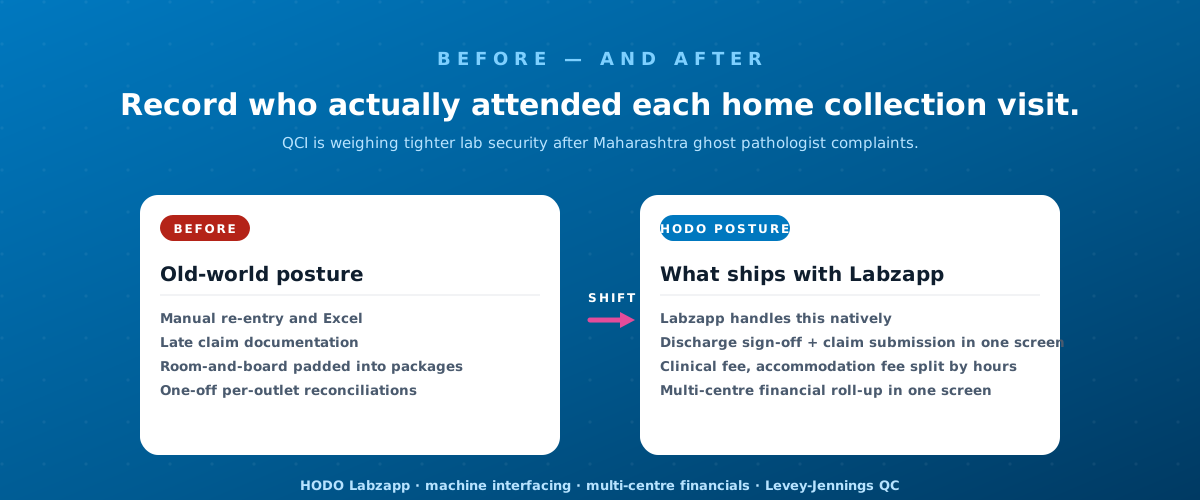
Record who actually attended each home collection visit.
What identity discipline does to cost per visit
The objection raised in most operations reviews is that all this recording slows the route down. Measured honestly, it does the opposite. The expensive events in home collection are repeat visits for rejected or mislabelled samples, reports delayed past the promised window, and disputes with corporate clients over visits that may or may not have happened. Each of those is a cost-per-visit problem caused by thin records.
A network that barcodes at the door and tracks turnaround by route can see which routes, which phlebotomists and which hubs generate rework, and can fix the two or three that account for most of it. Turnaround measured as one network-wide average hides this entirely; measured per route and per partner, it becomes a management number. The compliance benefit arrives as a by-product of an operational control the business needed anyway — which is the only version of compliance spending that survives a budget discussion.
What this means for HODO customers
The QCI discussion will land on premises security first, but the durable requirement is a sample whose identity is traceable from the doorstep to the released report. Labzapp's phlebotomy/home-collection workflows put the collection event into the same system as the bench, so the visit is recorded by the person performing it rather than assembled later. Barcoded samples bind the tube to that visit at the point of draw, and TAT reporting exposes turnaround by route and partner instead of a single average. For networks running partner centres, franchisee management keeps per-centre staff, pricing and report release visible to the parent lab.