King Faisal Specialist Hospital has reported a 75% cut in emergency department boarding time after deploying an AI-enabled patient flow system, in coverage carried by the Detroit Free Press via Google News. Boarding time is not a clinical measure, it counts the minutes a patient waits after a decision has already been made, because the next resource was not ready. Home-visit operators running doctor-at-home and lab-at-home services across the Gulf have the same category of loss, spread across a van route instead of a corridor.
Boarding is a measure of waiting after the decision
The reason boarding time responds to flow software is that it sits entirely between steps. The clinical decision is complete; the patient is simply held until a bed, a porter, a cleaning cycle or an admitting team becomes available. Nothing about the medicine changes when boarding falls by 75%. What changes is visibility: somebody can finally see where the queue is forming, which resource is the constraint, and how long each handoff takes on a normal Tuesday rather than on an audit day.
Home collection and home consultation businesses are built almost entirely out of these gaps. A booking exists, a phlebotomist exists, a courier run exists, a lab bench exists, a verified report exists, and the turnaround the patient experiences is mostly the sum of the pauses between them. Operators tend to report a single number, usually "same-day report" or "TAT 24 hours", measured from accession in the lab. That measurement starts after the hardest part of the day is over. The patient's clock started when the booking was confirmed, often twelve hours earlier, and the operator has no record of what happened in between.
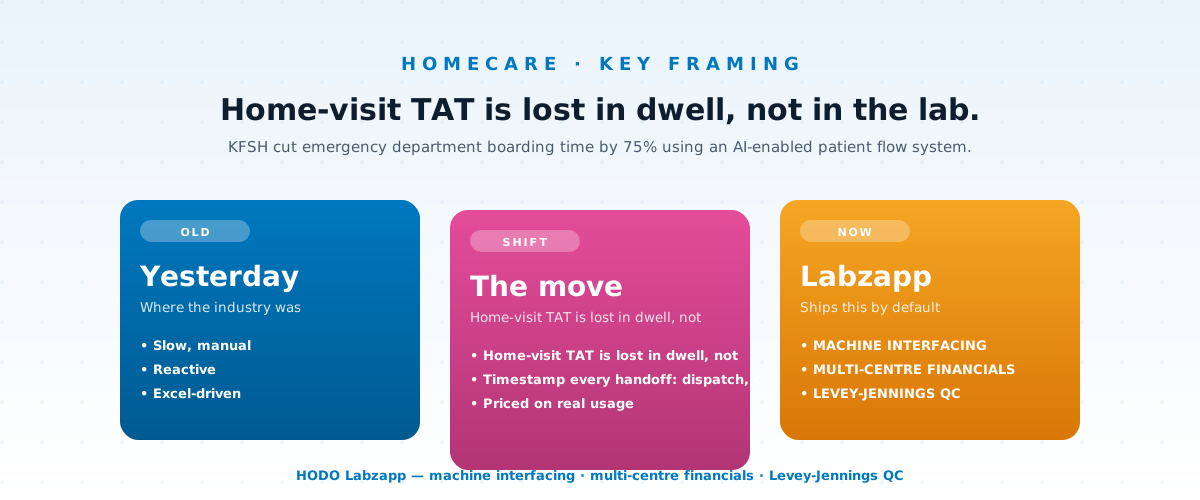
Home-visit TAT is lost in dwell, not in the lab.
The four dwell windows in a home visit
A home-visit chain has four windows worth timing separately, and almost every operator can only see the last one.
Booking to dispatch. The request is confirmed, but no phlebotomist or doctor has been assigned to a route slot. In most Gulf operations this window is set the previous evening, by hand, on a spreadsheet or a WhatsApp group.
Arrival to collection complete. The visit itself, identity check, consent, draw or consultation, labelling. This is the only window that is genuinely clinical work, and it is usually the shortest.
Collection to accession. The sample is in the field. It is in a bag, in a cool box, in a car moving through Dubai or Riyadh traffic, waiting for the rest of the route to finish before anything reaches the lab. This window routinely exceeds the actual analytical time and is the one most often undocumented.
Verification to delivery. The report is signed and sitting in the system while the patient phones the call centre to ask where it is.
Timing these four separately changes which problem gets solved. An operator convinced the lab is slow often discovers that the bench is finishing in ninety minutes and the sample spent four hours in a vehicle. The fix in that case is route cut-off discipline and a second drop run, not a new analyser.
Sample dwell is a quality problem before it is a speed problem
Extended field dwell is not only a turnaround issue in the GCC. Stability limits for potassium, glucose, coagulation studies and several hormone assays are measured in hours, and ambient conditions between May and September make those limits easier to breach. A sample that arrives late and warm produces a result that is technically reportable and clinically misleading. If the operator cannot show when the sample was drawn, when it entered the cool box and when it was accessioned, there is no way to tell a referring clinician whether a borderline result should be trusted or repeated.
That evidence has to be generated as a by-product of the work, not reconstructed later. A barcode scan at the point of draw, a scan at handover to the courier, and a scan at accession produce three timestamps without asking a phlebotomist to fill in a form. Those three scans also settle disputes about missing samples, which in multi-route operations are rarely missing at all, they are usually sitting in the wrong box because labelling happened after the visit instead of during it. For operators who send overflow work to a partner laboratory, the same chain is what makes referred-out volume auditable rather than a gap in the record.
Routes are planned with yesterday's assumptions
Dispatch is where unit economics are decided. Visits per phlebotomist per day, kilometres per visit, and the proportion of slots lost to no-shows and failed draws set the cost per visit far more than test pricing does. Most operators plan tomorrow's routes on booking order, first confirmed, first visited, which produces clustering by chance rather than by geography.
Three changes usually move the number. First, group bookings by area and by laboratory cut-off time, so the samples with the tightest stability windows are drawn on the earliest leg of the route. Second, record the reason for every failed visit, patient absent, address wrong, fasting not followed, difficult draw, because a failed visit still costs the full travel and still has to be rebooked. Third, measure phlebotomist-level productivity and failed-draw rates together, since a technician with high volume and high repeat rates is not the top performer. For doctor-at-home operations the same logic applies, with consultation duration replacing draw time and teleconsultation available as a cheaper substitute for the follow-up visit that currently takes a full slot.
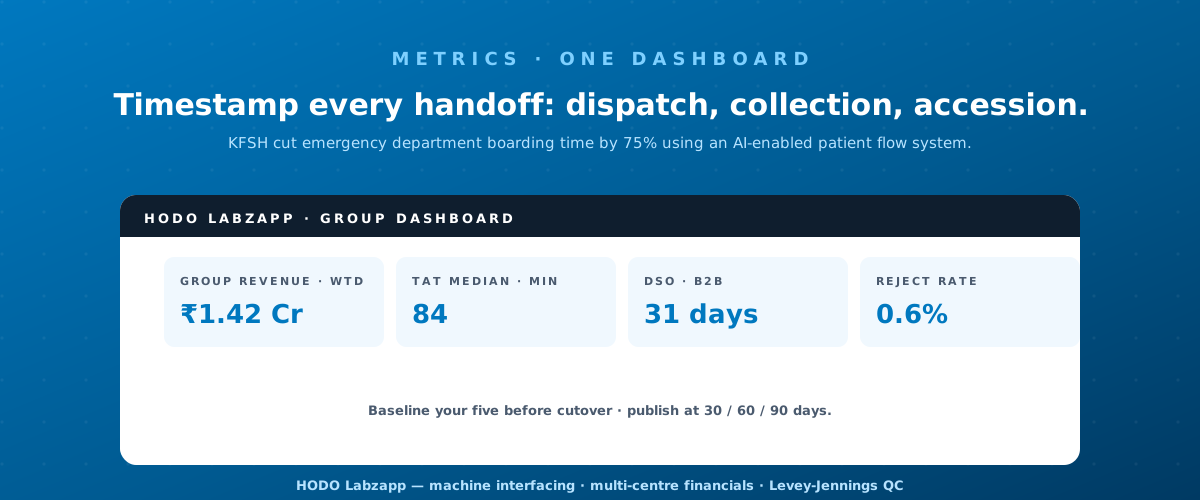
Timestamp every handoff: dispatch, collection, accession.
Delivery dwell shows up as call centre cost
The last window is the cheapest to close and the most neglected. Once a report is verified, every additional hour before the patient receives it converts into inbound calls, repeat requests to reception, and follow-up messages from referring doctors. In home-visit businesses, where there is no counter for the patient to walk up to, this traffic lands entirely on the phone line.
Automatic release on verification removes the window completely, and the operational benefit is measurable in staff hours rather than in patient satisfaction language. The same release event can push the report to the referring doctor and to a corporate client's portal, which is usually where the chasing originates. Operators who have made this change typically find call volume per hundred reports falls sharply, which in turn frees the coordinators who were supposed to be confirming tomorrow's bookings, the first dwell window in the chain. Closing the last gap tends to improve the first one.
What this means for HODO customers
HODO Labzapp is built around the assumption that a home-visit chain has to document itself while it runs. Barcoded samples and phlebotomy/home-collection workflows capture the draw, handover and accession events as scans, so field dwell becomes a reported number instead of an argument between the lab and the route team. TAT reporting breaks that chain into stages, which is what allows an operator to tell whether the constraint is dispatch, transport or the bench. Automated SMS/WhatsApp/Email report delivery closes the verification-to-delivery window on release, and partner-lab integration with anonymised sample tracking keeps referred-out work inside the same audit trail. For multi-route and multi-city operations, the per-stage view is also what makes a new route's economics comparable to an existing one before it is scaled.