Thyrocare founder Dr A. Velumani has put money into Prodoc AI, and the sentence he used to explain the cheque matters more to home-collection operators than the cheque itself: "Converting lead to revenue needs intelligence," as reported by Indian Startup News. Coming from the person who built India's largest preventive-testing network on home collection and franchise logistics, that is not a generic endorsement of AI. It is a statement about where diagnostics businesses actually lose money, in the gap between an enquiry and a settled bill.
The intelligence gap sits in the funnel, not the diagnosis
Prodoc AI's work, per the Indian Startup News report, sits on the patient engagement and conversion side of healthcare rather than the clinical side. That placement is the interesting part. Lab-at-home and doctor-at-home operators in India rarely have a lead shortage. Enquiries arrive from Google listings, WhatsApp forwards, referral doctors, corporate tie-ups, society noticeboards and a phlebotomist's own repeat customers. What is missing is the discipline that turns those enquiries into collected samples.
The conversion problem has a very specific shape in this vertical. A lead is seldom lost to a competitor's price list. It is lost because nobody rang back within twenty minutes. Or because the slot the patient asked for sat in a pin code the morning roster could not reach. Or because the phlebotomist arrived without the fasting instruction, the draw had to be repeated, and the patient quietly stopped answering. Or because the report was ready on Tuesday evening and reached the patient on Thursday.
None of that is a marketing failure. It is operations data that nobody reads. Thyrocare's structural advantage was never a better assay, it was logistics that held cost per test down while volume climbed. The intelligence being funded here is the same instinct applied one stage earlier, at the point where an enquiry becomes a sample in a barcoded tube.
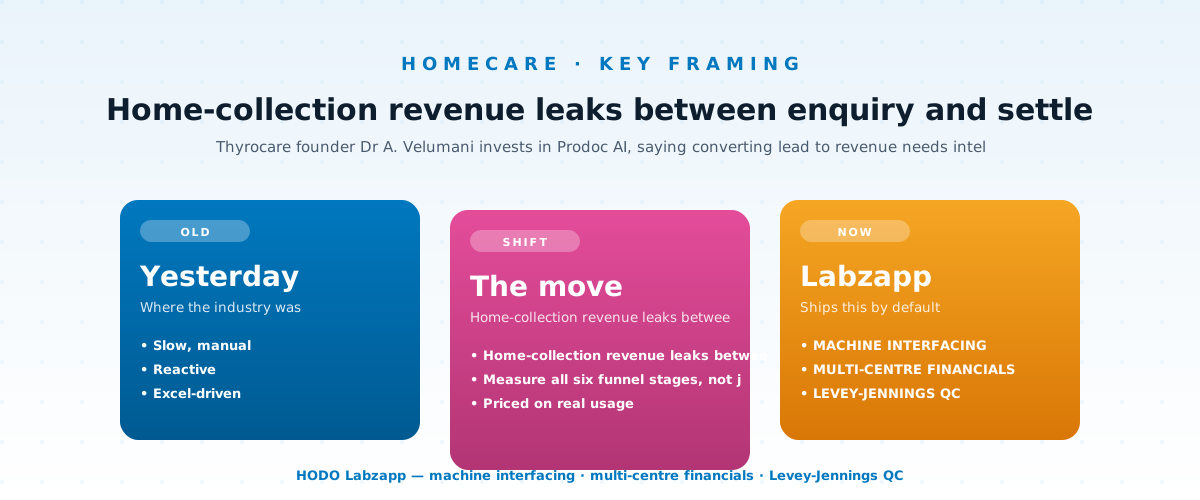
Home-collection revenue leaks between enquiry and settled bill.
Six stages, and most operators measure two
A home-collection order passes through six distinct stages: enquiry captured, slot confirmed, phlebotomist assigned, sample collected and received at the lab, report delivered, payment settled. Most operators can tell you the number at stage two and the number at stage five. The four numbers in between are where the margin goes.
Worth pulling for last month: how many enquiries never got a callback, and what the median callback delay was. How many confirmed slots were rescheduled by the operator rather than the patient. How many assigned visits ended without a sample, wrong address, patient not fasting, patient not at home, tube shortage in the kit bag. How many collected samples reached the lab outside the stability window and had to be recollected at your cost. How many reports were authorised but sat undelivered for more than six hours.
Each of those is a conversion loss with a rupee value attached, and each has a different owner. A twenty-five per cent callback failure is a call-desk staffing issue. A fifteen per cent failed-visit rate is a pre-visit instruction issue. Recollections are a chain-of-custody issue. Lumping them together as "conversion" guarantees the wrong fix. An AI layer pointed at that funnel can only rank what the system has already timestamped, which is why the stage-wise record has to exist before anyone buys intelligence to read it.
Cost per visit is decided by routing, not by the price list
Home collection has a hard arithmetic problem. A phlebotomist costs roughly the same whether the day's route holds four draws or eleven. Fuel, time between stops and the slot promise made at booking are what move cost per visit, and they are all set at the moment the slot is confirmed, not at the moment the invoice is raised.
This is where most operators make the avoidable mistake of confirming slots in the order calls arrive. A 7 a.m. draw in one locality and an 8 a.m. draw eleven kilometres away consumes one person's entire morning, and the fasting window closes in traffic. Operators who hold cost per visit down shape the day into geographic clusters, keep buffer slots for same-day additions, and give the call desk visibility of which clusters still have capacity before a time is promised.
The second lever is basket size. A single thyroid panel and a full preventive package carry nearly identical visit cost. Capturing what else the patient or household needs, a spouse's diabetes follow-up, a parent's lipid profile, an add-on that the referring doctor already indicated, at the point of booking is the cheapest revenue available in this model. It requires the booking screen to show the patient's previous tests, which again is a records question before it is an AI question.
Report delivery is a revenue event, not an admin task
In home collection the report is the only product the patient ever sees. The phlebotomist was polite, the tube was fine, the analyser ran clean, none of that registers. The delivery does. Operators who treat authorisation as the finish line and delivery as a clerical afterthought lose the repeat booking, which is the only booking with no acquisition cost attached.
Three measurements make this concrete. First, time from result authorisation to the patient's phone, tracked separately from laboratory turnaround, these two are habitually reported as one number, which hides the delay that patients actually experience. Second, the proportion delivered on the channel the patient actually uses, which in most Indian households means WhatsApp. Third, repeat booking rate within ninety days, split by whether the previous report landed on the promised day.
That third number usually settles the argument internally. Delivery discipline shows up in reorder behaviour, and reorder behaviour is what decides whether a home-collection route is a business or a treadmill. Automated delivery also removes the staff hour spent on follow-up calls asking where a report is, a cost that scales linearly with volume if left manual.
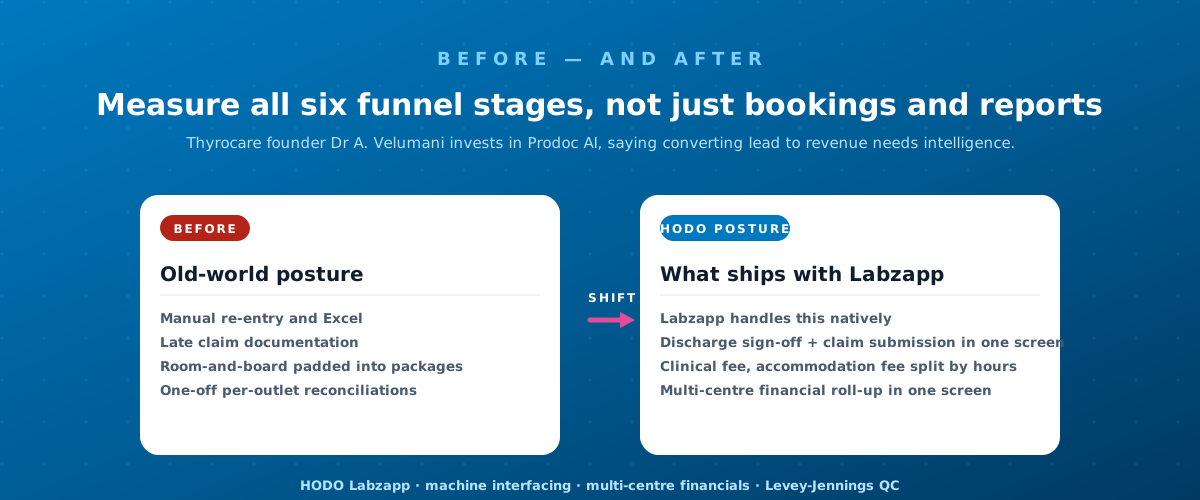
Measure all six funnel stages, not just bookings and reports.
Franchisee and partner routes leak at different points
Operators running a mixed model, direct bookings, franchisee collection centres, referral doctors and corporate contracts, need these funnels read separately. A direct booking leaks at callback and routing. A franchisee route leaks at sample handover and settlement reconciliation. A corporate camp leaks at the pre-registration stage, where half the employee list never books at all. A referral doctor leaks when the report does not reach the clinic that sent the patient.
Pricing also behaves differently across these routes, and mixing them produces a blended margin number that cannot be acted on. Each partner needs its own rate, its own TAT promise and its own cost-to-serve line. Franchisee settlements that are reconciled manually at month end tend to carry two to four per cent of silent leakage, disputed samples, rate mismatches, tests billed at the wrong slab. That is a full margin point in a business running on thin ones.
What this means for HODO customers
Velumani's point stands without any AI purchase: conversion is an operations discipline, and intelligence can only act on what the system records. The practical sequence is to make every funnel stage timestamped and attributable first. Labzapp's phlebotomy/home-collection workflows hold the booking, assignment, route and handover as one tracked record rather than a call register plus a WhatsApp group, so failed visits and recollections become countable instead of anecdotal. Automated SMS/WhatsApp/Email report delivery closes the last mile without a staff member chasing it, and TAT reporting separates laboratory turnaround from delivery delay so the right team owns the right gap. For mixed models, franchisee management with differential pricing per partner keeps each route's rate and settlement auditable rather than reconciled from memory.