BW Businessworld reports that Razorpay's AI agent on WhatsApp has cut the company's customer support volume by 30-40%, handling routine merchant queries before a human ever sees them. The number is interesting less for what it says about payments and more for what it says about any operation where customers ask the same five questions on a messaging app all day. Lab-at-home and doctor-at-home operators across the UAE and the wider Gulf are exactly that kind of operation, and most of them are still answering those questions by hand.
What a 30-40% deflection actually measures
A deflection figure of that size is rarely about clever language handling. It is about how much of the inbound queue was pure status lookup, where is my payment, what is the fee, has the refund gone out. Those queries have a single correct answer that already exists inside a system of record, and the agent's job is to retrieve it and phrase it. The hard queries, disputes, exceptions, anything requiring judgement, still go to people, and that is why the number lands at 30-40% rather than 90%.
The same split holds for home collection. A Dubai or Doha lab running 120 home visits a day does not get 120 complicated clinical conversations. It gets a few hundred messages asking whether the booking is confirmed, when the phlebotomist will arrive, whether the patient should fast, whether the report is ready, and where the invoice is. Each of those has one answer. The reason a coordinator is reading them is not that the question is hard; it is that the answer is locked inside a spreadsheet, a WhatsApp group of phlebotomists, or someone's head.
So the first piece of work is not buying a chat agent. It is sorting the inbound queue into questions with a single system-held answer and questions that need a person. Operators who skip this step deploy an agent that confidently answers the wrong half.
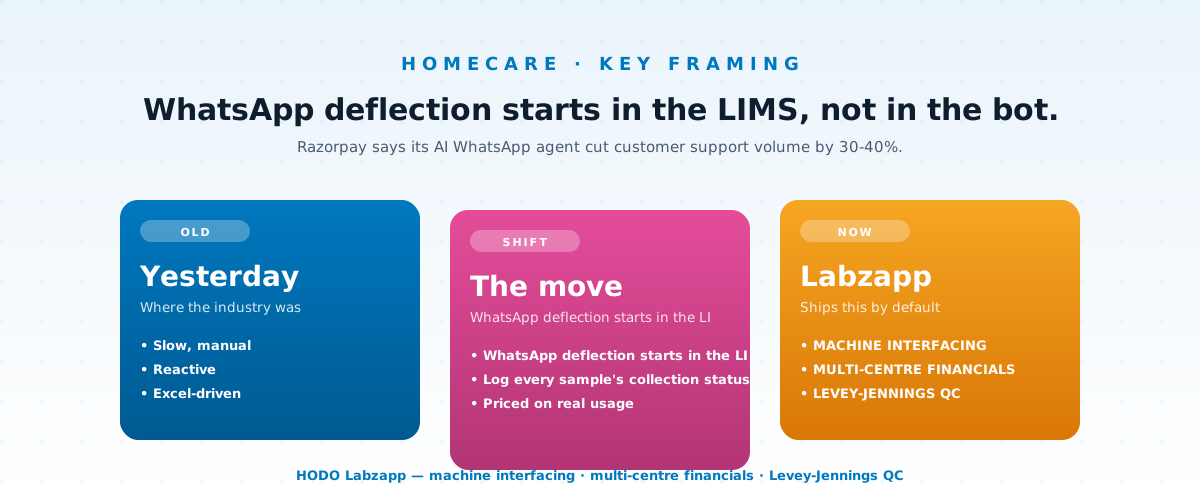
WhatsApp deflection starts in the LIMS, not in the bot.
The home-collection queue is mostly five questions
Across most home-collection operations the inbound mix is remarkably stable. Booking confirmation and slot changes dominate the morning. Phlebotomist ETA peaks in the collection window. Preparation questions, fasting hours, water, whether to hold the morning dose, cluster the evening before. Report status builds through the afternoon. Invoice, receipt and insurance questions trail everything.
Only the insurance and clinical-interpretation questions genuinely require a human in the Gulf context. The other four categories are status retrievals. But they can only be retrieved if the operational state is being written down as it happens: the slot as booked, the route as assigned, the sample as collected and barcoded at the door, the sample as received at the bench, the test as run, the report as authorised.
This is where most operators discover the real gap. The phlebotomist knows the sample was collected at 7:40 am, but nothing in the system knows it until the bag reaches the lab at 11 am. For three hours, no agent, human or otherwise, can answer "has my sample been picked up" without ringing the phlebotomist. Deflection fails not because the agent is weak but because the record is thin.
Deflection needs a system of record, not a chatbot
The sequence that works is unglamorous. First, capture collection events at the point of collection, on the phlebotomist's phone, with the barcode scanned at the patient's door rather than at the bench. Second, make every stage after that a timestamped state change rather than an email. Third, expose that state to whatever answers messages.
Once the states exist, the messaging layer becomes almost trivial. A patient asking about report status gets the actual stage. A patient asking about ETA gets the assigned route's position in sequence. A patient asking about fasting gets the preparation note attached to the specific tests on their booking, not a generic leaflet. None of this requires the agent to reason, it requires the lab to have written things down.
The second-order benefit matters more than the deflection. Once collection, receipt and authorisation are timestamped, turnaround time stops being an anecdote. A lab that can see the median gap between door-scan and bench-receipt per route will usually find one or two routes carrying most of the delay, and that is a dispatch problem with a cheap fix. Operators chasing a chat agent frequently find the routing insight was worth more than the saved coordinator hours.
Gulf specifics: language, insurance and escalation
Three things differ in the GCC from the Indian deployments that generate most of the case studies. Language is the obvious one: a home-collection book in Dubai or Abu Dhabi spans Arabic, English, Hindi, Malayalam, Tagalog and Urdu across a single day's route. Any automated reply has to pick the patient's language from the booking record, not guess from the message, because patients frequently type in English and read far better in their first language.
Insurance is the second. Eligibility, co-pay and pre-approval questions should never be answered automatically in a market where coverage varies by policy tier and by payer network. The correct behaviour is immediate routing to a human with the booking context attached. Attempting deflection here produces the one failure mode that costs real money, a patient told they are covered when they are not.
Third is the escalation path itself. Licensing regimes across Dubai, Abu Dhabi, Qatar and Bahrain treat result communication as a clinical act. An automated message can say a report is ready and deliver it to the right verified recipient; it should not interpret a value. Draw that line explicitly in the agent's scope before launch, and log every handover so the audit trail shows who said what.
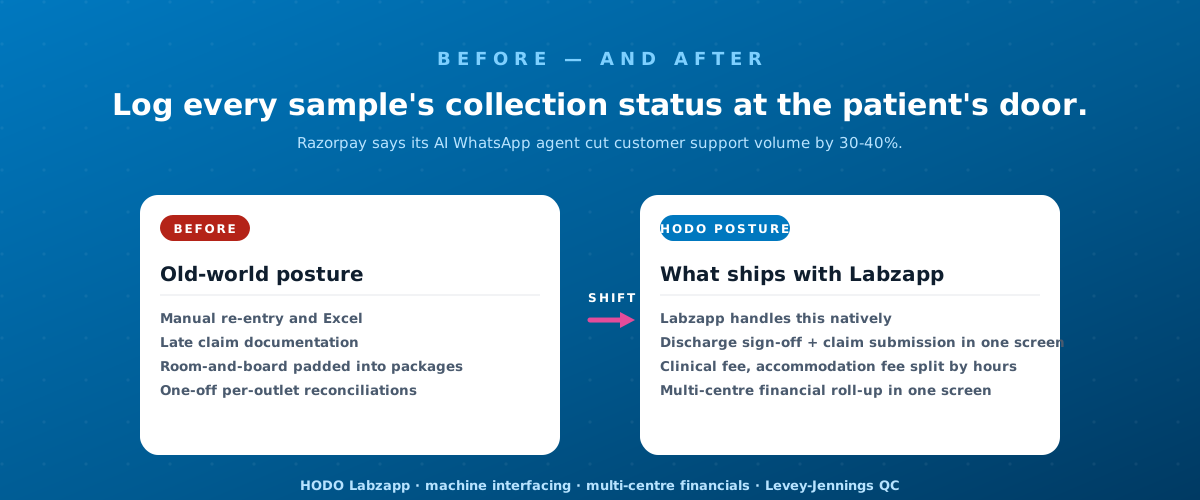
Log every sample's collection status at the patient's door.
Measure per visit, not per ticket
Support dashboards tempt operators into counting tickets closed. For a home-collection business the number that decides viability is cost per visit, and coordination labour is a visible line in it. The useful metric is repeat contacts per completed visit, how many times a patient had to message to get one blood draw done and one report delivered. A business running at three contacts per visit has a record-keeping problem. One running at 0.4 has an operation.
Track it alongside visits per phlebotomist per day and the door-scan-to-receipt gap. Those three numbers together tell an operator whether automation is removing work or merely moving it. Deflection that pushes patients into a loop of unhelpful replies before they call anyway shows up as a flat contact rate and a rising abandonment rate on bookings, worth watching in the first month after any launch.
What this means for HODO customers
Everything above depends on the operational record being complete before any messaging automation is switched on. Labzapp's phlebotomy/home-collection workflows capture the booking, route assignment and door-side barcode scan as timestamped events, which is what turns "has my sample been collected" into a retrievable fact rather than a phone call. Automated SMS/WhatsApp/Email report delivery handles the single highest-volume query category, report status and release, against verified recipients, with the delivery itself logged. And TAT reporting gives the per-route, per-stage view that shows whether the coordination load is a staffing problem or a dispatch problem. For multi-centre and partner-run networks, differential pricing per partner and franchisee management keep the same record structure intact as routes multiply.