Onrec reports that Call My Doctor Health Care has expanded its premium home healthcare services in Dubai, widening doctor-at-home, nursing and diagnostic coverage across the emirate. The headline reads like a marketing milestone. Read it as an operations announcement instead: expanding a home-visit business means adding routes, clinicians and a licensing footprint faster than the back office can absorb them, and that is where most home healthcare operators in the GCC stall.
A Dubai expansion is a routing problem before it is a clinical one
Home healthcare in Dubai sits in a narrow regulatory and commercial lane. Providers operate under a licensed home health care category, clinicians carry individual licences tied to scope, and the payer mix is a blend of cash-paying residents on premium packages and insured patients whose visits need pre-authorisation and coded submission. None of that is unusual. What is unusual, compared with a clinic, is that the delivery unit moves.
A polyclinic sells a room and a slot. A home healthcare operator sells a clinician plus travel time plus traffic risk, priced as though it were a slot. Expansion multiplies every variable at once: more geography per clinician, more time lost between Jumeirah and Dubai Investments Park, more cancellations discovered at the door rather than at a reception desk. Operators who grow by hiring tend to find that the second ten clinicians are materially less productive than the first ten, because nobody re-engineered the dispatch layer that worked fine at low volume on WhatsApp and a shared spreadsheet.
The operational question behind the Onrec story is not whether Dubai wants premium home care. It clearly does, an ageing expatriate parent population, post-surgical discharges pushed home earlier, and corporate wellness contracts all point the same way. The question is whether the provider can add a third or fourth service line without the cost per visit quietly climbing past the price per visit.
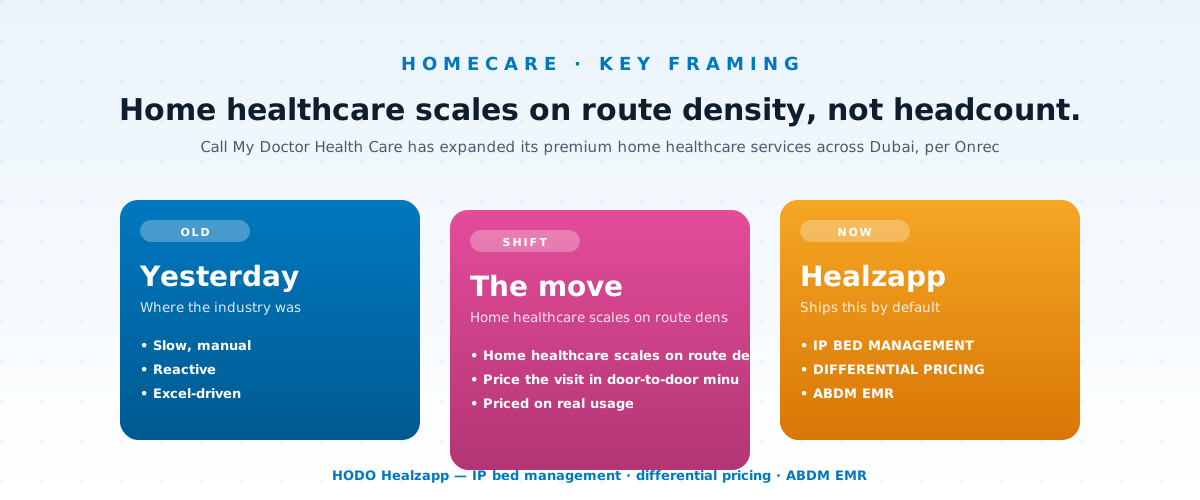
Home healthcare scales on route density, not headcount.
The economics live in the drive, not the consultation
Home-visit unit economics are unforgiving because the denominator is small. A clinic doctor might see four to six patients an hour. A doctor-at-home operation in Dubai realistically completes three to five visits in a shift once travel, parking, building access, documentation and supply restocking are counted. That means the fully loaded cost of a visit, clinician time, vehicle, consumables, coordinator time, unbilled no-shows, has to be recovered across a handful of billable events per clinician per day.
The practical discipline is to price and measure in door-to-door minutes rather than consultation minutes. A 20-minute consultation that consumes 95 minutes of clinician availability is a 95-minute product. Operators who track it this way make different decisions: they cluster bookings by area and time band instead of accepting whatever slot the caller prefers, they set a minimum visit fee that covers travel rather than discounting to win the booking, and they treat a same-day cancellation as a revenue loss with a name attached rather than an unavoidable cost of doing business.
Two numbers usually reveal whether an expansion is healthy. The first is visits completed per clinician-day, tracked weekly, not monthly. The second is the share of visits that required a second contact, a return trip, a missed sample, a prescription that had to be re-sent. In most home healthcare operations that second number sits between 10 and 20 per cent when it is first measured, and almost all of it is administrative rather than clinical.
Scheduling is the constraint, and a calendar will not fix it
Most home-visit operators start with a calendar tool and a coordinator who knows the city. That combination works up to roughly the point where one person can hold the whole day in their head. Past it, the failure modes are predictable: two visits booked in opposite corners of the emirate ninety minutes apart, a nurse dispatched without knowing the patient needs a male or female clinician, a follow-up promised verbally and never scheduled.
The fix is to make the booking record the single operational object that carries everything, patient, address, clinician scope required, payer, pre-authorisation status, consumables needed, and the link back to the previous visit. When the booking carries that, the coordinator stops being the integration layer. When it does not, the coordinator is the system, and the business cannot scale past that person's shift.
Teleconsultation belongs in the same flow rather than in a separate app. A meaningful share of home-visit demand in Dubai, medication queries, result review, post-visit check-ins, triage of whether a visit is needed at all, does not require a car. Operators who route those to a scheduled remote consultation protect their most expensive asset, clinician road time, and convert calls that would otherwise have been given away free into billable contacts. The gating factor is whether the remote contact lands in the same patient record as the physical visit. If it does not, staff will avoid it.
The record has to close before the clinician leaves the door
Continuity is where premium home healthcare is either earned or lost. A patient on a monthly package may see four different clinicians in a quarter. Each one arrives cold unless the previous visits are legible in under a minute, what was found, what was prescribed, what was deferred, what the family was told.
Paper notes photographed and sent to a group chat do not survive that test, and they do not survive an insurer's audit either. Documentation completed at the point of care, on the clinician's own device, with structured history the next clinician can actually scan, is the difference between a service that compounds trust and one that re-explains itself every visit. AI-condensed history matters more in home care than in a clinic precisely because the reading happens in a lift, not at a desk.
The same record drives the money. Billing for a mixed cash-and-insurance book in the UAE means handling package deductions, differential rates by corporate contract, and clean coded submissions, all generated from what was documented, not re-keyed later from memory by an administrator who was not in the room.
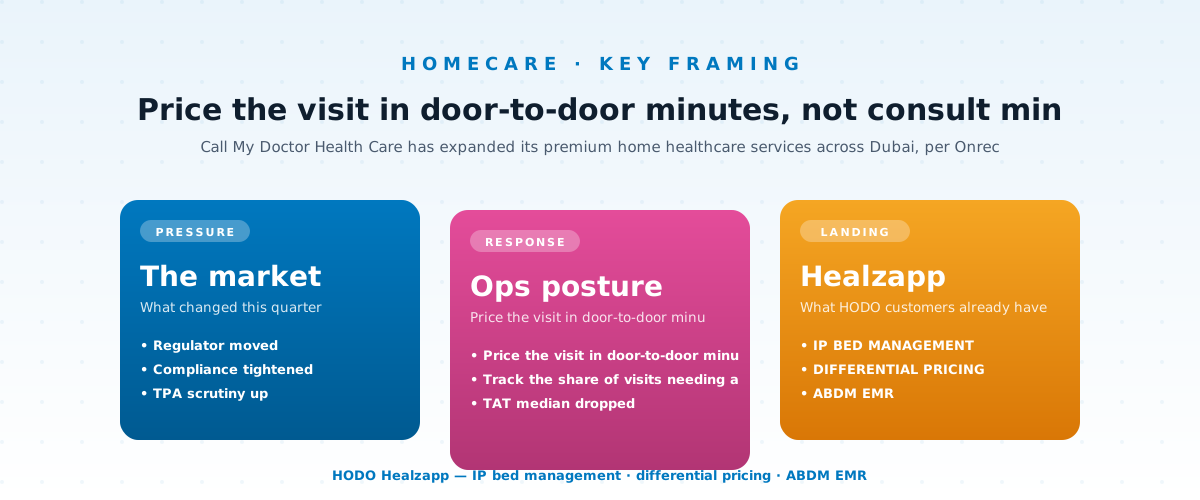
Price the visit in door-to-door minutes, not consult minutes.
When the home visit includes a blood draw
Most doctor-at-home businesses in the GCC add home collection within a year, because the marginal revenue is attractive and the patient is already expecting someone at the door. The operational load is heavier than it looks. A sample collected in a villa has to be barcoded at the point of collection, tracked through transport, matched to the right patient on arrival at the lab, and returned as a report the patient receives without calling anyone.
The failure point is almost always identification, samples labelled later, at the car or the lab, rather than in front of the patient. Barcoding at the bedside, phlebotomy and home-collection workflows built for field staff, and automated report delivery over WhatsApp close that gap and remove the report-chasing calls that consume coordinator hours. Turnaround time reported by route, rather than as a single lab average, is what tells an operator whether a new catchment area is actually serviceable.
What this means for HODO customers
Home healthcare scales on density and record continuity, not on headcount. For doctor-at-home operators in Dubai and the wider GCC, the spine is Appointments carrying the full visit context, Teleconsultation absorbing the contacts that do not need a car, and the Patient Health App giving patients and families their history, reports and upcoming visits without a phone call. Where home collection is part of the offer, barcoded samples with WhatsApp/SMS report delivery close the loop the same day. Measured together, those four cut the unbilled second contacts that quietly decide whether an expansion pays for itself.