Manipal Health Enterprises is scouting for hospital acquisitions in Andhra Pradesh, Keralam and Delhi-NCR, alongside a greenfield project in Mumbai, according to ETHealthworld. The group aims to add more than 2,400 beds by 2030 and is investing in AI-enabled nursing and patient monitoring as part of a digital-physical care model. For promoters of India's ~100-bed hospitals, the report raises a practical question: if a large chain came calling tomorrow, would the hospital's operational data survive due diligence?
Consolidation is reaching mid-sized hospitals
Large chains adding beds through acquisition is not new, but the geography matters. Andhra Pradesh, Keralam and Delhi-NCR each have dense clusters of promoter-run hospitals between 50 and 200 beds: family-owned, doctor-founded, often profitable, and frequently running on a patchwork of billing software, spreadsheets and paper case sheets.
Acquisition is usually faster than a greenfield build. An existing hospital brings licences, a referral network, a nursing workforce and patient footfall from the first day. That makes well-run mid-sized hospitals attractive targets. It also means they now compete, directly or indirectly, with chains that bring centralised procurement, brand trust and, increasingly, AI-assisted clinical operations.
A 100-bed hospital in these markets has three realistic paths: be acquired on good terms, partner with a chain under a management or O&M model, or stay independent and compete on throughput and patient experience. All three reward the same underlying asset: clean, structured, retrievable operational data. A hospital that cannot pull month-wise bed occupancy, average revenue per occupied bed (ARPOB) or TPA receivable ageing in a few clicks is harder to value, harder to integrate and harder to run efficiently, whichever path it chooses.
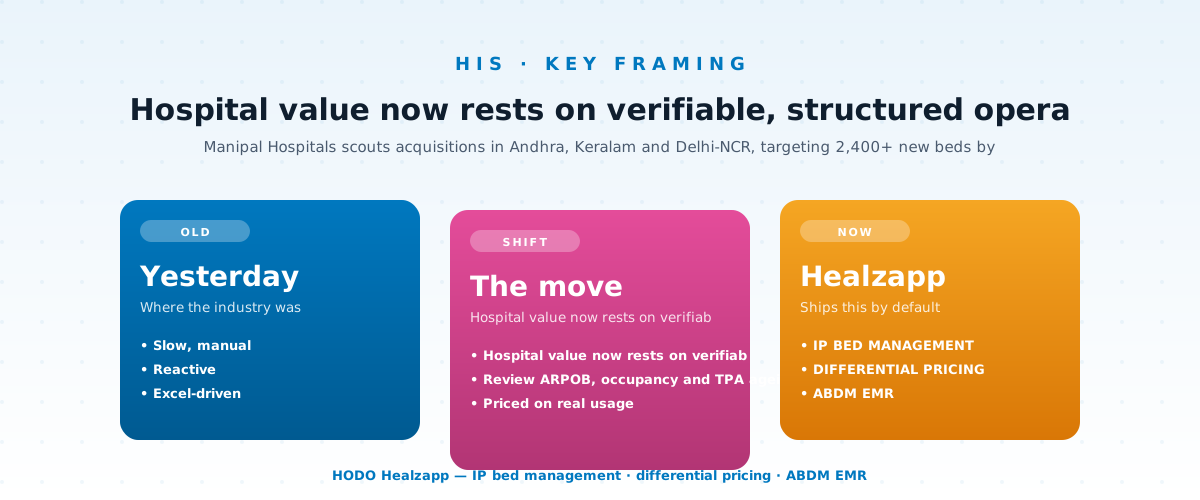
Hospital value now rests on verifiable, structured operational data.
Acquirers pay for verifiable numbers, not just beds
Due diligence on a hospital is largely a data exercise. Acquirers and their advisors typically ask for occupancy trends by ward and specialty, average length of stay, OP-to-IP conversion, payer mix across cash, TPA, corporate and PMJAY, claim rejection and deduction rates, pharmacy margins and doctor-wise revenue.
When this information lives in disconnected systems (a standalone billing package, a separate pharmacy tool, manual IP registers), the finance team spends weeks reconciling, and every gap becomes a negotiating point. Revenue that cannot be verified tends to be discounted. Receivables that cannot be explained tend to be written down.
A hospital whose IP/OP, Billing, Pharmacy and Inventory run in one system can export a consistent picture: the same patient record linking the OP consult, the admission, bed movements, the discharge bill and the insurance claim. Tally integration matters here too, because the acquirer's auditors will reconcile clinical billing against the books.
The operational benefit arrives long before any deal. Promoters who review ARPOB, discharge billing turnaround and TPA cashflow every week tend to fix leakages that would otherwise surface, expensively, during diligence.
AI-enabled nursing needs structured nursing data first
The ETHealthworld report highlights Manipal's investment in AI-enabled nursing and patient monitoring. It is worth being precise about what that requires. Early-warning scores, deterioration alerts and nurse workload balancing all depend on observations, medication administration and nursing notes being captured digitally, with timestamps. An algorithm cannot read a handwritten TPR chart clipped to the foot of a bed.
For a mid-sized hospital, the practical first step is not buying an AI monitoring product. It is digitising the nursing workflow so that any future analytics, built in-house or brought in by an acquirer, has something reliable to work with. That means a Nursing Station that brings ward work inside the HIS, IP bed management that shows current bed status and pending discharges, and an EMR that keeps the patient's history in one place instead of scattered across paper files.
Hospitals that make this shift usually see gains that have nothing to do with AI: clearer handovers, faster discharge preparation and better accountability on night shifts. When the AI layer does arrive, it sits on a foundation that already works rather than on paper that has to be transcribed first.
Integration cost is the hidden line item in every deal
Post-acquisition integration is where many hospital deals lose value. The acquirer has to map the target's service masters, tariffs, doctor payout arrangements, insurance packages and inventory codes into its own systems, or run two systems in parallel for months. Unstructured records stretch that timeline, and acquirers price the delay into their offers.
Four areas deserve attention before any conversation with a chain begins:
Patient records: an ABDM-compliant EMR keeps clinical data standards-aligned and portable, which reduces the friction of moving records between systems.
Pricing: hospitals with multiple payer contracts need Differential pricing configured in the system, not manual discounts applied at the billing counter.
Referral relationships: B2B Referral and Corporate-partner logins document where patients come from, which is part of what an acquirer is actually buying.
Assets: Warranty+AMC asset tracking turns a vague equipment list into a verifiable register with service history.
None of this is glamorous. Each item, however, shortens diligence, reduces the integration budget an acquirer mentally deducts from the offer, and gives current management better day-to-day control.
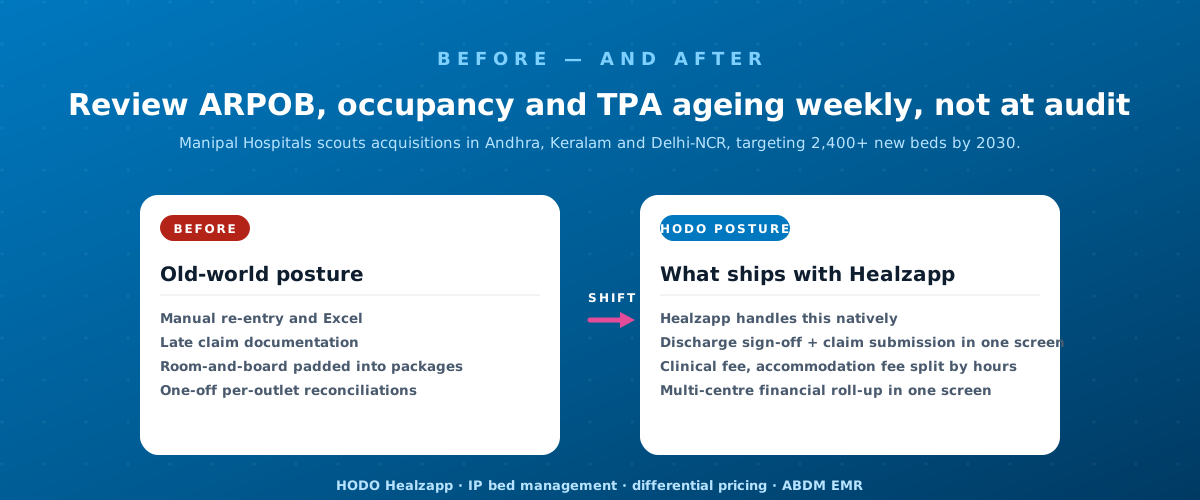
Review ARPOB, occupancy and TPA ageing weekly, not at audit time.
The independent counter-move: throughput and small-cluster scale
Not every promoter wants to sell. For hospitals choosing independence, pressure from chains is real, and the response has to be operational. The chain's advantage is scale and standardisation; the independent hospital's advantage is speed of decision-making and local relationships.
OP throughput is the first lever. Appointments, a TV Token Display in the waiting area and WhatsApp/SMS report delivery reduce crowding and repeat visits just to collect reports, which are improvements patients notice and compare against larger hospitals. A Patient Health App and Teleconsultation extend follow-up care without occupying OP rooms.
The second lever is building a small cluster. Several independent groups in Kerala and Andhra Pradesh have grown by adding a satellite clinic, a collection centre or a second hospital in a neighbouring town. Setting up each new centre from scratch, with separate masters, tariffs and user roles, is where that growth usually stalls. A three-location group with unified data and consolidated reporting is a stronger negotiator with insurers, with suppliers and, eventually, with any acquirer.
What this means for HODO customers
Manipal's expansion plan signals that consolidation will keep reaching mid-sized hospitals across India. Whether the goal is a good exit, a partnership or independent growth, the hospitals in the strongest position will be those whose operations are already digital and auditable.
For Healzapp users, three capabilities are directly relevant. IP bed management and the Nursing Station create the structured occupancy and ward data that AI-enabled monitoring, and any acquirer's diligence team, depends on. Billing with Tally integration ties TPA, PMJAY, corporate and cash revenue back to the books in one reconciled trail. Multi-outlet scale-up with one-click new-centre setup lets an independent group add centres without multiplying admin overhead. HODO has served 500+ client outlets since 2013 and was among the first 20 ABDM-integrated HealthTechs in India, so the ABDM-compliant EMR is part of the standard build.