Dealroom.co reports that Prodoc AI has closed a seed round to build an AI layer across Indian hospitals, a software tier meant to sit on top of whatever systems a hospital already runs. For a 100-bed hospital in Kerala, Maharashtra or Telangana, the useful question is not whether such layers are coming; several will, with near-identical slide decks. The question is what a hospital has to fix in its own stack first, so that an AI layer produces something a duty manager would actually act on.
An AI layer consumes data, it does not create it
Every AI product being pitched to Indian hospitals right now, discharge summary drafting, coding assistance, bed demand forecasting, claim scrutiny, OP no-show prediction, reads from systems the hospital already owns: the HIS, the lab system, radiology, pharmacy and billing. The ceiling on what the layer can do is set entirely by what those systems emit, in what structure, and how quickly.
That ceiling is lower than most managements assume. In a large share of 100-bed hospitals, admission diagnosis is free text typed by whoever was at the counter. The discharge summary is a Word file on a shared drive. Biochemistry and haematology results are read off the analyser screen and retyped into the HIS. Bed status lives on a whiteboard at the nursing station, updated twice a shift. Pharmacy stock is reconciled weekly against a separate ledger.
An AI layer sitting on that is doing optical character recognition and inference where it should be reading fields. Vendor demonstrations run on clean sample data. The practical counter-move: ask the vendor to list the exact fields they need, the format, and the latency at which they need them. Then check, field by field, how many of those your current HIS actually produces without a human retyping something.
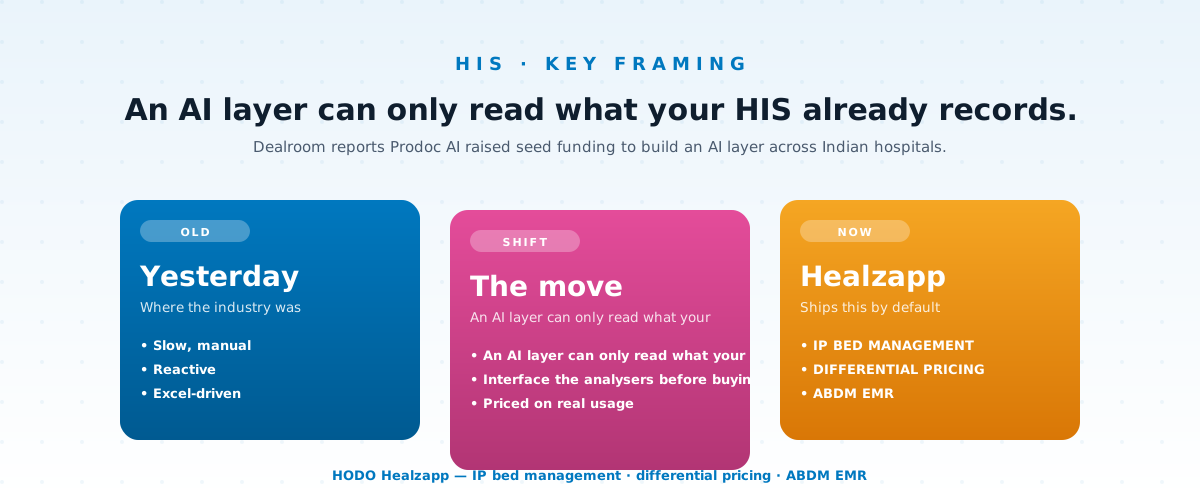
An AI layer can only read what your HIS already records.
The three gaps that show up in almost every assessment
First, analysers are not interfaced. Where results are retyped, two things happen, transcription errors enter the record, and turnaround time becomes invisible because the only timestamp is when someone got around to typing. Machine interfacing is unglamorous plumbing, but no AI model can recover a timestamp that was never captured.
Second, bed state is aggregate rather than per-bed. Management knows occupancy was 68 per cent yesterday. It does not know, at 11am today, which beds are occupied, which are billed and awaiting clearance, which are vacated but not yet cleaned. Any forecast of discharge load or admission capacity needs that event stream, admit, transfer, discharge initiated, bill cleared, bed cleaned, bed ready, with times attached. Aggregate occupancy will not support it.
Third, clinical history is unstructured and scattered across visits. A patient who has attended OP four times in two years has four sets of notes that nobody reads end to end. This is the gap AI summarisation is genuinely good at closing, but it needs the records linked to one identity in the first place. ABDM registration and ABHA-linked records give that identity spine, which is why the hospitals furthest along on ABDM tend also to be the ones where an AI pilot has something to chew on.
Where an AI layer actually pays in a 100-bed hospital
Not in diagnosis. In cashflow and throughput, which is where the pain already is.
Discharge cycle time is the clearest candidate. In most 100-bed hospitals the median gap between "doctor says discharge" and "bed ready for next admission" runs three to five hours, and much of it is billing clearance, pharmacy return and housekeeping sequencing rather than clinical work. Pulling sixty to ninety minutes out of that median is worth real bed-days across a year, and it is a coordination problem, exactly what an agent with visibility across billing, pharmacy and nursing can chase.
The second candidate is TPA and PMJAY paperwork. Pre-authorisation queries, document shortfalls and denial patterns are repetitive, deadline-bound and consistently under-staffed. A layer that flags which claims are ageing, which denials repeat the same reason code and which pre-auths have gone quiet for four days pays for itself in working capital, not in clinical outcomes.
Both of these require one thing before any AI is switched on: a measured baseline. Median discharge TAT by ward, claim query turnaround by TPA, denial rate by reason code, recorded for at least a quarter before the pilot. Without it, the vendor's ROI claim and the hospital's counter-claim are both unfalsifiable, and the renewal conversation becomes a matter of opinion.
The integration bill nobody puts in the budget
The typical Indian 100-bed stack is not one system. It is a HIS from one vendor, a lab system from another, pharmacy running partly in an accounting package, radiology on a separate PACS, and at least one departmental workbook that is load-bearing. An AI layer needs read access across all of it.
That access has a price, and it rarely appears in the pilot quotation: interface work per system, field mapping and terminology reconciliation, consent handling and DPDP-aligned logging, audit trails for who saw what, and a clear answer to who holds the data when the contract ends. Hospitals that have been through one integration project know the pilot cost is often the smaller half.
Two things reduce it. One is contractual, negotiate documented APIs and full data export rights into the HIS contract at renewal, not after an AI vendor has already been selected. The other is structural: the fewer systems of record a hospital runs, the smaller the integration surface. A single platform covering IP and OP, billing, pharmacy, inventory and lab interfacing presents one integration point to an AI layer instead of five, and one audit trail instead of five reconciliations.
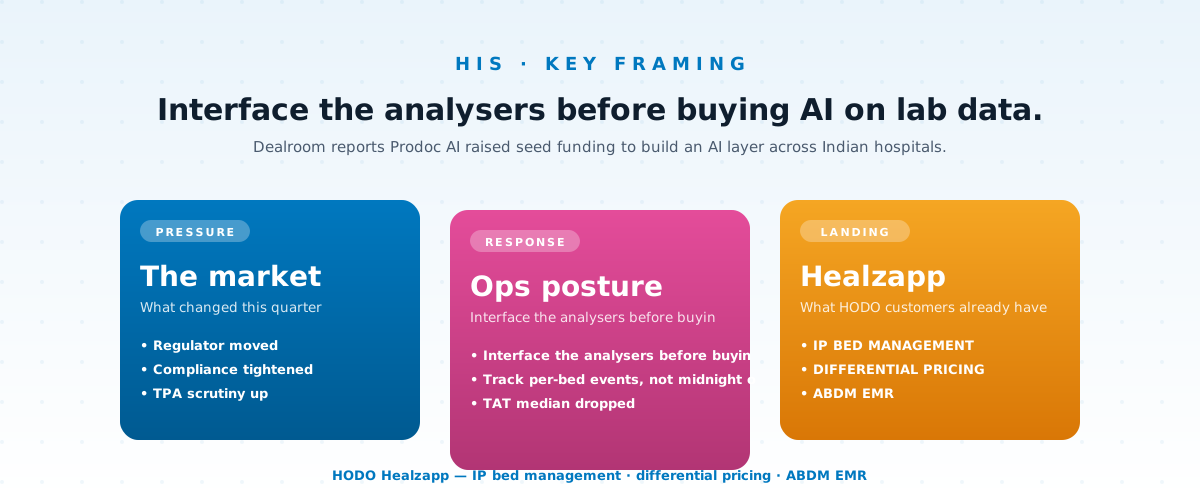
Interface the analysers before buying AI on lab data.
A readiness test before signing any pilot
Six questions, answerable in an afternoon by the IT lead and the nursing superintendent together. Are analyser results entering the system electronically, or being retyped? Is bed status updated as an event at the point it changes, or reconstructed later? Are OP and IP records of the same patient linked to one identity? Is there a timestamped record of billing clearance separate from discharge order? Can the hospital produce, today, a median discharge TAT by ward for the last quarter? And can data be exported in full, in a documented format, without vendor assistance?
A hospital answering yes to four or more is ready to run a genuine pilot and judge it on numbers. A hospital answering yes to one or two should spend the next two quarters on the plumbing instead. That is not a delay tactic, the plumbing pays on its own, through fewer transcription errors, faster bed turnaround and shorter claim cycles, whether or not an AI layer is ever bought. Rounds like Prodoc's raise the pressure to move fast; the hospitals that benefit will be those whose data was already worth reading.
What this means for HODO customers
The readiness list above maps closely onto modules that are already part of the platform rather than a separate project. Machine Interfacing removes the retyping step and puts real timestamps on lab results, which is what makes turnaround time measurable at all. IP bed management and the Nursing Station module capture bed state as events at the point of change, so occupancy is a live position rather than a midnight average. EMR (AI-condensed history) addresses the scattered-history problem directly, and ABDM-compliant EMR keeps records tied to one patient identity across visits and outlets. A hospital running these already has the event stream and structured history any such layer would need to read.