
Healthcare Asia Magazine reports that Kozhikode-based Baby Memorial Hospital is planning an AI rollout across nine hospitals in its network. For Indian hospital groups watching this, the instructive part is not the models — it is the rollout itself. Nine sites means nine sets of registers, nine billing habits and nine local versions of "how triage works here", and that gap between a working pilot and a working network is where most hospital AI budgets quietly disappear.
A single-site AI pilot succeeds on enthusiasm. One consultant champions it, one nursing in-charge adjusts the workflow, and the numbers look good within a quarter. Scale that to nine units and enthusiasm stops being the operative variable. What matters instead is whether the same patient event — a chest pain walk-in at 11 pm — gets recorded the same way in Unit 1 and Unit 7.
Most ~100-bed Indian hospitals and small groups discover this the hard way. The flagship site has a reasonably disciplined HIS. The satellite units run a mix of the HIS, a parallel Excel register for OP flow, and a WhatsApp group for bed availability. An AI layer sitting on top of that inherits every inconsistency underneath it. Triage acuity recorded as free text in one unit and as a dropdown in another cannot be compared, which means it cannot be modelled, which means the dashboard the management team wanted is built on sand.
The practical sequence is unglamorous: standardise capture, then standardise definitions, then add intelligence. Groups that invert this order usually end up paying twice — once for the AI, and again for the data cleanup that should have come first. The nine-site ambition is correct; the order of operations decides whether it lands.
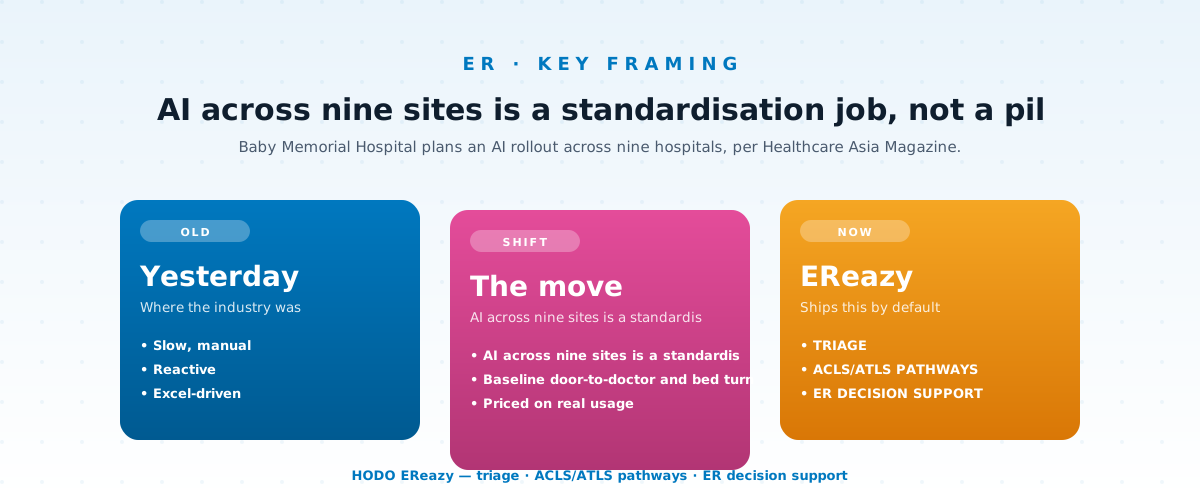
If a hospital group has to pick one department to start with, the ER has the strongest case. It is time-bound, protocol-driven and generates a dense, structured event trail in a short window. Door-to-triage, triage-to-doctor, decision-to-admit, admit-to-bed — these are measurable in minutes, not days, so any improvement shows up inside weeks rather than at the end of a financial year.
The ER is also where variation is most expensive. A delayed triage decision does not just affect one patient; it pushes the entire queue, occupies a trolley that the next ambulance needs, and converts a potential admission into a referral out. For a 100-bed hospital where the ER feeds a meaningful share of IP admissions, every avoidable walkout is lost bed-days and lost revenue in the same transaction.
Baby Memorial Hospital Kozhikode is the clinical anchor site for HODO EReazy, the ER clinical automation product built jointly with MCare Apps — which is relevant here mainly because it shows what the groundwork looks like. Structured triage, ACLS/ATLS pathway decision support and role-tailored flows for the triage nurse, ER resident, receptionist and consultant exist precisely so the clinical event is captured as data at the moment it happens, not reconstructed from case sheets later. That is the substrate an AI rollout needs. Without it, the model is guessing from notes typed at the end of a shift.
Hospital boards tend to budget AI projects as software purchases. In practice the dominant cost line is internal: cleaning master data, reconciling test and procedure codes across units, and retraining staff on capture discipline. A group with nine sites typically has nine slightly different service masters, three different naming conventions for the same investigation, and at least one unit still entering diagnosis as free text.
None of this is exotic. It is the ordinary residue of growth by acquisition and local autonomy. But it sets the schedule. Groups that run a two-month data audit before signing anything usually commission faster than groups that start with a pilot and discover the mismatch in month five.
A useful test: pick one clinical question the management team actually wants answered — say, average decision-to-admit time by unit and by shift — and try to answer it today from existing systems. If that takes a week of manual effort across nine sites, the AI rollout is not a modelling problem yet. It is an instrumentation problem. ABDM-compliant EMR requirements push in the same direction, since structured, shareable records are a prerequisite rather than a bonus. The hospitals that treat compliance work and AI readiness as the same project get two outcomes from one budget.
Any AI rollout in a multi-hospital group eventually runs into the bed. Faster triage and better clinical decision support increase the rate at which patients are cleared for admission — which only helps if there is somewhere to put them. If discharge processing, housekeeping turnaround and billing clearance still take three hours, the ER simply queues faster into the same bottleneck.
This is why bed occupancy visibility deserves to be in the first phase rather than the third. A real-time view of occupied, reserved, blocked and cleaning-in-progress beds across all units changes behaviour immediately, with no model involved. Referral decisions stop being phone calls. A patient who would have been sent out of network because "we are full" gets routed to the unit twenty minutes away that has two free beds.
For groups running TPA and PMJAY volumes, the same visibility carries a cashflow effect. Discharge delays are usually documentation delays, and documentation delays are claim-submission delays. Tightening the admit-to-discharge loop shortens the receivable cycle as a side effect — often a larger financial gain in year one than anything the AI layer contributes directly.
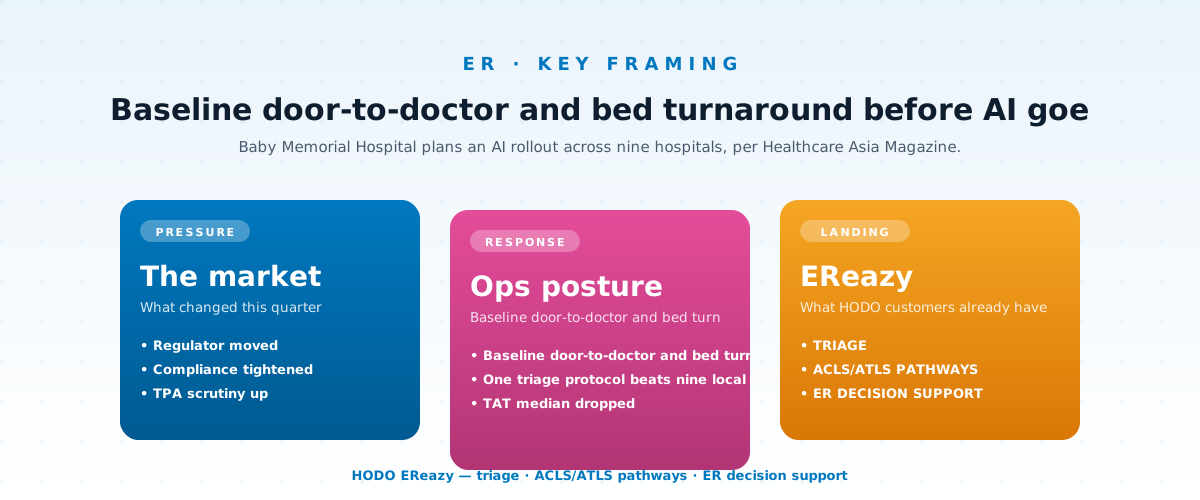
Before any AI deployment across multiple sites, five numbers should exist per unit and per shift: door-to-triage time, triage-to-doctor time, decision-to-admit time, bed turnaround time, and ER left-without-being-seen rate. Each should be pulled from the system, not estimated by the in-charge.
The value of the baseline is that it makes the rollout falsifiable. Six months in, the board can ask whether decision-to-admit time at the three weakest units has moved, and get an answer. Without a baseline, the review meeting becomes a discussion of impressions, and the project survives or dies on politics rather than evidence.
It also surfaces which units need process work rather than software. Frequently one or two sites account for most of the variance, and they need staffing or layout changes that no model will fix. Identifying them early keeps the rollout from being blamed for problems it was never going to solve.
Multi-site AI ambition is reasonable, but the sequence matters: capture discipline first, visibility second, intelligence third. EReazy is built around that sequence — Triage and role-tailored flows capture the clinical event as structured data while it is happening, the bed occupancy dashboard turns network capacity into a live operational view, and HIS-integrated billing keeps the admit-to-discharge-to-claim loop in one trail instead of three. ACLS/ATLS pathway decision support then has something consistent to work against. For groups adding units, Healzapp's Multi-outlet scale-up with one-click new-centre setup keeps the ninth site configured like the first, which is the whole point.
See how EReazy handles this — book a 30-min demo.
See how Healzapp, Labzapp and EReazy fit your speciality in a free 30-minute demo.
Book a Free Demo