The Economic Times has published a piece on the hospital balance sheet, arguing that AI could cut costs and lift efficiency across hospital operations. The argument holds, but the balance sheet is an unforgiving place to test it, because it records only what changed in rupees, not what was demonstrated in a pilot. For a 100-bed hospital, a clinic group or a lab chain adding AI as a digital USP, the narrower question is the useful one: which cost lines does AI actually touch, and what has to exist inside the organisation before it touches them at all?
Read the cost lines before choosing the tool
A 100-bed hospital in India carries a fairly predictable cost structure. Salaries and professional fees dominate. Pharmacy and consumables follow. Then come outsourced investigations, power and utilities, interest and depreciation on equipment, housekeeping contracts, and an administrative overhead that nobody has measured properly in years. Clinical staffing is not the place to look for AI savings in a 100-bed setting, because the roster is already thin and NABH expectations run the other way.
What remains is the administrative middle. Time spent assembling a single cashless claim file. Rework on denied or short-settled claims. Repeat phone calls chasing a TPA for a pre-authorisation that was answered and then forgotten. Discharge summaries that sit unsigned and delay a bill. Slow-moving pharmacy stock that was ordered because nobody remembered last quarter's consumption. Equipment whose AMC lapsed quietly and turned a service visit into a capital conversation. None of these are glamorous. All of them appear on the balance sheet, either as cost or as receivable ageing that eats working capital.
The discipline, then, is to list the ten recurring administrative tasks that consume the most staff hours in a month, attach a rough cost to each, and only then ask which of them a machine can carry. Operators who skip this step end up buying a model and reporting enthusiasm instead of savings.
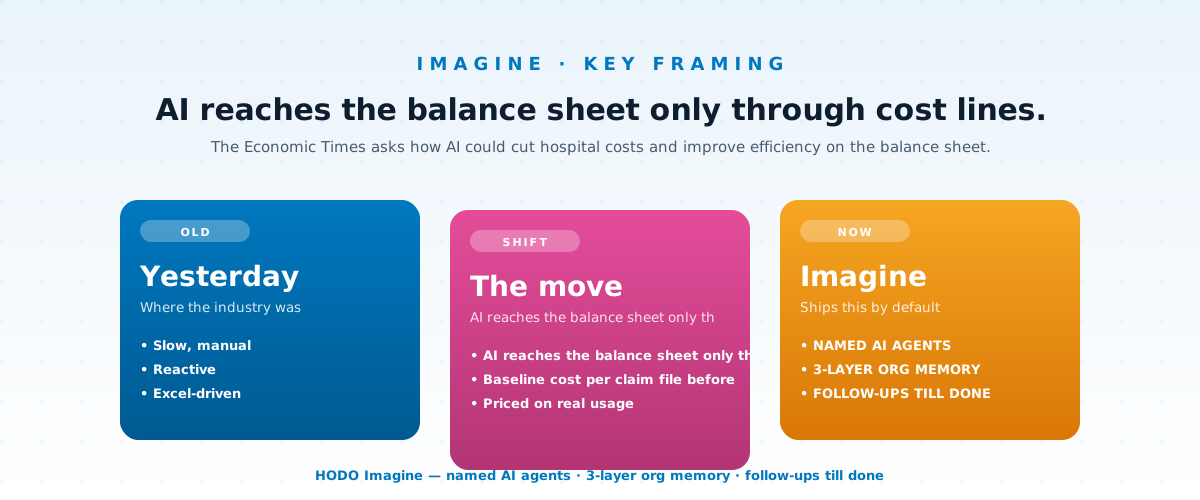
AI reaches the balance sheet only through cost lines.
Why hospital AI pilots stop short of the P&L
Most hospital groups in India have already run an AI pilot of some kind. Someone in billing uses a chatbot to draft appeal letters. A consultant dictates notes into a transcription tool. The quality team drafts policies with a general assistant. These are real productivity gains, and almost none of them survive contact with the next quarter.
The reason is structural rather than technical. The knowledge generated by those pilots lives in individual chat histories. When the billing executive who learned which TPA rejects which bundle of codes resigns, that learning leaves with her, and the next person rebuilds it from denial letters over six months. The pilot also has no owner in the organisational sense. There is a licence and an enthusiast, but no one is accountable for whether twenty-two pending pre-authorisations were followed up by Friday. Finally, there is no baseline. If nobody recorded the cost of assembling a claim file in March, the saving in September is a story, not a number.
This is the gap between AI as a tool and AI as organisational intelligence. A tool answers whoever is typing. Organisational intelligence remembers what the hospital learned, carries the task until it closes, and leaves a record that the finance team can audit. Only the second one reaches the balance sheet.
The cost lines that respond to institutional memory
Three categories respond fastest, and they share a trait: the cost comes from forgetting, not from a lack of intelligence.
The first is claim rework and receivable follow-up. Denials in Indian hospitals cluster around a small number of recurring causes per payer — missing implant invoices, an unsigned clinical note, a package mismatch, a late intimation. A system that retains every past denial reason by payer, by package and by consultant turns that history into a pre-submission checklist. The saving is not in writing a better appeal; it is in the claims that never get rejected, and in receivables that age in weeks rather than quarters.
The second is documentation and handover. Discharge summaries, referral replies, incident reports and NABH evidence files are all drafted repeatedly, in different voices, by staff who leave. A consistent voice and a retained template library cut drafting time and reduce the rewrite loop with consultants.
The third is procurement and asset discipline. Vendor rates negotiated last year, consumption patterns per department, warranty and AMC expiry dates, and which supplier delivered late during the monsoon are all facts the organisation owns and routinely loses. Holding them in one memory, rather than in one purchase manager's notebook, changes both the order quantity and the negotiating position.
Give the recurring work an owner, not a licence
The practical shift for an operator is to stop buying seats and start defining jobs. Name the agent that handles payer follow-up. Give it a written job — which payers, which ageing buckets, what to escalate, to whom, and by when. Give it a reporting line, so that its output lands with the billing head rather than in a shared folder. Then let it keep working on an item until the item closes, instead of answering once and going quiet.
That is the design of imagine: named AI agents with jobs, memory and reporting lines, sitting on top of the tools a hospital already pays for. It does not replace Microsoft 365, Copilot or ChatGPT. It connects them with memory, so that the context of a conversation in April is available in October. Its three-layer memory separates what is live today, what matters this week, and what the organisation should keep forever. Brand voice consistency keeps patient communication and payer correspondence sounding like the hospital rather than like a different assistant each time. The follow-up behaviour is the part finance notices, because an unclosed pre-authorisation is a cash problem, not an admin one.
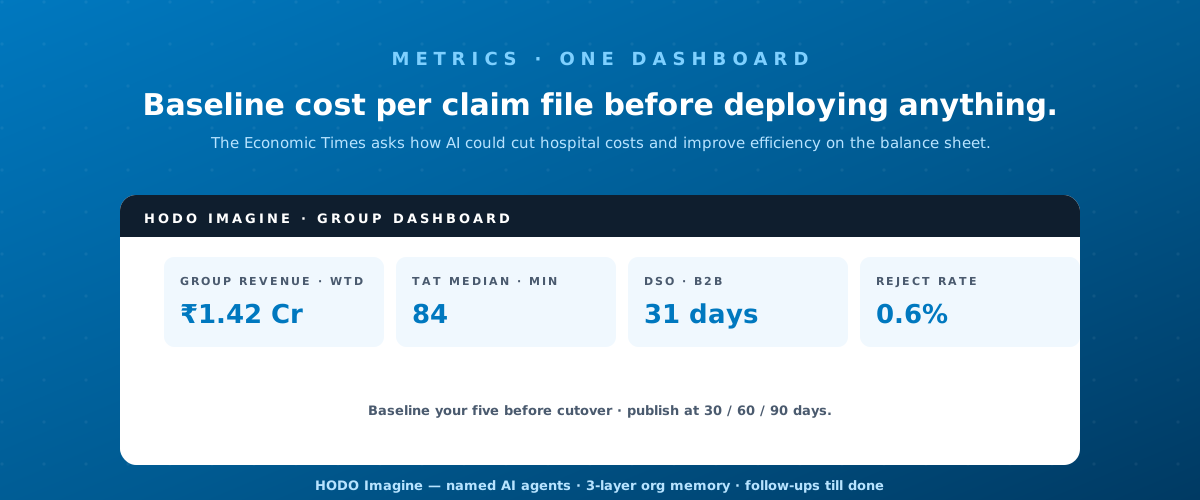
Baseline cost per claim file before deploying anything.
Measure it the way the CFO will
Any AI claim on the balance sheet should be defensible with four numbers. First, a baseline — staff hours and rupee cost per claim file, per denial appeal, per discharge summary, taken before anything is deployed. Second, the same number after ninety days. Third, the change in receivable ageing by payer. Fourth, the cost of the deployment itself, including the time senior staff spend supervising it.
Two more disciplines matter in India. Patient data handling under DPDP obligations must be settled before any clinical or billing text moves into an AI workflow, with a clear line on what leaves the hospital's systems. And every agent action needs an audit trail, because an accreditation assessor or an internal auditor will eventually ask who approved a document. Operators who run this measurement honestly usually find the savings are smaller than the vendor promised and more durable than they expected — which is exactly the profile a balance sheet rewards.
What this means for digital transformation
AI becomes a digital USP for a hospital or lab group only when the organisation, not the individual, owns what the AI learned. That is the difference between a clever pilot and a line item that improves. Named AI agents with jobs, memory and reporting lines put an accountable owner on recurring administrative work. 3-layer memory (today / this week / forever) keeps payer behaviour, vendor history and policy knowledge inside the institution when staff move on. Follow-ups until tasks close turn pending pre-authorisations and unsigned summaries from a monthly surprise into a tracked queue. The balance sheet effect follows from those three, in that order.
See how imagine turns AI into organisational intelligence — explore imagine.