Business Upturn reports that the Centre, in an affidavit before the Supreme Court, has flagged markups of up to 700% on cancer drugs and over 1,000% on consumables billed by private hospitals, with Apollo Hospitals and Max Healthcare shares in focus as the filing became public. The headline numbers will be argued over for months. The operational point for a 100-bed hospital is narrower and more urgent: the consumables line, not the drug line, is now the part of the bill that nobody can explain on demand.
The argument has moved from drugs to consumables
Drug pricing in India already has machinery around it. NPPA ceiling prices, scheduled formulations, trade margin rationalisation on selected oncology molecules, whatever one thinks of the enforcement, there is a reference price a hospital can point to. Consumables have far less of that. Syringes, cannulas, drapes, tubing, guidewires, sutures, gloves, dressing kits, catheters, stapler reloads and the long tail of OT disposables are mostly priced off a printed MRP that the distributor and the manufacturer set between themselves, with the purchase price landing somewhere far below it.
That gap is exactly what produces a 1,000% figure. A dressing kit bought at ₹40 and billed at ₹440 is not necessarily fraud; it may be an MRP-based billing rule that nobody revisited after the vendor changed. But a hospital that cannot produce the batch purchase price, the markup rule applied and the person who approved it is going to look the same as one that was profiteering. The distinction between a documented pricing policy and an undocumented one is becoming the whole argument, and most mid-sized hospitals currently have the second kind.
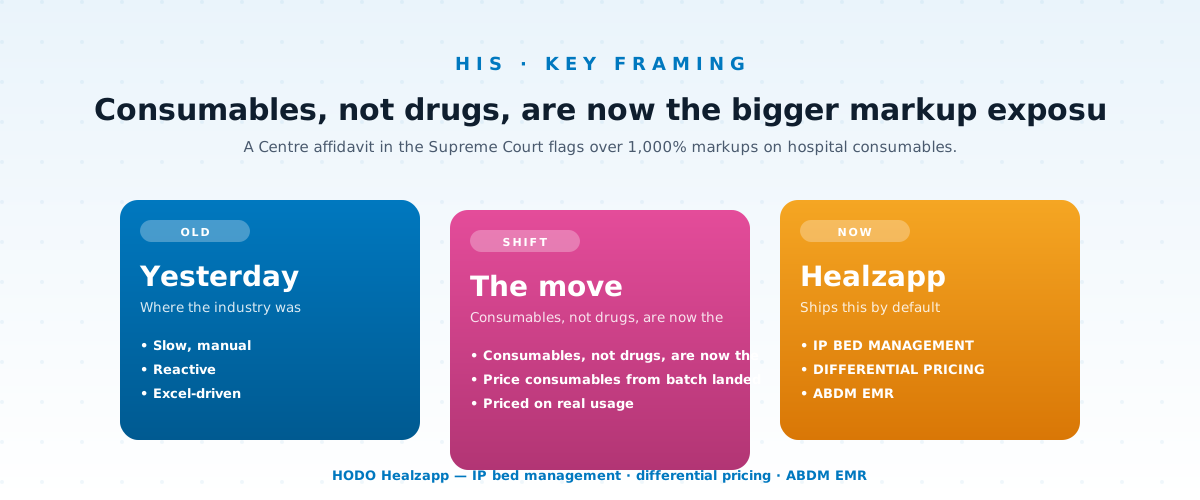
Consumables, not drugs, are now the bigger markup exposure.
Why the number is easy to produce and hard to defend
Anyone auditing a hospital bill can compute a markup percentage in two columns: what the item cost and what the patient paid. Hospitals struggle on the first column. In a typical ~100-bed setup, consumables enter through three or four doors, main stores, pharmacy, OT stores, and direct-to-ward purchases during stockouts, and only one of those doors reliably records a landed cost with batch, expiry and GST split. When the item is finally billed, the rate often comes from a chargemaster row created years earlier, carrying an MRP from a vendor who no longer supplies.
The result is that the markup on any given line is an accident of data entry rather than a decision. Two patients in the same ward, same procedure, same week, can be billed different rates for the same cannula because two different batches with two different printed MRPs were issued. When a TPA, a regulator or a consumer forum asks why, the hospital has no single answer to give. Costing discipline here is not an accounting nicety; it is the ability to answer a question that is now being asked in open court.
Where a 100-bed hospital actually loses control
Three leak points recur. First, the OT tray. Consumables are pulled for a case in bulk, partially used, partially returned, and reconciled from memory at the end of a shift. Unused items get billed, used items get missed, and the case-level consumable cost is never trustworthy enough to build a package rate on. Second, ward floor stock. Dressing material and IV sets sit in a cupboard with no issue record against a patient, so the ward consumes against nobody and the shortfall surfaces as a stores variance at month end. Third, emergency purchases. A stockout at 2 a.m. gets solved by a cash purchase that enters the system as an expense, never as a priced stock item, so the next hundred issues of that item are billed at whatever the old row says.
Each of these is a workflow problem before it is a pricing problem. Indent, issue, return and charge have to be the same transaction chain, with the patient ID attached at the point the item leaves the shelf. Hospitals that have closed this loop can tell a consumable cost per case within a few rupees. Hospitals that have not are arguing about markup percentages computed from two unrelated systems.
A consumables chargemaster needs tariff-grade discipline
Rate transparency work over the past two years has mostly gone into procedure and room tariffs. The consumables master has been left alone because it is long, boring and changes constantly. That is where the exposure now sits. A workable approach has four parts: price off batch landed cost rather than printed MRP; set markup slabs by category, with a declared ceiling, rather than item-by-item discretion; make rate changes a logged, approved event with an effective date; and keep one master used by pharmacy, OT, IP billing and the stores so the same item cannot carry two prices.
Differential pricing then becomes a deliberate instrument rather than a loophole. A cash patient, a corporate panel, a PMJAY beneficiary and an insurance case can legitimately attract different consumable rates where the package, the discount agreement or the scheme rules require it, provided each rate traces back to the same base cost and a named agreement. The problem is never that a hospital has multiple price lists. The problem is multiple price lists nobody can reconstruct.
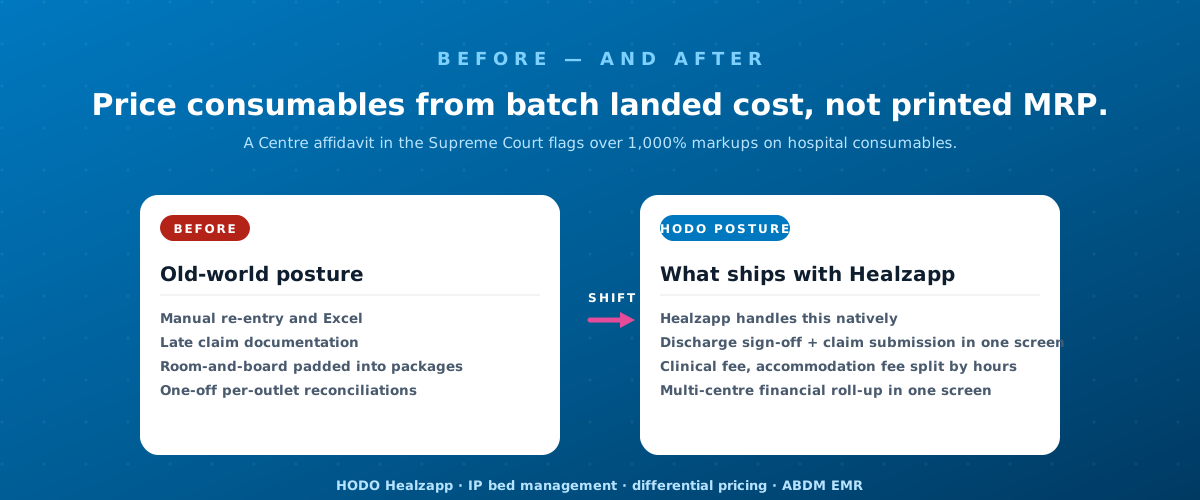
Price consumables from batch landed cost, not printed MRP.
The payer side will move before the regulator does
Insurers and TPAs read the same affidavit. Consumables and "non-medical items" are already the most-deducted part of a cashless claim, and a Supreme Court-level spotlight gives claims teams cover to tighten further. Expect sharper queries on consumable line items, more demands for purchase invoices against high-value disposables and implants, and quicker disallowance where the billed rate cannot be tied to a batch. For PMJAY and state scheme cases, the package already absorbs most consumables, so every untracked ward issue is pure cost leakage with no billing upside at all.
The cashflow effect is mechanical. A hospital doing ₹4-5 crore a year of consumable billing with a 6-8% deduction rate on that line is writing off a sum comparable to a consultant's annual cost, mostly on documentation grounds rather than clinical ones. Fixing the trail recovers more than any renegotiated markup would. And a hospital that can attach a landed-cost-to-bill audit trail to a claim file gets its queries closed faster, which is the actual working-capital win.
What this means for HODO customers
Consumables control is an inventory problem wearing a billing costume. Inventory in HODO Healzapp carries batch, expiry and landed cost from goods receipt through to patient issue, so the cost column in any markup calculation is real rather than reconstructed. Pharmacy and IP billing draw from the same item master, which removes the two-prices-for-one-cannula problem, and OT issues post against the case rather than against a store. Differential pricing keeps scheme, corporate and cash rates as declared rules tied to one base cost, with the change history intact. For asset-linked disposables, Warranty+AMC asset tracking keeps the equipment and consumable relationship documented. None of this changes what a hospital chooses to charge. It changes whether that charge can be explained in one screen when a TPA, an auditor or a court asks.