The Economic Times reports that the Centre has asked the National Pharmaceutical Pricing Authority to submit a report on high markups charged on hospital consumables, the syringes, cannulas, dressings, catheters, gloves and tubing billed alongside a procedure rather than sold as a listed drug or device. The jurisdiction of that referral is Indian. The question behind it is not. In Dubai, Abu Dhabi, Doha, Kuwait City and Manama, the same question gets asked every working day, only by an insurance adjudicator rather than a price regulator.
What the consumables review is actually asking
Price control in hospital supply chains has historically targeted the visible, high-ticket items, cardiac stents, orthopaedic implants, a handful of devices where a single unit carries a large spread. Consumables are the opposite shape: low value per unit, very high volume, consumed in rooms where nobody is holding a barcode scanner, and billed in a line item most patients never question. The referral reported by the Economic Times is essentially a request for evidence on that spread, what the facility paid, what the patient was charged, and whether the difference has any structure to it.
The operational reading matters more than the regulatory one. A markup on a consumable is not automatically indefensible. It absorbs storage, expiry write-off, cold chain where applicable, sterile handling, wastage on partially used packs, and the nursing time to stock and reconcile. The problem is that most facilities cannot show any of that. When a clinic cannot produce a purchase price, an issue record and a patient attribution for a single dressing pack, the margin stops looking like cost recovery and starts looking arbitrary. That is true in Kochi and it is equally true in Al Barsha.
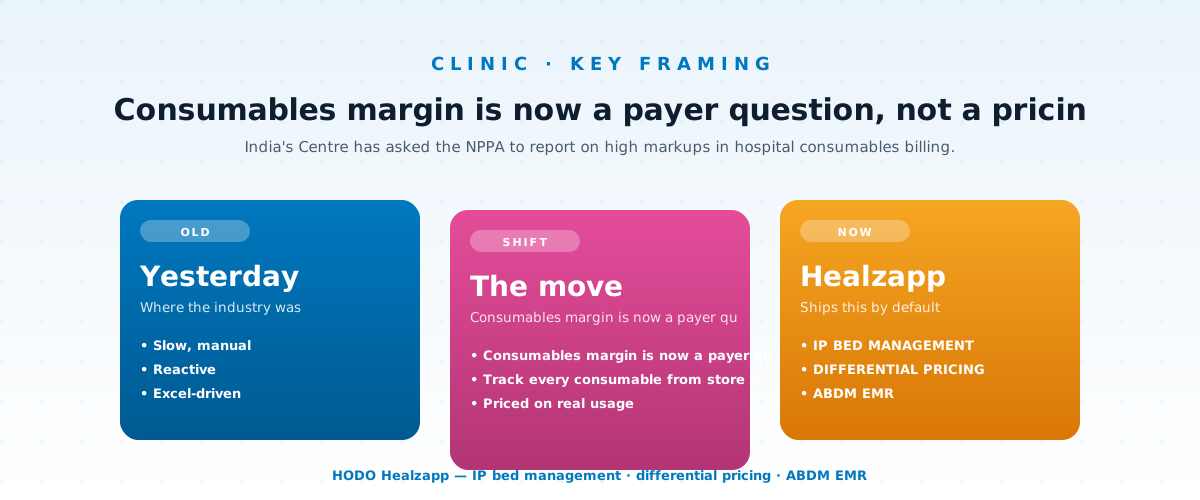
Consumables margin is now a payer question, not a pricing one.
In the Gulf, the auditor is the insurer
There is no NPPA equivalent across the GCC, and importing that framing wholesale would be wrong. Consumables pricing in the UAE, Qatar, Kuwait and Bahrain is governed by a different mechanism: payer contracts, licensing-authority tariff schedules, coding rules, and the claim adjudication process that sits between a polyclinic and its revenue. The effect on a clinic's books, though, converges on the same place.
Most GCC payer contracts take a position on consumables. Some items are bundled into the procedure code and cannot be billed separately at all. Some are reimbursable only with a quantity cap or a documented indication. Some are payable at a contracted rate that differs from the clinic's cash price. A polyclinic that bills a separately-charged consumable against a bundled code does not get a warning letter, it gets a rejected line, and if the pattern repeats, a post-payment recovery after a sample audit pulls twelve months of claims.
This is why the Indian consumables story deserves attention from a Gulf operator who has no regulatory exposure to it whatsoever. Both systems are converging on the same demand: show the chain from procurement to bill. The Indian version arrives as a government report. The Gulf version arrives as a claim denial with a reason code. The record a clinic needs to produce is identical.
The margin leak lives between the store and the bill
Consumables leak in two directions, and most polyclinics only worry about one of them. The visible risk is over-billing, charging for items that were bundled, or applying a retail markup to an insured patient whose contract says otherwise. The invisible and usually larger loss is under-capture: consumables that were genuinely used on a patient and never made it onto any bill at all.
The mechanics are mundane. A nurse opens a suture pack in the minor procedure room at the end of a busy afternoon. The doctor uses two of three units. Nobody writes anything down, because writing it down means walking to a different screen after the patient has left. At month end, the stock count is short, the shortfall gets written off as wastage, and the cost per patient for that procedure quietly rises. Repeat that across dressings, lignocaine vials, ECG electrodes, ultrasound gel and cannulas at four or five outlets, and the number stops being rounding error.
Reconciling issue registers against a monthly physical count is far too late a control. By then the encounter is closed, the claim is submitted, and there is no patient to attribute the item to. The only point at which a consumable can be priced correctly and captured completely is the moment of use, inside the same workflow the clinical staff are already in.
Multi-doctor clinics make attribution harder
A single-doctor clinic can get away with imprecision. A polyclinic cannot. One shared procedure room serves a GP, a dermatologist and an orthopaedic consultant on the same afternoon, each with different patients, each patient potentially on a different payer contract, plus self-pay patients billed at retail. The same cannula legitimately carries three different prices in one hour. Asking a receptionist to remember which is which, from a printed rate sheet, is a control that fails quietly and constantly.
Machine-linked consumables add a second layer. Reagents, cartridges, electrodes and films are consumed per test, at a rate that is knowable from the device itself rather than from a nurse's memory. When test volumes are read from the analyser and consumable draw-down is not, the cost per test drifts away from reality and pricing decisions get made on stale numbers.
Multi-outlet groups compound this again. A branch that negotiated a better local supplier rate should see that reflected in its cost of delivery, but not in a different billed price to the same insurer, unless the contract actually allows it. Without a shared item master and a single pricing rule set, each new outlet invents its own version of the truth within a quarter.
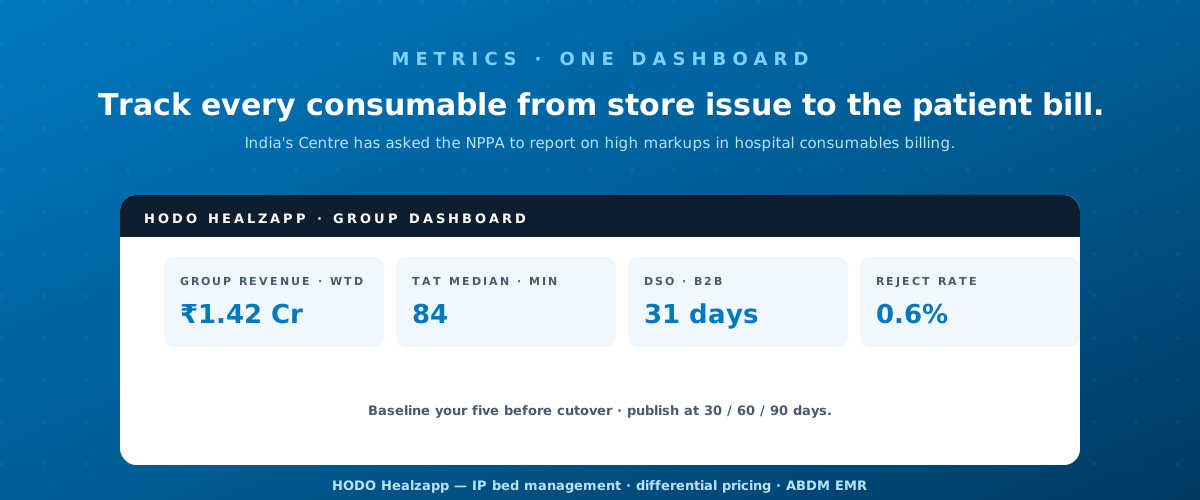
Track every consumable from store issue to the patient bill.
Build the audit trail before anyone asks for it
A defensible consumables record has five links, and they need to hold together months after the fact: the purchase price with batch and expiry; the issue from central store to a named department or room; the attachment of that item to a specific patient encounter; the price applied from the correct payer contract rather than from a default; and a query path that reconstructs all four on demand when an auditor, a regulator or a board member asks.
Clinics that already have this chain treat pricing scrutiny as a reporting exercise. Clinics that do not treat it as a crisis, because assembling the evidence manually across purchase files, stock registers and claim exports takes weeks of finance time that was budgeted for something else. The difference is not diligence. It is whether the record was captured as a by-product of normal work or has to be reconstructed after it.
What this means for HODO customers
HODO Healzapp handles consumables as part of the clinical and billing flow rather than as a separate stores exercise. Inventory tracks items from purchase through batch and expiry to issue and point-of-use consumption, so cost per procedure reflects what was actually used rather than what the monthly count implies. Differential pricing applies the correct rate per payer, corporate partner or self-pay category automatically at billing time, which removes the front-desk judgement call that generates most rejected lines. Billing (incl. multi-currency / GCC patterns) keeps that pricing aligned with local payer and tariff structures across UAE, Qatar, Kuwait and Bahrain operations, and Multi-outlet scale-up with one-click new-centre setup carries the same item master and pricing rules into a new branch instead of letting each outlet build its own.