
Express Healthcare's year-end review, "India's transformation of the hospital sector: Looking back in 2025 and a route to the USD 200 billion healthcare market", puts a number on what most operators already sense: the domestic hospital opportunity has doubled in a decade and will double again. The piece argues that scale, technology adoption and financing reforms — not new beds alone — will decide who captures it. For a hospital MD reading it in Trivandrum, Nashik or Guwahati, the practical question is narrower: which parts of the operation must be re-plumbed before the next expansion?
The market-size number is comforting until you back into what it demands per hospital. Doubling revenue without doubling headcount, real estate or working capital means every bed has to turn faster, every OP slot has to be filled with less lag, and every claim has to reach the TPA without a manual chase. That is a productivity target masquerading as a market forecast. Hospitals that grew to 200-300 beds on a mix of Excel, Tally and a lightweight HIS are already hitting the ceiling — the bottleneck shows up as billing queues at discharge, uncollected co-pays and consultant-utilisation numbers no one can pull on demand. The gap between the current-state HIS and what the coming five years demand is where the important vendor decisions of 2026 will get made.
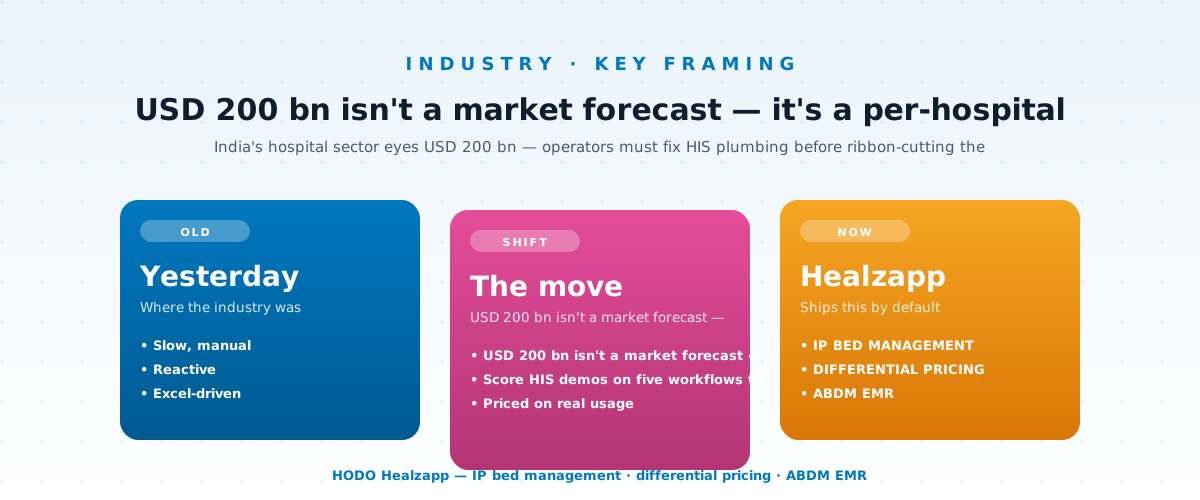
Three shifts landed in 2025 and will compound through 2026. First, ABDM adoption crossed the threshold where refusing to issue an ABHA-linked record starts to look eccentric rather than cautious; corporate patients ask for it, and insurers increasingly want the discharge summary in a machine-readable form. Second, TPA cashflow tightened as insurers pushed back harder on incomplete documentation — the cost of a missing investigation report in a claim file is now visible in the finance MIS every month. Third, multi-outlet chains overtook standalone hospitals as the fastest-growing segment, which means group-level dashboards (bed occupancy, TAT, receivables aged by outlet) went from nice-to-have to a board-review artefact. A stack that cannot roll up numbers across outlets in near-real-time is quietly costing money each quarter.
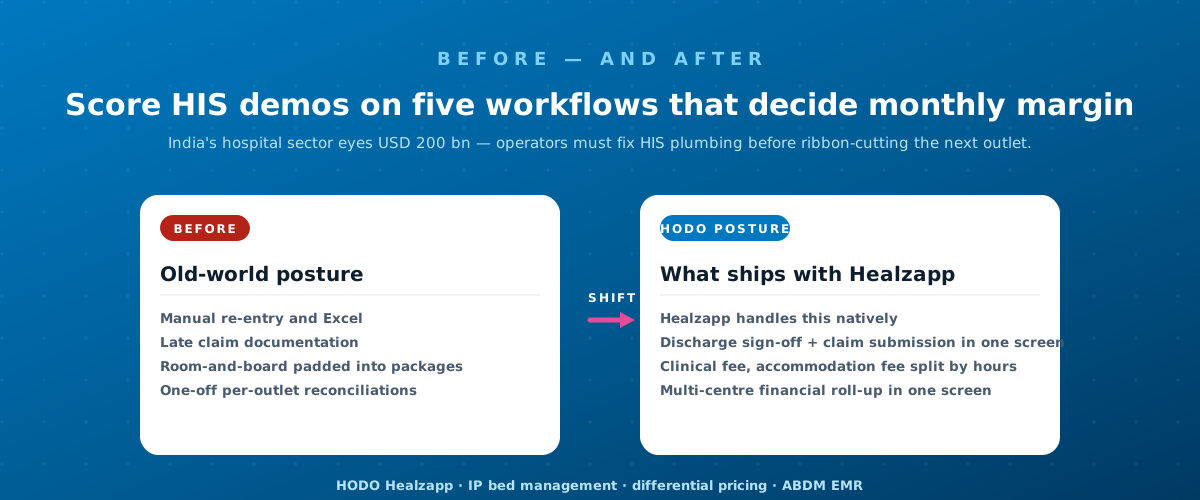
Vendor pitches will keep improving. The buyer-side discipline that helps: strip the demo down to five workflows that decide margin. One, patient registration to first billing at OPD — how many clicks, and does the counter clerk need three tabs open? Two, IP discharge to final bill — can pharmacy, investigations and consultant fees close within an hour, or does the patient wait at the counter? Three, insurance pre-authorisation and claim submission — is the packet auto-assembled from the EMR, or does a coordinator re-key data? Four, inter-outlet patient movement — does the second centre see the first centre's investigations, or does the patient repeat the CBC? Five, month-end MIS — does the CFO get gross margin per specialty without an analyst rebuilding the pivot? A vendor that cannot demo these five without a "custom development" caveat is not ready for a 200-bed operator.
The romantic view of chain growth is a new city and a ribbon cutting. The unglamorous view is master data. A second outlet doubles the number of doctor codes, service codes, pharmacy SKUs and tariff cards that have to stay in sync. A third outlet quadruples the reconciliation errors if the HIS treats each site as an island. Chains that scale cleanly have three ingredients in place before the second site opens: a single patient identifier that survives across outlets, a differential pricing engine so the corporate-partner tariff at Site A is the same as at Site B, and a one-click new-centre setup that clones the parent configuration instead of rebuilding it. Skip these and every new outlet adds two months of parallel-running plus a permanent SPOC in the finance team.
ABDM compliance is often framed as a regulatory chore. Operators who have completed the integration describe it differently — as a forcing function that cleaned up patient master data, standardised discharge summaries and made insurance packets faster to assemble. The cashflow effect is measurable: TPAs process cleaner claims faster, and the days-sales-outstanding on the insurance receivable book falls. For a 200-bed hospital carrying six to eight crores in outstanding TPA money at any time, a ten-day reduction in DSO is genuine working capital freed up. The same logic applies to WhatsApp and SMS report delivery — every report that reaches the patient without a phone call from the front desk is a cost avoided and a repeat visit made easier to book.
The Express Healthcare piece frames the USD 200 billion market as a race; the operational reality is that most of the race is won by cleaning up plumbing before the next site opens. HODO Healzapp is built for the operator asking the five workflow questions above. The Multi-outlet scale-up with one-click new-centre setup collapses the six-week configuration exercise that usually accompanies a new site into a repeatable template — doctor codes, tariff cards and pharmacy SKUs inherit from the parent. Differential pricing handles the corporate, TPA and cash-tariff variations that used to live in the finance team's head, so a corporate patient sees the correct rate at every outlet from day one. And the ABDM-compliant EMR gives the discharge summary format that insurers now expect, cutting coordinator time spent assembling claim packets each week.
See how HODO Healzapp handles this — book a 30-min demo.
See how Healzapp, Labzapp and EReazy fit your speciality in a free 30-minute demo.
Book a Free Demo