Karnataka has asked the Centre to step in after inspections found private hospitals billing drugs and consumables at up to 52 times their procurement cost, The Indian Express reported. The state wants a cap mechanism that applies to in-hospital dispensing, not only to retail pharmacy shelves. For a 100-bed hospital in Hubli, Kochi or Nagpur, the practical question is not whether such a cap eventually arrives, but whether the billing system can show, line by line, what a drug cost to buy and what the patient was charged.
What Karnataka has actually asked for
The state's letter follows a pattern that is now familiar across Indian health administration: a complaint-driven audit of private hospital bills, a sample of extreme markups, and a request for central price regulation because the state's own powers under clinical establishment rules stop at display boards and rate cards. NPPA ceilings already cover scheduled formulations. What they do not cover well is the long tail that fills an in-patient bill, non-scheduled brands, surgical disposables, IV sets, catheters, implants, sutures, dressings and the general consumable basket that a ward consumes without the patient ever seeing an item name until discharge.
State action usually lands before any central notification. Expect inspection drives, mandatory rate-card display, and a demand that hospitals produce purchase invoices against billed items on short notice. That sequence has played out with room tariffs, with COVID-era package rates and with implant pricing. The hospitals that came through those episodes without penalty were not the ones with the lowest margins. They were the ones that could pull a batch-level purchase trail for a disputed bill within the same working day. That capability is a systems question, not a pricing-policy question, and it is the part a management team can actually control this quarter.
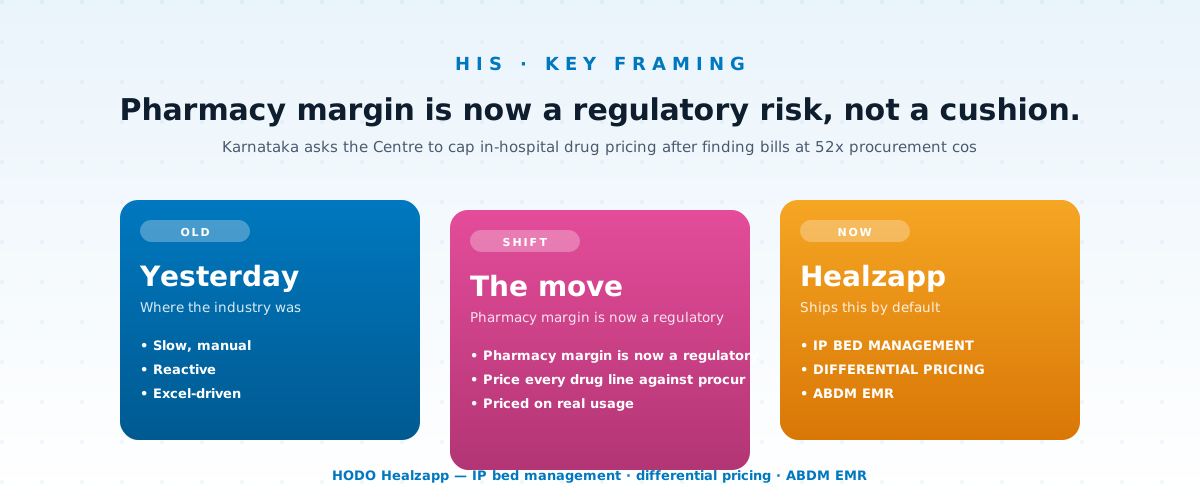
Pharmacy margin is now a regulatory risk, not a cushion.
Why the markup sits at the pharmacy counter
Nobody sets out to charge 52 times cost. The number is an outcome of how Indian hospital P&Ls have been forced to work. Consultation fees are compared openly and held down by the clinic next door. Room rents are now visible on aggregator listings and get negotiated by patients before admission. Procedure and surgery rates for a large share of volume are fixed by TPA contracts and scheme tariffs that the hospital did not set. Pharmacy and consumables are the one line where the hospital still has discretion, because the patient cannot price-compare an item they did not choose and will not see until the final bill prints.
So pharmacy and consumables routinely carry the thickest margin of any line on an in-patient bill, and that margin quietly funds the rest of the hospital, nursing salaries, equipment AMC, the diagnostic block running below break-even, the deficit on scheme patients. When regulators read that margin as profiteering and hospitals read it as cross-subsidy, both are describing the same arithmetic from different ends. A cap does not remove the underlying cost; it moves the recovery problem somewhere the hospital has not yet modelled. Hospitals that cannot see cost per patient per payer will discover the gap only when the cash stops arriving.
What TPA and scheme rates did to the maths
The cross-subsidy is sharpest where payer mix is lopsided. A PMJAY or state-scheme package pays a bundled amount that includes drugs and consumables, settles weeks or months later, and often sits below the hospital's actual consumption cost for a complicated case. A corporate TPA contract discounts the tariff and then disputes the consumable lines in the claim. The cash patient, billed at list, absorbs the difference. That is why two patients in adjacent beds, on the same clinical pathway, can show wildly different realisation per bed-day, and why a hospital that only tracks revenue per bed, not margin per payer, cannot answer a regulator or a board with any confidence.
A price cap on in-hospital dispensing compresses the only flexible line in that structure. The response cannot be a uniform markup cut, because that would push scheme work further underwater. It has to be payer-specific pricing that is defensible: a documented list rate, a documented contract rate per TPA and scheme, procurement cost visible against each, and an approval trail for any deviation. Hospitals running these as spreadsheets maintained by a billing supervisor will not survive a serious audit, because the spreadsheet cannot prove what rate was live on the date of the disputed bill.
A cap regime is a billing-engine problem
Translate the policy risk into system requirements and the list is short but unforgiving. Every drug and consumable master item needs a purchase rate carried from the goods-receipt entry, not a typed-in guess. Selling price needs to be derivable from that cost by a rule the hospital can state out loud, with separate price lists per payer category rather than one list and manual discounting at the counter. Counter staff should not be able to override a rate silently; overrides need a reason code and a named approver. And the rate that applied on a given date must be reconstructable months later, because that is precisely what an inspection asks for.
The second requirement is the consumption loop. Ward indent, nursing-station administration, returns of unused stock and the item lines on the IP bill have to be the same records, not three systems reconciled at month end. Most inflated-bill findings in India are not deliberate overcharging at all, they are unreturned issues, duplicated indents and consumables billed to a bed rather than a patient. A hospital that closes this loop usually finds its real markup is far lower than the inspection sample suggests, and it can prove it. That evidence is worth more than any argument about whether the markup was justified.
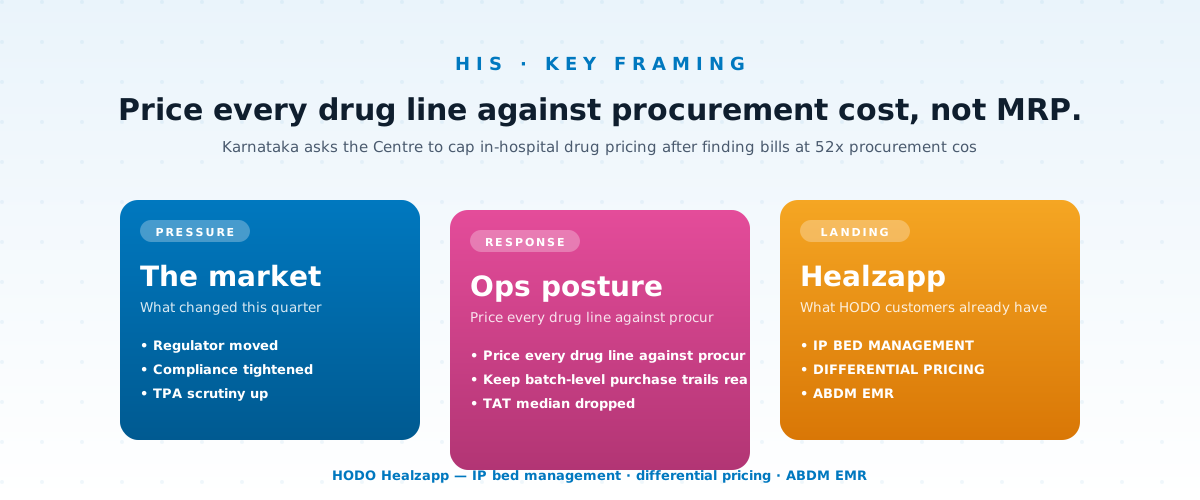
Price every drug line against procurement cost, not MRP.
What this means for HODO customers
This is a module-level fix, not a policy debate. In Healzapp, Pharmacy and Inventory carry batch-wise procurement cost from receipt through ward indent to the patient bill, so the purchase rate behind every billed line is retrievable rather than reconstructed. Differential pricing holds separate rate structures per payer, cash, corporate TPA, scheme, referral and corporate-partner logins, so compressing one price band does not silently drag the others down. Billing keeps the IP and OP bill tied to the same consumption records the nursing station created, which is where inflated-bill findings usually originate. Tally integration closes the loop to accounts, so the margin the finance team reports and the margin a state inspector computes from bills come from one source. Hospitals running multiple outlets get the same masters and price logic at every centre instead of per-unit improvisation.
The hospitals that will handle a cap calmly are the ones that already know their cost per patient per payer today. That number is not produced by a pricing committee; it is produced by a system where procurement, consumption and billing are the same chain of records.