The Financial Express reports that rapid expansion is denting the margins of India's hospital chains, as fast bed additions and new-unit launches run ahead of the revenue those beds actually generate. For a listed chain that shows up as compressed quarterly EBITDA; for a ~100-bed hospital or a three-branch lab chain it shows up as a unit that has been "about to break even" for four quarters running. The arithmetic is the same at both scales — expansion margin is decided inside each new unit, not by the size of the round that paid for it.
Bed capacity is not bed productivity
A new bed carries its full fixed cost from day one. Rent or interest, the nursing roster, housekeeping, biomedical maintenance, licence compliance and the minimum consultant retainer all start immediately. Revenue, on the other hand, ramps over 18 to 30 months while the referral base, empanelment and specialty mix build up. That lag is the margin dent. A chain with ten mature units can absorb it; a single 100-bed hospital adding a 30-bed block or a second branch cannot.
The controllable variable is time-to-productivity, and occupancy is a poor way to track it because it is a lagging number. Operators who ramp faster watch daily measures instead: discharge-by-noon percentage, bed turnaround time from discharge to the next admission, how many admissions were scheduled versus walk-in, OT slot utilisation against slots released, and OP-to-IP conversion by consultant. A 100-bed hospital running at 68% occupancy with a six-hour bed turnaround is effectively a 90-bed hospital that paid for 100. Recovering two hours of turnaround across a 20-discharge day adds real bed-days without a single rupee of capex — and it is the cheapest capacity any expanding operator owns.
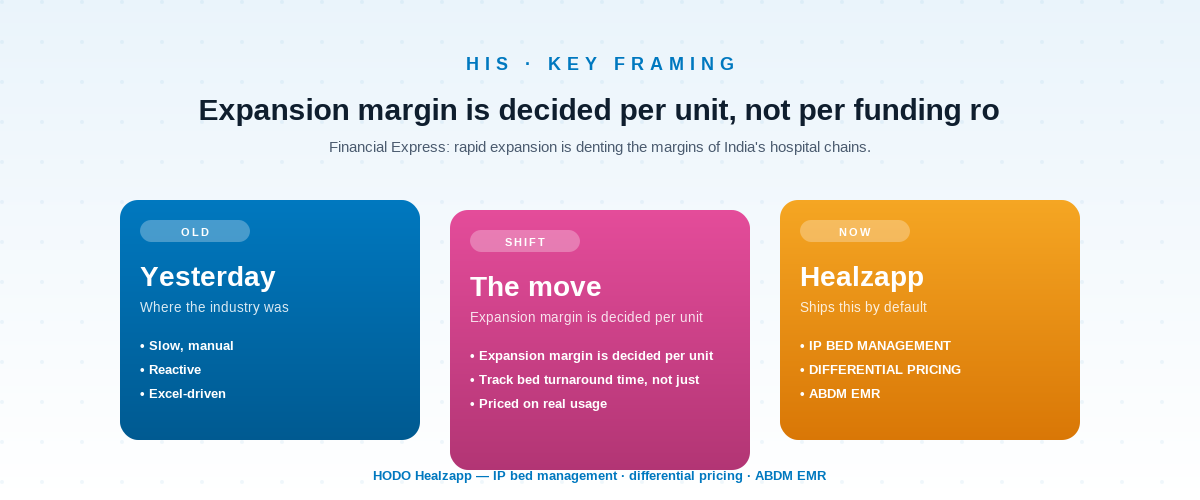
Expansion margin is decided per unit, not per funding round.
Where the second unit quietly leaks money
Most expansion leakage is not clinical, it is administrative, and it clusters in four places. First, inventory. A second site means a second pharmacy and consumables store, usually with its own purchase pattern and no consolidated visibility. The predictable result is overstock at one branch, stock-outs at the other, and expiry write-offs that nobody attributes to expansion.
Second, assets. Equipment bought during a launch is under warranty, then slides into paid repairs because no one tracked when the warranty ended or whether an AMC was renewed. For a new unit, two or three unbudgeted service calls can wipe out a month of contribution.
Third, tariffs. Price masters and package definitions get copied by hand into the new unit, then drift. Under-billed consumables, stale package rates and manually approved discounts are hard to detect because the units report separately.
Fourth, staffing. New units over-staff because there is no baseline to staff against. Without per-unit numbers on OP footfall per registration counter, samples per phlebotomist or billing transactions per cashier, the roster is set by anxiety rather than throughput. Each of these is individually small. Together they are the difference between a unit that breaks even in year two and one that does not.
Payer mix decides how fast you can expand
Expansion is a working-capital event before it is a revenue event. When a large share of IP revenue sits with TPAs, PMJAY or state schemes and corporate accounts, the new unit's cash burn is effectively funded by the mature unit's receivables. If the claim cycle stretches by three weeks during a launch — and it usually does, because the new unit's documentation discipline is immature — the whole group feels it.
Three practices separate chains that expand on their own cash from those that keep going back for more. One, treat pre-authorisation as a managed queue with an owner and an ageing report, not as paperwork the ward clerk handles between admissions. Two, make the discharge summary claim-ready at discharge, which means structured diagnosis coding, investigation records and implant or consumable details captured in the EMR rather than reconstructed a week later. Three, code denial reasons and review them monthly; most denials in an expanding unit repeat, and three fixed causes often explain the majority.
It also helps to split the metric. Days-to-bill is an internal discipline problem and fully controllable; days-to-collect is a payer problem and only partly controllable. Chains that report them as one number cannot tell which one is actually hurting the new unit.
Standardise the rollout, not just the signage
The most expensive way to open a second or third centre is to treat it as a fresh IT project. Separate HIS instances per site, masters rebuilt by hand, local Excel workarounds and divergent report formats produce the one thing an expanding operator cannot afford — numbers that are not comparable across units. If branch two defines a package differently from branch one, group-level cost per bed-day and cost per test become estimates rather than facts.
A standard rollout means shared service and price masters with controlled local variation, role templates so a new receptionist or nursing station is configured rather than trained from scratch, analyser integrations re-used instead of re-engineered, referral-doctor and corporate-partner access switched on from day one so the new catchment starts feeding the unit immediately, and finance posting into the same ledger structure so the group P&L does not need a monthly reconciliation exercise. The target is a new centre live in days with the parent unit's configuration intact — and more importantly, a monthly report where unit three sits in the same table as unit one, on the same definitions, with the same cost lines.
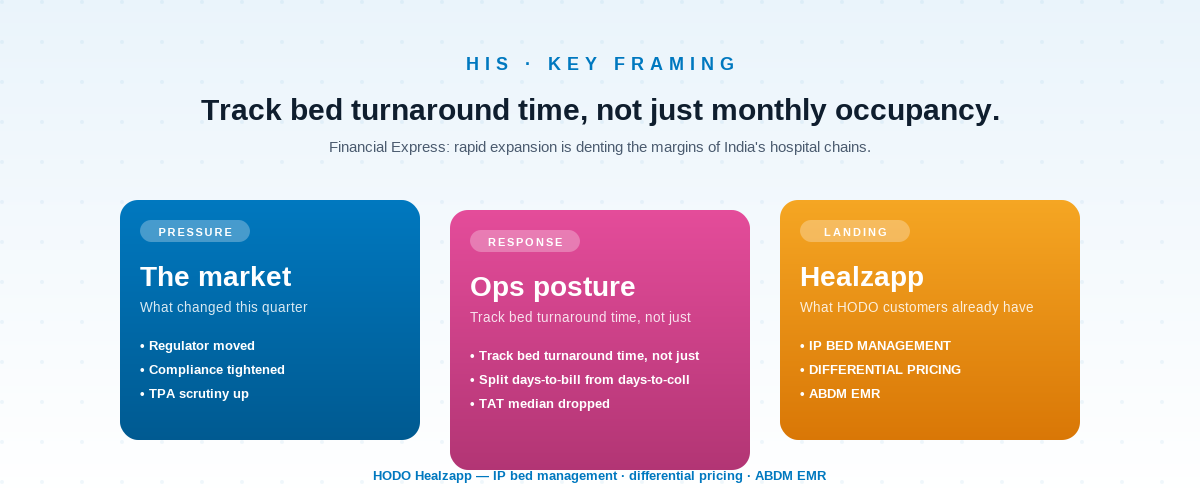
Track bed turnaround time, not just monthly occupancy.
What this means for HODO customers
HODO Healzapp is built around the assumption that a hospital will add beds, specialties and branches, so the scale-up mechanics are part of the system rather than a services engagement. Multi-outlet scale-up with one-click new-centre setup clones an existing unit's configuration — masters, roles, tariffs, report formats — so a new branch opens on proven settings and reports on identical definitions from the first day. IP bed management gives the live occupancy and turnaround view that converts bed capacity into bed-days, with nursing station and OT flows connected to the same record. Warranty+AMC asset tracking closes the quiet leak in newly equipped units by keeping warranty expiry and service contracts visible before the first paid repair. Add Differential pricing for payer- and partner-specific rates, and the tariff drift that erodes new-unit realisation stops being a manual control.
Expansion does not have to dent margin. It dents margin when each new unit is run as a separate business with separate data. See how Healzapp handles this — book a 30-min demo.