Medical Buyer's recent piece, Scale alone will not power India's next hospital growth cycle, makes a blunt argument: bed addition has stopped being a differentiator, and the next cycle will reward operators who run the capacity they already own much harder. For a 100-bed hospital in a tier-2 city, or a four-centre lab chain feeding it, that changes the planning question entirely. The question is no longer how many beds to add, but how much throughput each existing bed, OP chair, OT slot and analyser is actually producing — and most of that answer is sitting unread inside the HIS.
Capacity has stopped being the scarce resource
Through the last expansion decade, the growth formula was simple enough: add a block, add beds, add a branch, and volume followed. That formula is wearing out. In most district and tier-2 markets, the constraint is no longer physical capacity — it is the number of patients the hospital can move through that capacity in a working day, and the share of that work that converts to collected cash rather than ageing receivables.
This matters because the cost of the two strategies is nothing alike. A new 30-bed block is a multi-crore commitment with a long ramp. Lifting average occupancy from 62% to 72%, or cutting average OP waiting time by eighteen minutes, needs no construction at all — it needs discharge discipline, slot design and a billing desk that is not waiting on paperwork. Hospitals that have run both experiments usually find the second one pays faster and carries far less risk.
The catch is measurement. Occupancy, throughput and TAT are only levers if they are visible daily at the level where decisions get made — ward, department, centre — rather than as a monthly figure reconstructed in a spreadsheet after the month has closed. That visibility is a systems property, not a management-intent property.
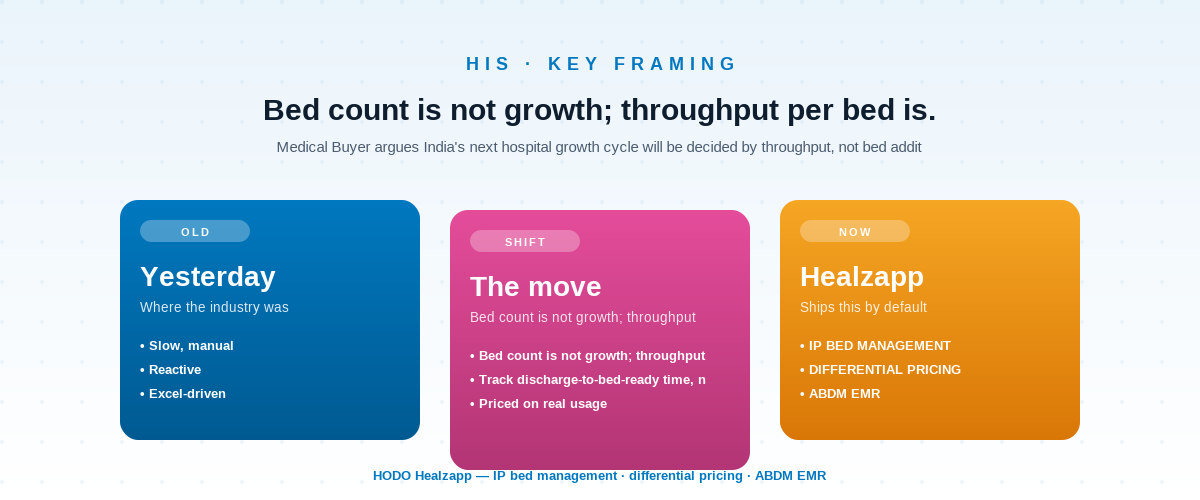
Bed count is not growth; throughput per bed is.
Occupancy is a lagging number; discharge timing is the lever
Monthly average occupancy is one of the least actionable numbers in hospital reporting. It tells an operator what happened, not what to do on Tuesday at 11 a.m. when three admissions are waiting and two patients are clinically fit for discharge but still occupying beds because the discharge summary, pharmacy return and final bill have not closed.
The operational metric that actually moves occupancy is discharge-to-bed-ready time, measured per ward. In many ~100-bed hospitals this sits between four and seven hours, often because the bill cannot be finalised until pharmacy issues and consumables are reconciled by hand, and the nursing station has no way to flag a bed as cleaned and available. Each hour of that lag is a bed-hour that cannot be sold, and it compounds across every ward every day.
Compressing it is not a clinical project. It is a sequencing project: the discharge summary drafted from the EMR rather than typed fresh, consumables already posted against the admission as they were issued, the final bill assembled rather than compiled, and bed status updated by the ward instead of by phone call to reception. Hospitals that fix this sequence routinely free up the equivalent of several beds without touching a wall — and they can show the lender exactly how.
OP throughput is a scheduling problem before it is a doctor problem
The common diagnosis for crowded OP is that more consultants are needed. Often the real problem is slot design and arrival management. Where appointments are nominal and most patients walk in, the department absorbs a front-loaded morning rush and then runs idle after 1 p.m., while the consultant's effective consultation time gets eaten by repeated history-taking that the records should have supplied.
Three corrections usually do more than an extra consultant. First, real slotting with differential slot lengths for new versus review patients, so that a 20-minute new case is not fighting a 7-minute review for the same gap. Second, a token and display discipline so that patients know where they stand and stop crowding the corridor to hold their place — queue anxiety is itself a throughput tax. Third, condensed prior history available at the start of the consultation, so the consultant is reading rather than reconstructing.
For hospitals running a doctor-at-home or teleconsultation line alongside OP, the same slot grid has to carry both, or the two channels will quietly double-book the same consultant. That is a single-calendar requirement, and it is one of the clearest tests of whether a HIS can support growth or will cap it.
Receivables ageing decides whether growth is fundable
Growth in Indian hospital volume increasingly arrives through TPA, government scheme and corporate channels, which means it arrives with a payment delay attached. A hospital can raise revenue 30% and tighten its cash position at the same time if claim ageing stretches in parallel. That is the mechanism behind most expansion that looks good on the P&L and feels terrible at the bank.
The controllable part is not the payer's processing time — it is the hospital's own contribution to the cycle: incomplete documentation at submission, tariff mismatches between the scheme rate and the billed rate, pre-authorisation captured on paper and keyed in later, and queries that sit unanswered because nobody owns the ageing bucket. Each of these is a workflow defect, and each is measurable.
The reporting that matters here is boring and specific: claims by payer by ageing bucket, rejection reasons grouped by cause rather than by case, scheme tariff applied automatically at billing rather than corrected afterwards, and a clean handoff from hospital billing into the accounting ledger so that the finance view and the operational view agree. Hospitals planning their next centre should be able to state their average claim realisation days from the system, not from memory. If that number cannot be produced in a minute, expansion is being planned on an unverified base.
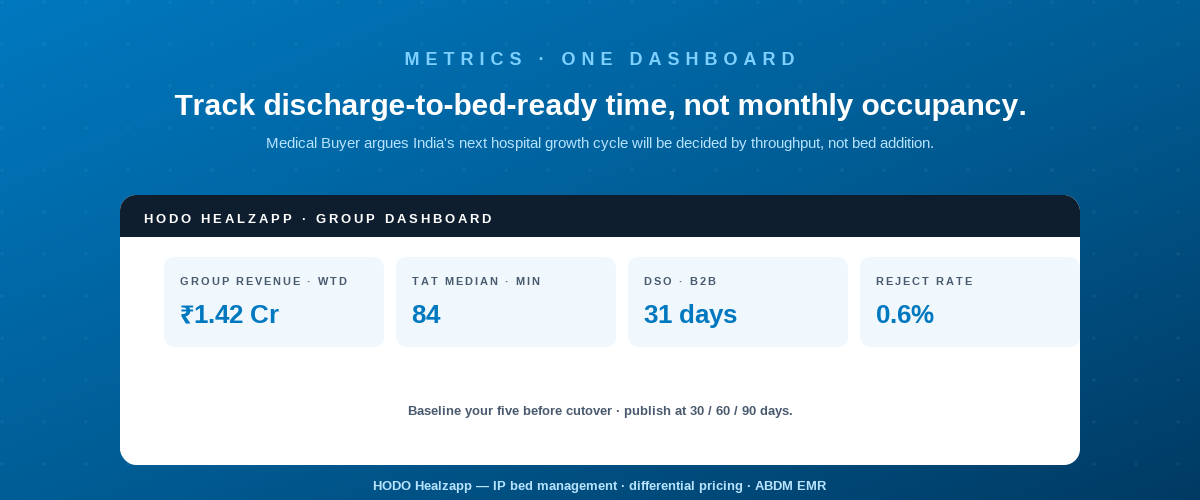
Track discharge-to-bed-ready time, not monthly occupancy.
Decision support and the second centre fail the same way
The news hook sits in a clinical decision support context, and the pattern there is familiar: pathway guidance that lives in a separate tool, a binder or a browser tab gets consulted during audits and ignored during a busy shift. Support only changes behaviour when it appears inside the screen the clinician is already using — triage scoring at the triage desk, pathway prompts in the ER resident's own flow, not in a parallel system. HODO EReazy was built around that constraint, with ACLS/ATLS pathway decision support and role-tailored flows for the Triage Nurse, ER Resident, Receptionist and Consultant, anchored clinically at Baby Memorial Hospital Kozhikode.
Multi-outlet expansion fails for the same structural reason. When the second and third centre each get configured from scratch — their own tariff masters, their own user roles, their own report formats — the group loses comparability precisely when it needs it most. Centre-level performance cannot be compared if the definitions differ, and head office ends up managing three different businesses. The alternative is to treat the first centre's configuration as the template and clone it, so that a new unit opens with the group's tariffs, roles and reporting already in place and contributes to a single consolidated view from day one.
What this means for HODO customers
Running existing capacity harder is a software problem as much as a management one, and HODO Healzapp is built around the specific points where throughput leaks. IP bed management with a Nursing Station flow turns occupancy from a monthly average into a live ward-level picture, including which beds are held by discharge paperwork rather than by patients. Appointments with Differential pricing and TV Token Display lets OP run on designed slots instead of arrival order, while EMR (AI-condensed history) gives the consultant the prior record at the start of the consultation rather than halfway through it. On the cash side, Billing with Tally integration keeps the operational and finance views reconciled, and B2B Referral / Outsource Lab / Corporate-partner logins bring referring doctors and corporate accounts into the same ledger. For groups adding units, Multi-outlet scale-up with one-click new-centre setup means the next centre inherits the group's configuration instead of inventing its own. Healzapp also carries ABDM-compliant EMR for Indian hospitals, with HODO among the first 20 ABDM-integrated HealthTechs in India.