Infosys is set to acquire Optimum Healthcare IT, a healthcare digital transformation firm whose business is built around implementing, migrating and optimising hospital systems, as reported by TheWire.in. The deal does not add a product to the Infosys catalogue; it adds people who know how to put hospital software into live use. For an Indian 100-bed hospital or a growing lab chain, that is the part worth reading twice, the market has just priced implementation capability, not feature count, as the scarce asset in healthcare IT.
What an acquisition like this actually buys
Firms in Optimum's category do not write EHR software. They staff go-lives, migrate data out of legacy systems, train end users shift by shift, sit at the elbow of clinicians in the first fortnight after cutover, and clean up the revenue-cycle mess that follows a badly sequenced switch. Large hospital groups abroad buy that capacity because the platform licence alone does not produce a working hospital.
System integrators have been buying these shops steadily. The logic is simple: the software layer is consolidating into a handful of platforms, so the margin and the differentiation move to whoever can land the platform inside a running institution without breaking the billing cycle. Infosys buying into that layer is a statement that the hard problem in healthcare IT is the last hundred metres.
Indian hospitals in the 50-150 bed band cannot buy this model as it exists abroad. In US health systems, consulting and implementation spend frequently runs at or above the software spend over a multi-year programme. A 100-bed hospital in Thrissur or Nagpur running on thin margins has no budget line for a separate transformation partner. That does not make the problem disappear; it means the HIS vendor has to absorb it, and be judged on exactly that basis.
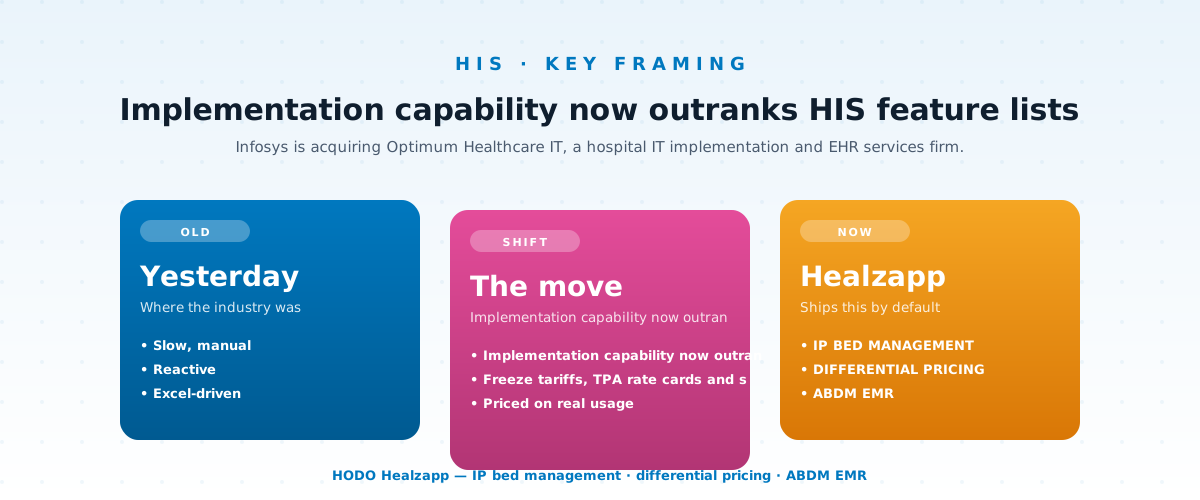
Implementation capability now outranks HIS feature lists.
HIS projects fail at go-live, not at selection
Most HIS replacement decisions in India are made on a feature comparison sheet. Modules are ticked off, a per-bed price is negotiated, and the project is handed to an IT executive and a hopeful administrator. The failure then arrives three months later, and it is almost never a missing feature.
The recurring failure points are predictable. Patient master data arrives with duplicate MRNs because two legacy systems were merged without a dedup rule. Tariff masters and TPA rate cards are re-keyed by hand, so the first month of claims goes out at the wrong package rate. Pharmacy stock is migrated at a stale cut-off, and the store starts the new system with a physical count that does not match the digital one. Pending IP bills straddle the cutover date, leaving half a bill in the old system and half in the new. Analysers that were interfaced with the old HIS revert to manual entry because nobody scheduled the re-interfacing work.
Each of these is an implementation task, not a software capability. Each is invisible on a feature sheet. And each shows up in cashflow rather than in an IT ticket, which is why the finance head usually discovers the problem before the IT team does.
The cashflow arithmetic of a bad cutover
For a 100-bed hospital with a meaningful TPA and PMJAY mix, receivables already sit at 45-90 days. A cutover that delays claim submission by three weeks does not cost three weeks; it pushes a full cycle of claims into the next quarter and raises the rejection rate on the batch that does go out, because discharge summaries, investigation records and package mapping are incomplete in a half-migrated system.
Run the numbers at the hospital's own scale rather than in the abstract. Take monthly credit billing, divide by thirty, and multiply by the number of days claim filing is expected to slip. Add an assumed rejection uplift on the first two months, a five-point rise on a significant cashless book is not pessimistic for a rushed go-live. That figure is usually larger than the annual HIS licence being negotiated. It is the real budget for implementation quality, and it gets spent either way: on a disciplined go-live, or on delayed and rejected claims.
The same arithmetic applies to lab chains, with TAT standing in for claim days. A collection centre that cannot print a barcoded sample label on day one sends samples onward with handwritten identifiers, and the mis-mapping costs more than any licence saving.
What a go-live without a consulting layer looks like
If there is no third-party transformation partner, the structure has to come from the vendor and the hospital's own team. A few practices separate the go-lives that hold from the ones that wobble.
Sequence the rollout by cash dependency. Registration, OP billing and IP billing go first, because they carry the money. Pharmacy and stores follow once billing is stable. EMR, nursing station and OT documentation come last, when staff already trust the system for the transactions they cannot avoid. A single big-bang across clinical and financial modules on the same Monday is the most common self-inflicted wound.
Freeze the masters before the date, not during the week of cutover. Tariffs, package rates, partner-wise differential pricing, doctor share rules and test panels should be signed off and locked, with a named owner per master. Migrate stock at a physical count taken the same night.
Schedule analyser interfacing as its own workstream with its own dates, since it depends on biomedical vendors who do not work to the HIS timeline. Run a parallel day, one full working day where every transaction is entered in both systems, rather than a parallel month, which nobody sustains. And keep the finance ledger continuous: if accounting entries have to be rebuilt by hand after cutover, the first audit will consume more senior time than the migration did.
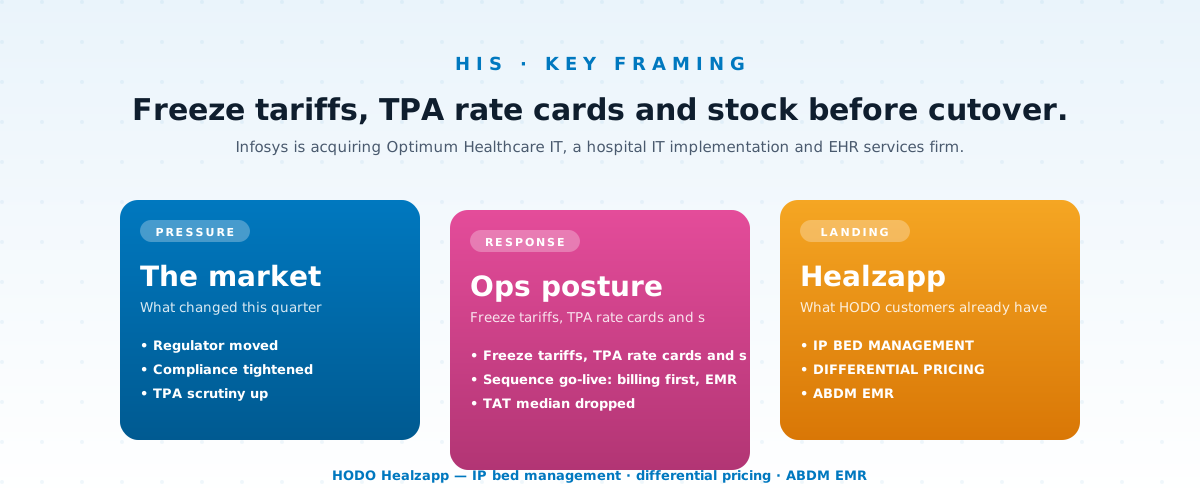
Freeze tariffs, TPA rate cards and stock before cutover.
Questions worth putting to a HIS vendor
The Infosys-Optimum framing suggests a shift in how an Indian hospital or lab chain should run a vendor evaluation: less time on module checklists, more on delivery evidence.
How many go-lives of comparable size were completed in the last twelve months, and can two of those administrators be spoken to directly? Who is the named implementation lead, and what else are they running concurrently? Is data migration priced in or billed separately as a change request? What is the support escalation path in the first thirty days after cutover? Which analysers have been interfaced before, and by whom? How does the second and third outlet get configured, by repeating the whole exercise, or from a template? What does the ABDM and NABH documentation trail look like at handover, rather than as a promise?
Vendors who sell on implementation answer these with names and dates. Vendors who sell on features answer with a roadmap. That difference predicts the next two years better than any comparison matrix.
What this means for HODO customers
Healzapp is built for hospitals and chains that do not have a transformation consultancy sitting between them and their software. Multi-outlet scale-up with one-click new-centre setup exists precisely so that the second, fifth and tenth centre inherit masters, tariffs and workflows from a working template instead of starting a fresh implementation each time. Machine Interfacing is treated as standard scope rather than a post-go-live project, so lab and radiology devices come online with the billing modules and not months after. Tally integration keeps the finance ledger continuous through cutover, which is the difference between an audit that takes a day and one that takes a fortnight.
The acquisition news is about a distant market, but the claim travels: value in healthcare IT sits with whoever can make the system work inside a live hospital. Ask that before signing, not after.