QXL Diagnostics has set out a target of 60 hospital laboratory partnerships by 2028, as reported by The Tribune. The number is one company's business plan, but the model behind it is now a live procurement question on the desk of almost every 100-bed hospital in India. Sooner or later somebody will offer to run your lab, and the terms of that offer decide far more than the margin on a CBC.
A 60-lab target is a bet on mid-sized hospitals
Large corporate chains run their own labs and have no reason to hand the bench to a third party. The addressable base for a lab management partnership is the 50 to 150 bed hospital: enough OP footfall and IP admissions to keep an analyser busy, not enough to absorb the capital cost of replacing it, the NABL accreditation cycle, and a full-time pathologist on payroll. The partner brings equipment, reagents, quality systems and manpower; the hospital keeps the patient relationship and, usually, the patient billing.
Growth from a handful of sites to sixty only works on a standardised operating template. The partner will want the same test menu, the same rate structure, the same reporting format and the same software at every hospital it runs. That standardisation is what makes the offer commercially attractive, and it is also where the negotiation actually happens. A hospital signing such a contract is not merely buying a service, it is agreeing to let an outside operator define how a core clinical department records its work for the next five years. Hospitals that treat this purely as a cost line discover the consequences late.
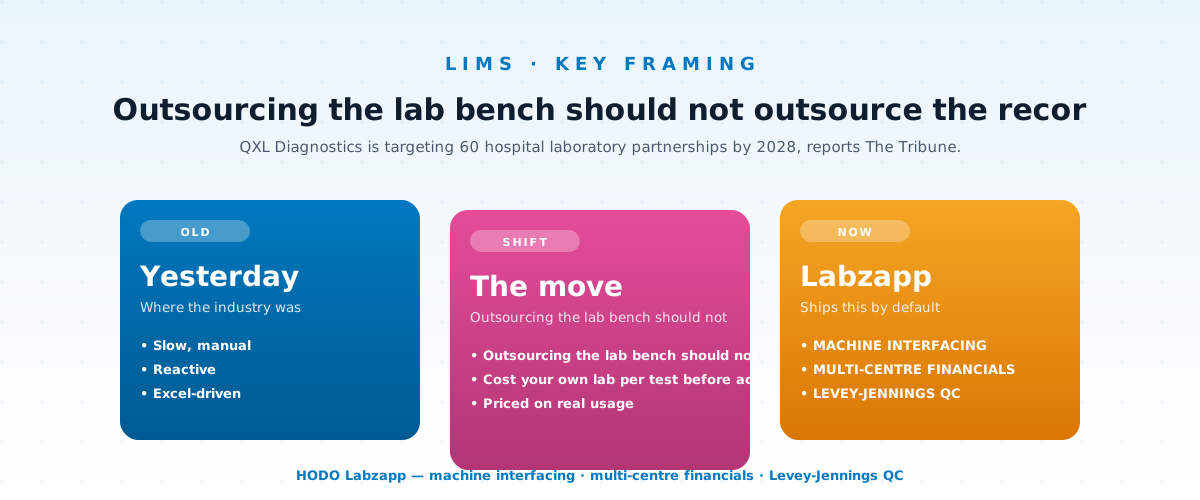
Outsourcing the lab bench should not outsource the record.
Do the arithmetic before you accept somebody else's
The common trigger for outsourcing is a finance meeting where the lab appears to lose money. Very often nobody has actually calculated cost per test. Reagent cost is only the visible part. Add controls and calibrators run every shift, wastage on kits that expire before a low-volume assay reaches its run size, AMC on analysers, technician shifts including night coverage for casualty, sample rejection and repeats, and the share of the pathologist's time that signing out reports consumes.
Once those are in, the picture usually splits. High-volume routine work, haematology, basic biochemistry, urine routine, is almost always cheaper in-house at 100 beds, because the marginal cost of one more test on a running analyser is small. The specialised assays run two or three times a week are where money leaks, and those are the tests worth outsourcing to a reference lab regardless of any partnership. A hospital that can produce a month of test-wise costing has a real negotiating position. A hospital that cannot is accepting the partner's model of its own economics.
Outsourcing the bench does not outsource the record
This is the part that gets signed away by default. If the partner's software holds the order, the sample, the analyser result and the authorised report, the hospital ends up with PDFs attached to visits. A PDF is a document, not data. Discrete values do not flow into the EMR, previous results cannot be trended when the same patient returns in six months, ABDM-compliant record linkage has a hole in it where investigations should be, and NABH assessors asking for an audit trail from order to release will be shown a screen the hospital does not control.
The migration risk is worse. Contracts end. If five years of results live only in a partner system, the hospital cannot take them anywhere. The workable arrangement is that the partner operates the bench while results return into the hospital's own LIMS or HIS as structured values through an interface, with the hospital retaining the order-to-report trail. Machine interfacing at the partner's end and result integration at the hospital's end are two different things, and the contract should name both. Ask, in writing, what leaves with the partner on the day the agreement lapses.
Rate cards and the monthly reconciliation nobody staffs
Under most partnership structures the partner invoices the hospital at an agreed rate while the hospital bills the patient at its own tariff. That is simple until the tariffs multiply. A 100-bed hospital typically carries cash rates, TPA rates, PMJAY package rates where investigations are bundled and not separately payable, corporate and camp rates, and staff concessions. Each of those produces a different realisation against the same partner rate, and the tests that are quietly loss-making sit inside bundled packages where nobody looks.
Then there is the monthly dispute. Repeat tests after a haemolysed or short sample, add-on tests ordered verbally in casualty, samples rejected at receipt, tests billed but cancelled after the patient left, every one of these becomes a line item argument if the reason is not coded at the point it occurs. Reconciliation done by comparing a partner's spreadsheet against the hospital's billing report will always find a variance, and without reason codes the variance gets settled by whoever argues harder. Partner-wise rate configuration and coded credit notes convert that conversation into a report instead of a negotiation.
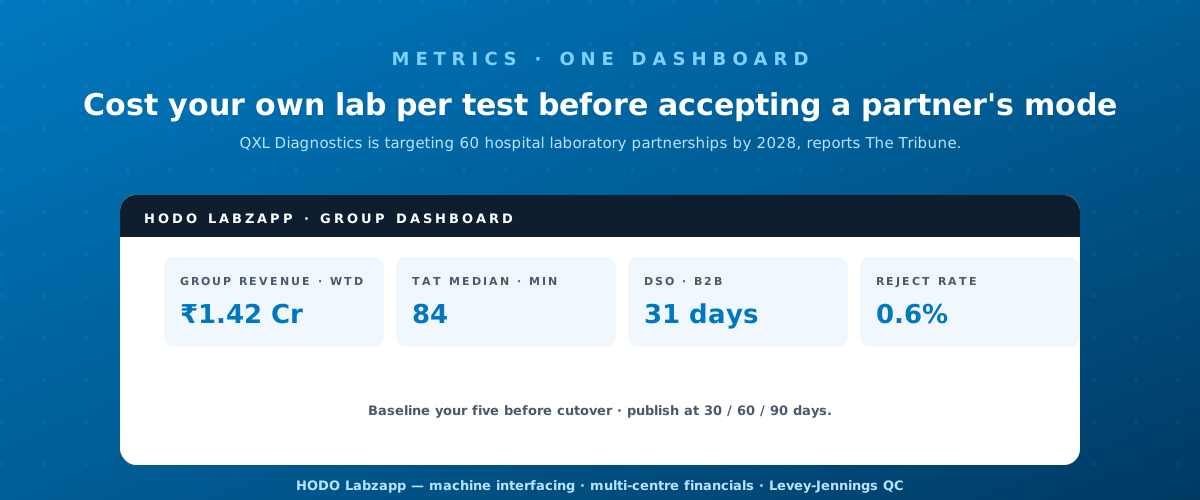
Cost your own lab per test before accepting a partner's model.
TAT is the only clause you can actually enforce
Quality is hard to police month to month. Turnaround time is not, provided the clock is defined and measured by the hospital's own system. Agree what starts it, sample collection, or receipt at the bench, because partners prefer the second and clinicians experience the first. Measure separately for casualty, IP and OP; a single hospital-wide TAT average hides the only number that matters, which is how long an ER troponin takes at 2 am.
Report delivery belongs in the same clause. If the patient receives a report on WhatsApp, the sender, the format and the branding are the hospital's business, not the partner's. Automated delivery also removes the collection counter queue that OP throughput dies in. A hospital that can show test-wise, shift-wise TAT from its own records has something to hold a partner to at renewal. One that relies on the partner's monthly summary is grading its own supplier's homework.
What this means for HODO customers
A lab partnership is a data architecture decision wearing a procurement disguise. Labzapp is built for exactly this split: Partner-lab integration with anonymised sample tracking lets work move to an outsourced or reference lab while the order, the barcode and the authorised result stay in the hospital's record, so the EMR keeps discrete values rather than attachments. Differential pricing per partner holds separate rate cards for each partner, corporate and referral arrangement against the hospital's own tariffs, which is what makes month-end reconciliation a report instead of an argument. TAT reporting gives shift-wise and test-wise turnaround measured in the hospital's system, the evidence needed at renewal, while automated SMS/WhatsApp/Email report delivery keeps the patient-facing last mile under the hospital's brand.