India's News.Net reports that QXL Diagnostics has set a target of 60 hospital laboratory partnerships by 2028. The goal points to a model that is growing in Indian diagnostics. Lab operators are not only opening new collection centres; they are also taking over, co-running or partnering with laboratories inside hospitals. Setting a partnership target is easy. Running dozens of labs inside other organisations, each with its own wards, billing desk and doctors, while keeping control of turnaround time, quality and margin is much harder.
Why hospital lab partnerships are the growth route
For a typical 100-bed Indian hospital, the in-house laboratory is essential but rarely efficient. Analysers sit idle at night, and reagent kits expire before they are used up. Pathologist and technician salaries stay fixed while volumes rise and fall with bed occupancy. NABL readiness also needs documentation that a small lab team struggles to keep up. Specialised tests get sent out anyway, often tracked with nothing more than a courier slip.
A diagnostic chain looks at the same lab and sees steady volume it doesn't have to chase. OP investigations, daily IP panels, pre-operative workups and emergency stat samples arrive without the marketing spend a retail collection centre needs to attract walk-ins. The chain can spread fixed costs across its network, buy reagents in bulk and send specialised tests to a hub. The unit economics improve for both sides.
The commercial structures vary: fully outsourced management, shop-in-shop arrangements, revenue share, reagent rental, or a tie-up for high-end reference tests. Each one changes who bills the patient, whose letterhead goes on the report and how money is reconciled at month end. A chain aiming for dozens of partnerships will almost certainly run several of these models at once, and its software has to handle all of them.
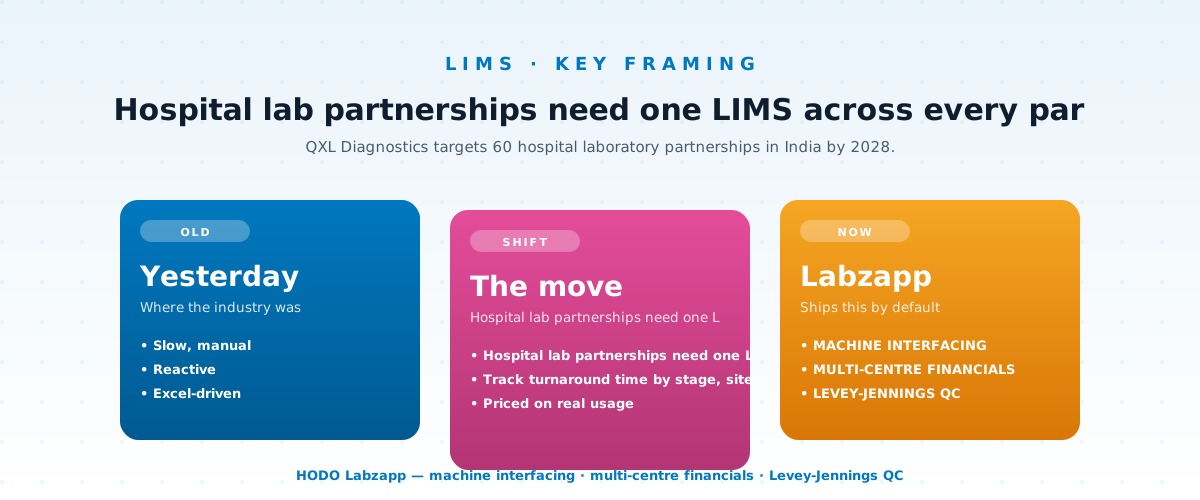
Hospital lab partnerships need one LIMS across every partner site.
Sixty labs, sixty different host organisations
The hard part of hospital partnerships is not the testing. It is working inside a host organisation that the lab chain does not control.
Every hospital has its own HIS, and some have none. Samples arrive from the wards, OT, ER and OP counter, each with a different level of urgency. Critical values have to reach a nursing station within minutes, not wait in a validation queue. TPA patients need itemised bills that match their pre-authorisation. PMJAY packages may fold investigations into a fixed rate, which the lab has to account for separately. Consultants expect reports in a familiar format, often under the hospital's brand.
At three or four sites, a regional manager with spreadsheets and phone calls can hold this together. Beyond ten, problems pile up: duplicate registrations, samples relabelled by hand, and reports sent late because nobody validated them. Monthly reconciliations take a week and still end in disputes. A 60-site network run this way would spend more on coordination than it saves through scale. The chain needs one system of record across every partner lab, with each hospital's rules set up in advance rather than handled ad hoc.
Turnaround time is the real contract
Whatever the signed agreement says, hospitals judge a lab partner on turnaround time. A delayed troponin in the ER, or a renal panel missing before the morning ward round, reaches the medical superintendent long before any contract review.
Useful TAT measurement splits the journey into stages: collection, receipt at the lab, processing, validation and report dispatch. Network-wide averages hide problems. The data needs to be broken down by site, department, test and priority, with stat and routine samples tracked separately. If validation at one site keeps running late after 8 pm, that is a staffing problem, not a software problem, but only the data shows it.
Two practices remove the biggest sources of delay and error. The first is barcoding samples at the point of collection, so a tube drawn in a ward is never relabelled at the lab bench. The second is machine interfacing, so results go straight from the analyser to the report without manual typing. Together they cut repeat collections, transcription errors and the phone calls that follow. A chain that brings stage-wise TAT data to a hospital's quarterly review negotiates renewals from a position of strength.
Quality, NABL and the patient-poaching worry
Scaling to dozens of hospital labs multiplies quality risk. Each site runs its own analysers, controls and staff shifts, yet one bad result hurts the whole brand. It also hurts the host hospital, which may be preparing for its own NABH assessment and will ask for laboratory QC evidence.
A central quality team needs Levey-Jennings charts for every analyser at every site, available without waiting for monthly reports. If a biochemistry analyser in one district starts drifting, someone should act the same day, not after a clinician questions a result. Standard SOPs, calibration logs and QC records also make NABL accreditation faster for each new partner lab.
There is a commercial concern too. Hospitals worry that a diagnostic chain working on their premises will use patient data to draw patients to its own retail centres. When samples move from a hospital lab to a hub or reference lab, they should travel with anonymised IDs, and only the originating site should hold the link to the patient. This protects patient privacy under India's DPDP Act. It also answers one of the most common objections in partnership negotiations.
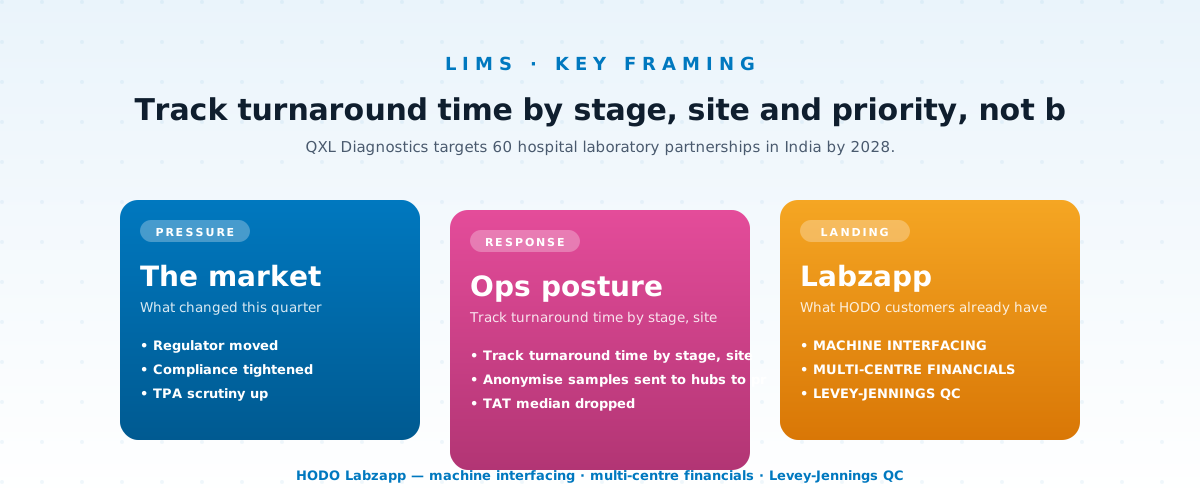
Track turnaround time by stage, site and priority, not by averages.
Pricing, billing and cost per test across partners
No two hospital partners pay the same way. One agreement sets a discounted rate card for IP tests, another shares revenue on OP billing, and a third pays per test only for referred specialised work. Corporate clients and referral doctors linked to the hospital may have their own price lists. Managing all this through manual rate sheets guarantees billing errors and month-end disputes.
Each partner's price list needs to be set up once and applied automatically at billing. Reconciliation should run off the same transaction data that both sides can see. Referral doctors and corporate partners should have their own logins to view reports and statements, which cuts down the steady stream of calls to the lab desk.
The bigger question is at network level: which partnerships actually make money? Cost per test varies sharply with volume, test mix, reagent use and staffing. Multi-centre financials that show revenue, consumables and contribution for each site let the chain:
spot loss-making labs before renewal
renegotiate terms with evidence
move low-volume tests to a hub
A target of 60 partnerships only pays off if most of them are profitable.
What this means for HODO customers
The hospital-partnership model rewards lab chains that run every partner site on one shared system instead of treating each site as a separate project. HODO Labzapp is built for this kind of operation. Partner-lab integration with anonymised sample tracking lets samples move between hospital labs, hubs and reference labs without exposing patient identity beyond the originating site. Differential pricing per partner keeps each hospital, referral doctor and corporate client on its own negotiated rates. TAT reporting gives operations heads the turnaround data by stage and by site that renewal conversations depend on.
Behind these, barcoded samples, machine interfacing and Levey-Jennings QC cut manual handling and keep quality visible on every analyser. Multi-centre financials show cost and contribution for each site. Where the host hospital runs Healzapp as its HIS, its B2B Referral / Outsource Lab logins connect the hospital and the lab partner.