Business Standard reports that QXL Diagnostics is targeting 60 hospital laboratory partnerships by 2028, a growth plan built on running other institutions' labs rather than simply opening more of its own collection centres. For diagnostic chains in India and the Gulf alike, the partnership count is the more instructive number in that story. A managed-lab target is an operations target, and it lands on the lab information system long before it lands on the balance sheet.
Managed partnerships are a different business from retail diagnostics
A retail lab chain scales by repetition. Each new collection centre looks like the last one: same test menu, same price list, same reporting format, same turnaround promise. Onboarding is a template. A hospital lab partnership breaks every one of those assumptions. The hospital owns the patient relationship, sets its own test menu, negotiates its own rate card, runs its own clinician expectations on turnaround, and often insists that reports carry its letterhead rather than the lab operator's. Sixty of those contracts is not one business repeated sixty times, it is sixty small businesses that happen to share analysers, couriers and quality systems.
The cost structure shifts too. In retail diagnostics, cost per test is dominated by reagent, consumable and analyser depreciation. In managed partnerships, a large and frequently unmeasured share of cost sits in coordination: reconciling which samples belong to which contract, chasing pending results against a contractual clock, producing monthly statements that the hospital finance team will actually accept, and handling the disputes that follow when it does not. Chains that grow partnership counts without instrumenting that coordination layer discover the problem around contract fifteen to twenty, when the reconciliation spreadsheet becomes a full-time job and margin quietly leaks into back-office headcount. The system question is therefore not whether a LIMS can process the volume, most can, but whether it can hold sixty distinct commercial identities without sixty distinct workarounds.
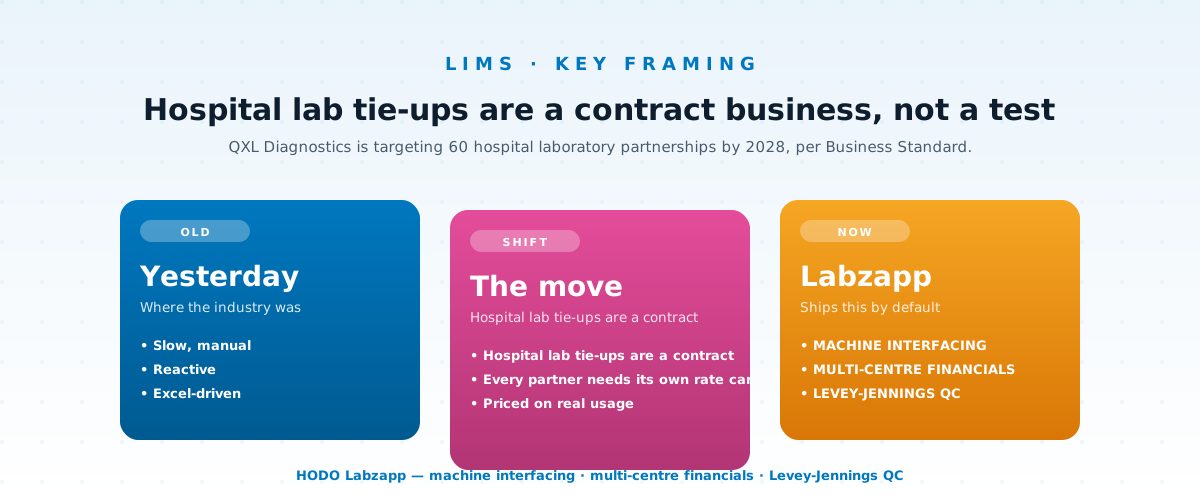
Hospital lab tie-ups are a contract business, not a test business.
The identity problem: one sample, two institutions
The first technical constraint in any hospital partnership is sample identity. The hospital has its own patient identifier, its own accession numbering and its own record system. The lab operator has a separate one, plus a reference laboratory behind it for specialised assays. A single sample can therefore carry three identities on its journey, and every handoff between them is a place where the wrong result reaches the wrong record.
Barcoding at the point of collection solves half of it. The other half is deciding how much identity travels with the sample. When a partner hospital sends work to a central or reference lab, the receiving lab usually needs the specimen type, the test panel, the collection time and the clinical flags, it does not need the patient's name, and in many contracts it is not permitted to hold it. Partner-lab integration with anonymised sample tracking exists precisely for this: the sample moves and remains traceable end to end, while the identifying data stays with the institution that owns the patient relationship.
Getting this wrong is expensive in two directions. Too little separation and the lab operator is holding identifiable records it has no contractual basis to hold, a growing concern under India's DPDP regime and under the health data rules that DHA, DoH and Qatar's MoPH apply to licensed facilities in the Gulf. Too much separation and traceability collapses: nobody can reconstruct where a sample sat for six hours, and the turnaround dispute becomes unwinnable because there is no chain of custody to point at. The workable answer is one barcode, one custody trail, and identity exposed only to the parties entitled to see it.
Pricing stops being a price list and becomes sixty of them
Every hospital partnership negotiates its own rates. A 200-bed tertiary hospital with high volumes will not pay what a 40-bed nursing home pays for the same panel. Some contracts price per test, some price per bundled profile, some carry minimum monthly commitments with step-downs above a threshold. Layer in referral doctors who receive different commercial terms, corporate and insurance panels with their own tariffs, and franchisee outlets buying at internal transfer rates, and the single master price list becomes a fiction maintained by exception.
Handling this in the billing layer rather than the LIMS is the usual first mistake. Rates then live in an accounting system that does not know which tests were actually released, which were repeated at no charge after a QC failure, and which were cancelled on sample rejection. Month-end reconciliation becomes a manual comparison between two systems that were never designed to agree. Differential pricing per partner attached to the order itself keeps the commercial terms and the clinical record in the same object, so the invoice is a report on what happened rather than a reconstruction of it.
The second half of this is visibility. Partner hospitals that can see their own pending list, their own turnaround performance and their own monthly statement raise far fewer tickets than partners who have to email for them. Referral-doctor and corporate-partner portals convert a recurring support load into self-service, which is the difference between a partnership manager handling eight contracts and handling thirty.
Turnaround is the contract, so it has to be measured per contract
Most hospital lab agreements specify turnaround in writing: routine biochemistry within a stated window, critical values called within minutes, histopathology within days. Aggregate TAT across the whole chain is close to useless against these commitments, because the average hides the specific partner whose evening runs consistently miss the cut-off. TAT has to be sliced by partner, by test group, by shift and by the stage where time was lost, collection to receipt, receipt to run, run to validation, validation to delivery.
That slicing also drives the operational fix. Delay concentrated between collection and receipt is a logistics problem: routes, pickup frequency, courier accountability. Delay between receipt and run is a capacity or scheduling problem. Delay between run and validation is a pathologist availability problem, and it is the one most often mistaken for a machine problem. Only the first two are solved by buying another analyser.
Onboarding cost matters as much as steady-state performance. If connecting a new partner hospital's analysers takes weeks of custom integration work, partnership number forty costs materially more to start than partnership number four, and the expansion plan decays. Mature machine interfacing, bidirectional where the analyser supports it, with a repeatable configuration rather than a bespoke build per site, is what keeps the marginal cost of the next contract flat. So is a Levey-Jennings QC setup that applies the same rules across every connected site, so a new partner inherits the quality system rather than negotiating one.
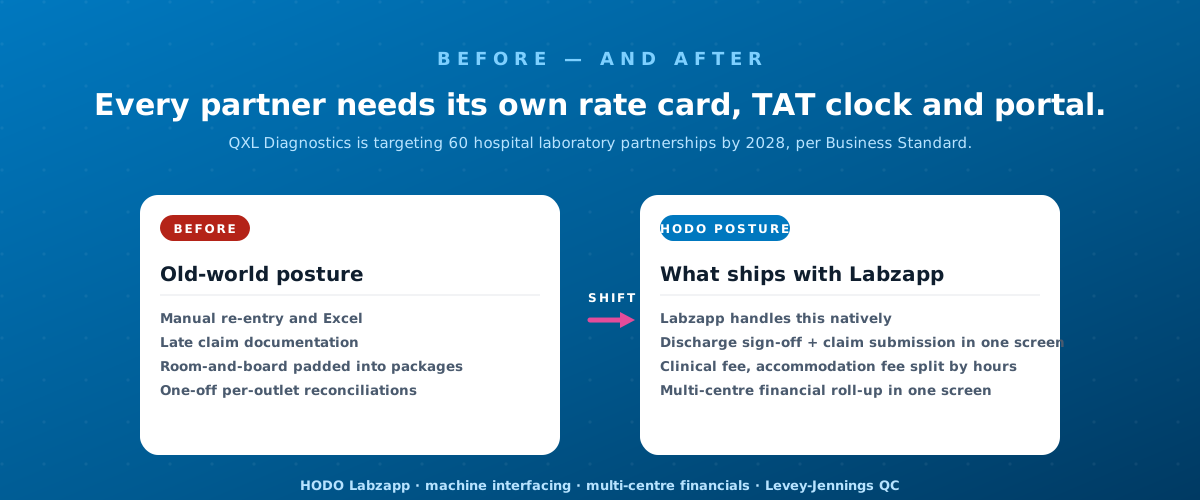
Every partner needs its own rate card, TAT clock and portal.
The Gulf version of the same play
The managed-lab model is not an India-only pattern. Across the UAE, Qatar, Kuwait and Bahrain, polyclinic groups and small private hospitals routinely outsource their laboratory to a specialist operator rather than staffing and licensing a full in-house lab. The commercial logic is identical, the clinic keeps the patient, the lab operator brings the analysers, the accreditation and the pathologist coverage, and the operational pressure points are the same: per-contract pricing, per-contract turnaround, and clean separation of patient identity between institutions.
Two local differences are worth planning for. First, billing runs through insurance in most GCC markets, so the lab operator's output frequently has to reconcile against the clinic's claim submission; report timing and coding accuracy affect the clinic's cashflow, not just its clinical workflow. Second, licensing is facility-specific, a DHA-licensed clinic in Dubai and a DoH-licensed one in Abu Dhabi are separate regulatory entities even under common ownership, which means the lab's records have to segment along the same lines. Multi-currency and multi-entity handling stop being nice-to-haves once a chain works across two emirates and a neighbouring country.
What this means for HODO customers
Lab chains reading the QXL target as a volume story will underestimate what sixty partnerships require. It is a contract-management problem wearing a laboratory's clothes, and the systems that survive it are the ones where commercial terms, sample custody and turnaround evidence live in one place. Labzapp is built around that shape: partner-lab integration with anonymised sample tracking keeps specimens traceable while identity stays with the institution entitled to hold it; differential pricing per partner attaches each contract's rates to the order rather than to a downstream accounting system; and TAT reporting makes turnaround measurable per partner, per test group and per stage, so a missed commitment points at the step that caused it. Franchisee management and multi-centre financials extend the same structure to owned outlets and partner-run centres under one set of books.
The practical test before signing partnership number ten: can the current system produce, without manual assembly, one partner's pending list, one partner's turnaround performance by stage, and one partner's month-end statement? If any of those takes a spreadsheet, that spreadsheet is the real constraint on the expansion plan.