The Supreme Court has described the mark-up on some cancer drugs as "carnage", pointing to cases where the amount billed to a patient ran close to ten times what the hospital paid, and has asked whether a uniform 16% trade margin should apply across the supply chain, as reported by India Today. For a 100-bed hospital, or a lab chain running its own retail counter, the operational message is narrower than the headline: pharmacy margin is moving from an internal management decision to an externally auditable number.
Where the 16% figure comes from
The number is not arbitrary. Under the Drugs (Prices Control) Order, 2013, scheduled formulations already carry a fixed retailer margin of 16% on the ceiling price, while non-scheduled drugs have historically been governed mainly by an annual price-increase limit. That gap is what produced the divergence the court is examining: two items on the same shelf, one with a statutory margin and one where the distance between procurement rate and MRP was purely a commercial matter. The NPPA has narrowed the gap before, the 2019 trade margin cap on a set of non-scheduled anti-cancer drugs was the first large-scale test of capping margin rather than price. Extending a single 16% figure across categories would be a far bigger change, because it would also touch fast-moving consumables, surgical items and injectables where hospital purchase prices vary widely by volume and distributor. Whether the court's suggestion becomes policy is uncertain. What is more certain is the direction of travel: regulators are increasingly interested in the spread between what a hospital pays and what it bills, and they will expect that spread to be reconstructible from records rather than explained in a letter.
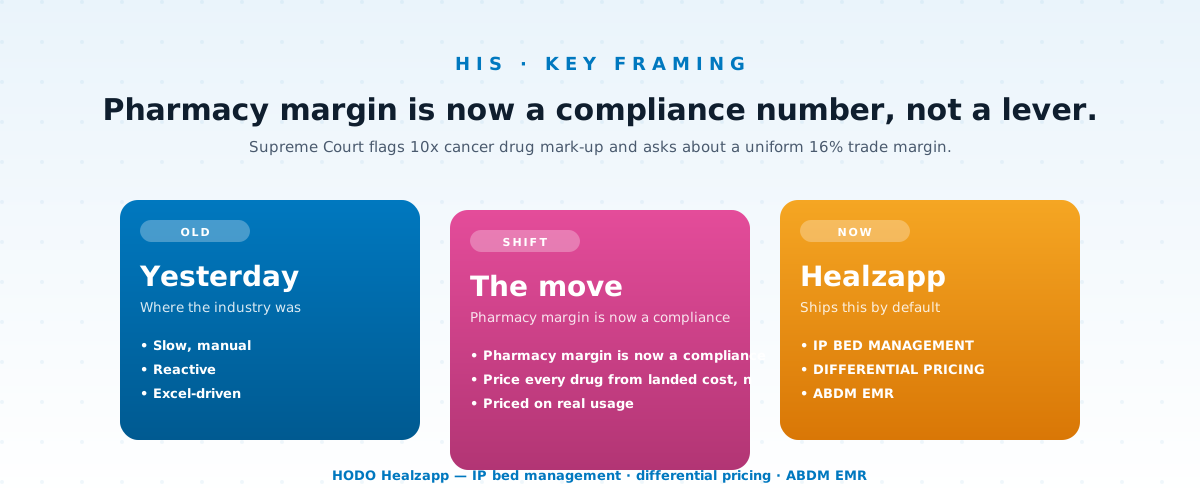
Pharmacy margin is now a compliance number, not a lever.
Why pharmacy margin became load-bearing
In most Indian hospitals of this size, the in-house pharmacy is one of the few departments that reliably contributes cash. IP pharmacy revenue lands on the same bill as bed and procedure charges, collection risk is low for cash patients, and the margin quietly offsets tariffs that TPAs and PMJAY packages have held flat for years. Finance teams know this; it rarely appears in a board deck as "cross-subsidy", but that is what it is. A margin cap therefore does not merely trim one line item, it removes part of the cushion that absorbs delayed insurance settlements and package rates priced below cost. The hospitals that will handle a cap without distress are the ones that already know margin per item, per store and per patient class, because they can then decide what to renegotiate with distributors, where to substitute, and which packages genuinely lose money. Those still working off a single blended pharmacy margin percentage will discover the cap and their costing problem at the same moment. That is an ops and MIS gap rather than a pricing gap, and it takes months to close, not weeks.
Item-level costing is the actual requirement
A margin rule is only enforceable if landed cost is known at batch level. Landed cost is rarely just the invoice rate, it includes scheme quantities, distributor credit notes, freight on cold-chain items and GST treatment that differs across categories. Hospitals that record purchases at MRP and work backwards to a discount percentage cannot demonstrate compliance with any margin ceiling, because the denominator is an assumption. The practical fix is to make goods receipt the point where cost is captured: batch, expiry, purchase rate, scheme quantity and landed rate per unit, posted once and used by billing thereafter. Selling price then becomes a calculated field with a documented rule, not a value typed in at the counter. This also changes what can be shown to an auditor or a regulator. Instead of a narrative, a hospital can produce a report listing every dispensed item with purchase rate, billed rate and realised margin for a defined period, and explain exceptions individually. Any hospital that expects to operate under a margin-cap regime should be able to run that report today, well before anyone asks for it.
Differential pricing without breaking a uniform cap
A uniform ceiling and differential pricing are not in conflict, but they have to be built in the right order. Hospitals legitimately bill different rates to different payers, corporate tie-ups, TPA-empanelled patients, PMJAY beneficiaries, staff, and camp or outreach pricing. Under a margin cap, the ceiling becomes the outer boundary and payer-wise rates sit at or below it, each attached to a defined price list rather than to counter-level discretion. The control that matters is not the discount itself but the record: which price list applied, who authorised a deviation, and when. Discounts entered as ad hoc line-item overrides are the fastest route to a failed audit, because they look identical to a billing error. There is a revenue-leakage angle too. In multi-outlet setups, a price change made at head office but not propagated to a satellite centre produces both billing disputes and unexplained margin variance across units. Centralised price masters with outlet-level effective dates remove that whole class of problem, and they are a prerequisite for any group planning to open more counters over the next two years.
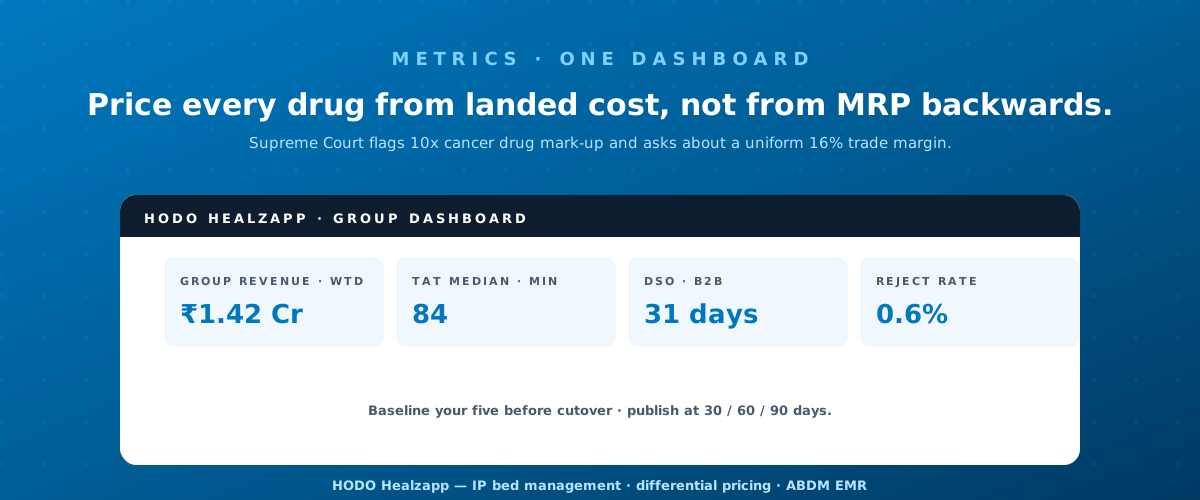
Price every drug from landed cost, not from MRP backwards.
Expiry, substitution and the margin nobody measures
Focusing only on the cap misses where hospital pharmacy money actually leaks. Expiry write-offs, near-expiry returns that distributors decline, overstocked slow movers bought against a scheme, and stock-outs that push an IP patient to an outside chemist together cost most 100-bed hospitals more than any regulated margin change would. These are inventory disciplines: reorder levels tuned to consumption rather than habit, batch-wise expiry alerts early enough to return or rotate stock, ward-level indent tracking so floor stock is visible, and substitution rules agreed with clinicians in advance so a stock-out does not become a lost sale plus a patient complaint. A cap raises the value of each of these, because once margin per unit is fixed, wastage avoided and stock turned become the only remaining variables. Consumption data also strengthens the purchase side. A hospital that can place twelve months of item-level offtake in front of a distributor negotiates a better landed rate than one that orders reactively, and under a fixed margin, the purchase price is what protects contribution.
What this means for HODO customers
Margin regulation rewards hospitals whose systems already treat pharmacy as a costed, audited operation rather than a retail counter. Healzapp's Pharmacy and Inventory modules capture batch, expiry and purchase rate at goods receipt, so billed rate and realised margin per item can be reported for any period without manual reconciliation. Differential pricing holds payer-wise and outlet-wise price lists centrally, keeping corporate, TPA and scheme rates inside a defined ceiling instead of depending on counter discretion, while Tally integration carries purchase and sales entries into the books without re-keying, so finance and pharmacy report the same number. For groups adding counters, multi-outlet scale-up with one-click new-centre setup means a new outlet inherits the same price masters and controls from day one.