Medical Buyer reports that hospital pharmacies are pushing margins and driving medical markup, a framing that reads as a pricing accusation from outside, and as a survival calculation from inside the building. For a ~100-bed Indian hospital, pharmacy and consumables routinely account for a quarter to a third of gross revenue and a larger share of contribution after doctor payouts. The uncomfortable part is that the department carrying this much weight is usually the least instrumented module in the hospital information system.
Why the pharmacy now carries the hospital
A mid-sized hospital earns from three broad blocks: room and nursing charges, procedures and OT, and pharmacy plus consumables. The first two are tariff-capped. PMJAY package rates are fixed, TPA and corporate tariffs are negotiated downward at every renewal, and OP consultation pricing is set by the local market rather than by the hospital. Pharmacy is the one block where volume rises with every admission and where a management decision still moves contribution within a quarter. That is why markup becomes the default lever.
The problem is that markup is also the most exposed lever. DPCO ceilings, trade margin rationalisation on selected products, state-level price display requirements and patient grievance channels all point at the same number on the bill. A hospital that depends on markup alone is one circular away from a margin shock. Hospitals that instead run the pharmacy as a trading business, purchase terms, stock turn, expiry write-off, dispensing discipline, reach similar contribution with far less exposure. That shift needs the pharmacy measured like a retail chain, not treated as a store room attached to billing.
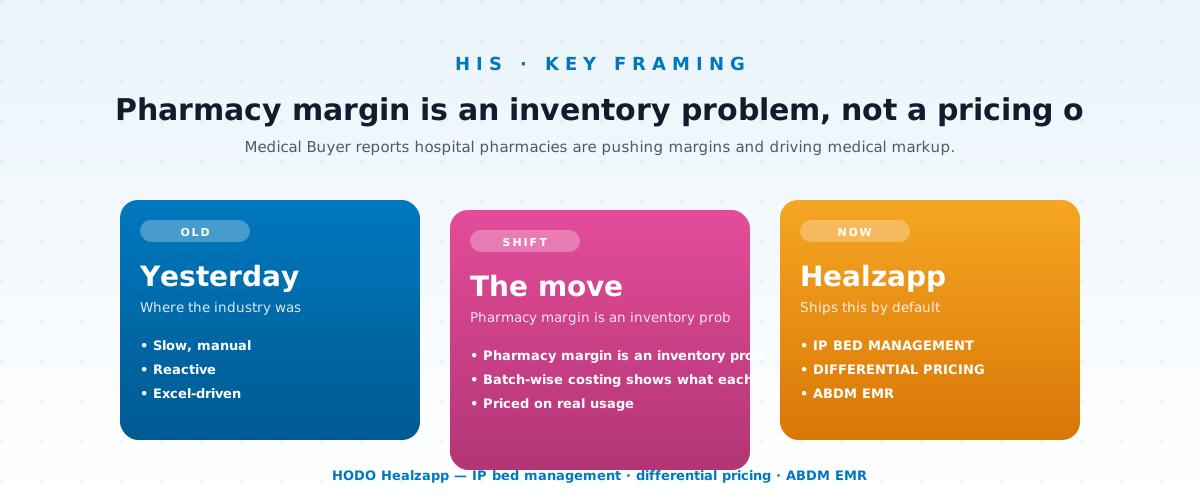
Pharmacy margin is an inventory problem, not a pricing one.
Markup is downstream of procurement
Most pharmacy margin reports in Indian hospitals are fiction, because stock is valued at a notional MRP-minus-percentage rather than actual landed cost per batch. The same molecule can enter the store at three different rates in one month, a scheme purchase, a regular invoice, and an emergency local buy at near-MRP. Unless costing is batch-wise, the margin report averages all three and hides the emergency buy that actually destroyed the margin on a particular admission.
Bonus and free goods make this worse. If scheme quantity is received without being valued, margin looks inflated on one set of bills and negative on the next. Formulary discipline is the other half. A 100-bed hospital stocking 2,200 SKUs where 1,100 would serve the same case mix has working capital parked in slow movers, and expiry follows automatically. Distributor return windows typically close three to six months before expiry; a near-expiry report by batch, reviewed monthly, is the cheapest margin gain available to any hospital pharmacy. Stock turn is the honest scoreboard, a well-run in-house pharmacy should be turning ten to twelve times a year, and most mid-sized hospitals sit well below that.
Where the leakage actually sits
Markup discussions distract from an unglamorous truth: in most 100-bed hospitals, one to two per cent of pharmacy revenue leaks before it reaches the bill. The usual sources are consistent. Ward indents are raised against a bed, the patient is discharged, and unused strips stay in the nursing station instead of returning to stock. OT consumables are opened, partially used, and never reconciled against the procedure bill. Counter staff give discretionary discounts without an authority limit. Stock transfers between the main pharmacy and the OP or satellite counter move on a register rather than a document trail.
Each of these is a workflow gap, not a staff integrity problem. The fix is that every drug issued against a bed must be either billed or returned to stock within the same shift, with the nursing station and OT raising and closing indents in the same system that holds the bill. Schedule H1 and narcotic registers should fall out of dispensing records rather than being maintained separately in a notebook, because a register that is written at month end is also a register that cannot be audited. Where returns and reconciliation close daily, the markup argument becomes much less urgent.
Payer mix decides the margin you keep
A pharmacy margin number that is not split by payer is close to useless. For a PMJAY admission, drugs are inside the package rate, so pharmacy issue is an internal cost centre, not a revenue centre, every avoidable brand substitution reduces the hospital's own realisation. For most TPA and corporate tariffs, pharmacy is billed at MRP but the settlement is netted against a discount on the total claim. For cash patients, the counter margin is real but price-sensitive. Three payer categories, three different economics, usually one report.
Cashflow compounds this. Distributor credit runs 30 to 45 days, while TPA and government scheme settlements run 60 to 90 days or longer. The pharmacy is therefore funding the hospital's receivable with its own supplier credit, which is why a payer mix shift towards scheme business shows up first as a pharmacy payment problem. Practical controls are straightforward: maintain a price list per payer rather than one MRP with manual discounting at the counter, produce payer-wise pharmacy consumption alongside claim submission so that package overruns are visible before the claim goes out, and review outstanding distributor credit against scheme receivable ageing in the same monthly meeting.
Batch-wise costing shows what each molecule really cost.
Audit trail, accreditation and multiple outlets
NABH medication management standards expect controls that are hard to demonstrate on paper: look-alike and sound-alike segregation, storage temperature logs, high-risk drug handling, and recall traceability from batch down to the patient who received it. A hospital that can trace a batch to a bill in minutes also happens to have the data needed for accurate margin reporting, the compliance requirement and the commercial requirement are served by the same record.
The accounting side matters too. Purchase registers, GST and HSN treatment, credit notes for expiry returns and stock transfer entries all have to reconcile with the books rather than being re-keyed. And as mid-sized hospitals add OP collection points, satellite clinics or a second unit, each new counter needs the same formulary, the same payer price lists and the same reporting from day one. Opening a new pharmacy counter on a separate system or a spreadsheet is how a hospital loses visibility of exactly the department that is funding it.
What this means for HODO customers
The operational answer to a margin debate is instrumentation, not a bigger markup. In Healzapp, the Pharmacy module runs indent, dispensing, ward return and counter billing inside the same record as the patient's bill, so drugs issued against a bed are either billed or returned within the shift, and Schedule H1 or narcotic registers come out of dispensing data rather than a separate notebook. Inventory carries batch-wise and expiry-wise stock with near-expiry visibility, which is what makes landed-cost margin reporting and timely distributor returns possible. Differential pricing holds a price list per payer and per corporate partner instead of leaving discounts to counter discretion, so PMJAY, TPA, corporate and cash economics can be read separately. Tally integration keeps the purchase, credit note and stock transfer trail reconciled with accounts, and the multi-outlet scale-up with one-click new-centre setup means a satellite counter inherits the same formulary and price lists rather than starting its own.