The Supreme Court has asked why a cancer drug procured at Rs 2,700 is billed to patients at Rs 27,000 inside hospital pharmacies, as reported by The Economic Times. The bench framed it as a pricing question, but the operational problem sitting underneath is record-keeping: most hospital pharmacies cannot produce, line by line, the trail from purchase invoice to billed rate. That gap is what converts a margin discussion into a legal one.
The court is asking a costing question, not a clinical one
The defence that hospital pharmacies usually offer is that the maximum retail price printed on the pack is legal, so billing at MRP is legal. Legality of MRP and reasonableness of the margin are separate questions, and the second one is what is now being examined. For non-scheduled formulations that sit outside DPCO ceilings, the distance between landed cost and printed MRP can be very wide, and the in-house pharmacy is the one counter where a hospital controls both supply and billing. There is no competing chemist two doors away for an admitted patient on day three of chemotherapy.
For administrators of ~100-bed hospitals, the practical reading is not that margins must collapse. It is that margins must become explainable. A regulator, a TPA auditor, a PMJAY claims reviewer or a patient grievance cell asking for the breakup of a pharmacy line should get a consistent answer from the system, not a reconstruction done by the pharmacy in-charge from memory and a stack of distributor bills. Hospitals that can answer in minutes will absorb this scrutiny as paperwork. Hospitals that cannot will absorb it as reputational damage, because the only number available to the public will be the ratio in the headline.
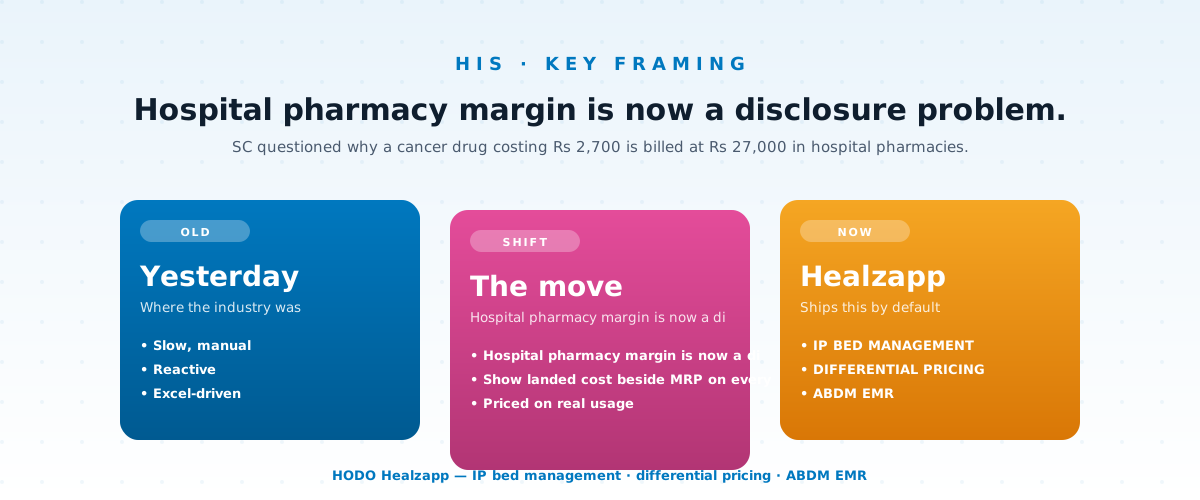
Hospital pharmacy margin is now a disclosure problem.
Where the margin actually sits in a 100-bed hospital
Pharmacy is typically the second or third largest revenue line after bed and procedure charges, and in oncology-heavy or ICU-heavy case mixes it can top the list. But the margin is rarely a single decision. It accumulates across procurement terms with distributors, batch-wise purchase rate variation, trade margin on fast movers, bundled consumable charges on IP indents, and write-offs on expiry that get quietly priced back into the next cycle.
This is why the cost per admitted patient is so hard to pin down in most hospitals of this size. The IP bill shows pharmacy as a consolidated figure. The purchase side lives in a separate ledger, often reconciled monthly. Package rates under TPA and government schemes bundle drugs and consumables into a single head, so the hospital absorbs an unknown spread on each case without knowing which packages are actually loss-making.
The operational consequence is that nobody at the decision table sees margin by batch, by therapy area, or by payer at the time it matters. Procurement negotiates blind. The counter bills at MRP because MRP is the only rate it trusts. Finance discovers the picture a month later. The fix is not a policy memo, it is making landed cost, billed rate and payer context visible in the same screen, at the same moment, to the staff who act on them.
Close the gap between purchase price and billed rate
The first structural correction is traceability from goods receipt to patient bill. Every dispensed unit should carry its batch, its purchase rate, its expiry and its receiving document, so that any pharmacy line on any bill can be opened and read backwards. Once that chain exists, the markup on a given drug stops being an opinion and becomes a calculated field.
Three things follow from it. One, the pharmacy counter can be shown landed cost alongside MRP, which changes behaviour on substitution and on high-margin fast movers. Two, expiry and near-expiry stock stop being hidden costs, they get flagged against a specific batch and a specific purchase decision, which is where the correction belongs. Three, finance reconciliation moves from monthly guesswork to daily agreement between the pharmacy stock ledger and the accounting books.
Multi-outlet groups have a sharper version of the same problem. Different centres receive different rates from different distributors for the same molecule, and without a common item master the group cannot compare. One-click new-centre setup matters here less for speed and more for standardisation: a new pharmacy counter that inherits the group item master and rate structure cannot invent its own pricing logic in month one.
Differential pricing belongs in a rate master, not at the counter
Hospitals legitimately bill different rates to different payers. Cash patients, TPA panels, government schemes, corporate contracts, referring partners and staff all sit on different commercial terms. The risk is not that these rates differ, it is that they differ by discretion. When a billing executive applies a concession manually, the hospital loses both the margin and the audit trail at once, and cannot later demonstrate that pricing was applied by policy.
Configuring differential pricing per payer and per partner inside the system converts that discretion into a rule. The rate that appears on the bill is the rate the management approved, applied automatically based on who is paying. Exceptions still happen, but they become logged exceptions with an approver attached, which is exactly what any scrutiny of pricing is looking for. Corporate and referral partners given their own logins can see the rates applicable to them, which removes a large share of the disputes that currently consume billing staff time.
There is a cashflow benefit alongside the governance one. TPA and scheme claim rejections frequently trace back to a pharmacy line billed outside the agreed package or at a rate the payer does not recognise. Rate discipline at the point of billing reduces the rework loop that keeps receivables ageing. For a 100-bed hospital running thin on working capital, that loop is often more expensive than the margin being argued about.
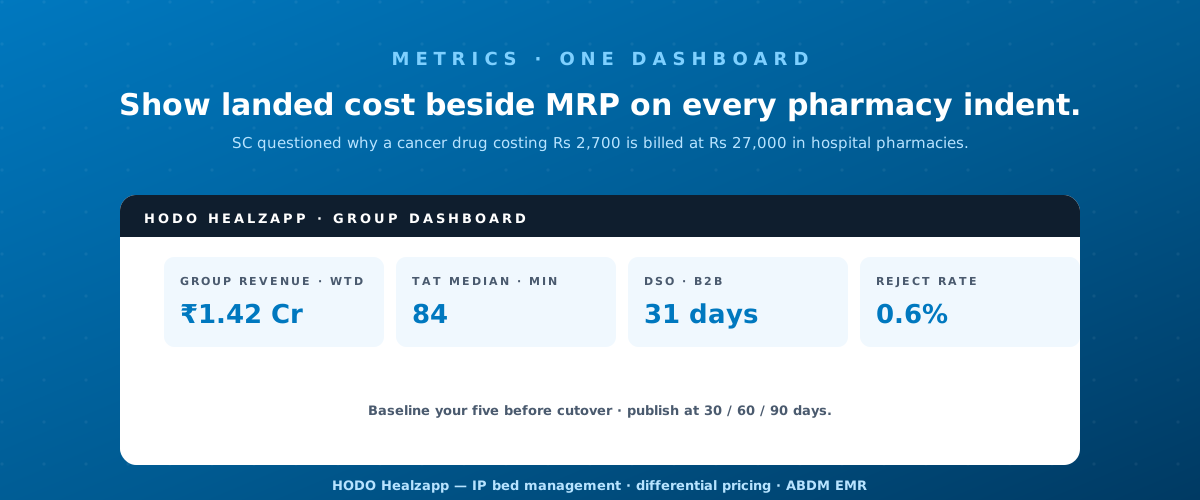
Show landed cost beside MRP on every pharmacy indent.
Inventory discipline is what makes the margin defensible
A hospital that can justify its pharmacy pricing is usually a hospital that runs tight stock. Reorder levels set against actual consumption rather than habit. Batch-wise issue so that older stock moves first. Dead stock reviewed monthly and returned or exchanged while it still can be. Indent flows from the nursing station and OT recorded against the patient at the time of consumption instead of being reconciled at discharge.
Each of these reduces the hidden cost that markup is quietly covering. Wastage, pilferage, emergency purchases at poor rates and expiry write-offs are the real reason many pharmacies hold a margin they cannot explain. Remove those, and the explainable margin that remains is a defensible number, one that covers storage, cold chain, licensed pharmacist cost, 24x7 availability and inventory carrying cost, and can be presented as such.
This is also the groundwork for anything a hospital wants to do next on pricing transparency, whether that is publishing rate boards, offering a cost estimate at admission, or standardising package costing across a chain. None of it is possible on a pharmacy that reconciles once a month.
What this means for HODO customers
Scrutiny of hospital drug margins is not going to reverse, and the hospitals that handle it best will be the ones whose systems already answer the question. In Healzapp, the Pharmacy module works against the same item and batch master as Inventory, so dispensing, stock position, expiry and purchase rate stay on one chain rather than three. Differential pricing applies payer and partner rates by rule at the point of billing instead of leaving them to counter discretion, and Tally integration keeps the pharmacy ledger and the accounting books reconciled without a month-end scramble. For groups adding counters, multi-outlet scale-up with one-click new-centre setup keeps every new pharmacy on the same masters from day one.