Healthcare Asia Magazine has put the question most Indian expansion plans quietly avoid: if tariffs are capped, what happens to the next hundred beds? The honest answer is not that expansion stops, mid-sized hospitals continue to add blocks, ICUs and day-care theatres every quarter. What changes is the arithmetic. Under a cap, the decision moves from revenue per bed to cost per occupied bed-day, and most ~100-bed hospitals cannot see that number until the books close for the month.
Why the cap question lands hardest at 100 beds
Price regulation in Indian healthcare is not a new development. NPPA ceilings on coronary stents and knee implants, CGHS and ESIC rate schedules, PMJAY package rates under the Health Benefit Package, state notifications under the Clinical Establishments Act requiring display of standard rates, and pandemic-era state caps on ICU per-day charges have all narrowed pricing freedom over the last decade. Large corporate chains absorb this through procurement scale, harder payer negotiation, and ancillary revenue streams that sit outside the capped procedure.
The single-unit or two-unit ~100-bed hospital has none of those cushions. It buys implants in small lots, negotiates with TPAs from a weak position, and earns most of its margin inside exactly the procedures and bed-day charges a cap touches. For this cohort, a cap does not shave a few percentage points off a large base, it converts a pricing lever into a cost problem overnight. And it reframes the expansion question entirely. The board stops asking whether the new block will fill, and starts asking whether the new block can be run profitably at the capped realisation rather than at last year's cash rate. That is a very different feasibility study, and it needs operational data the finance team usually does not have.
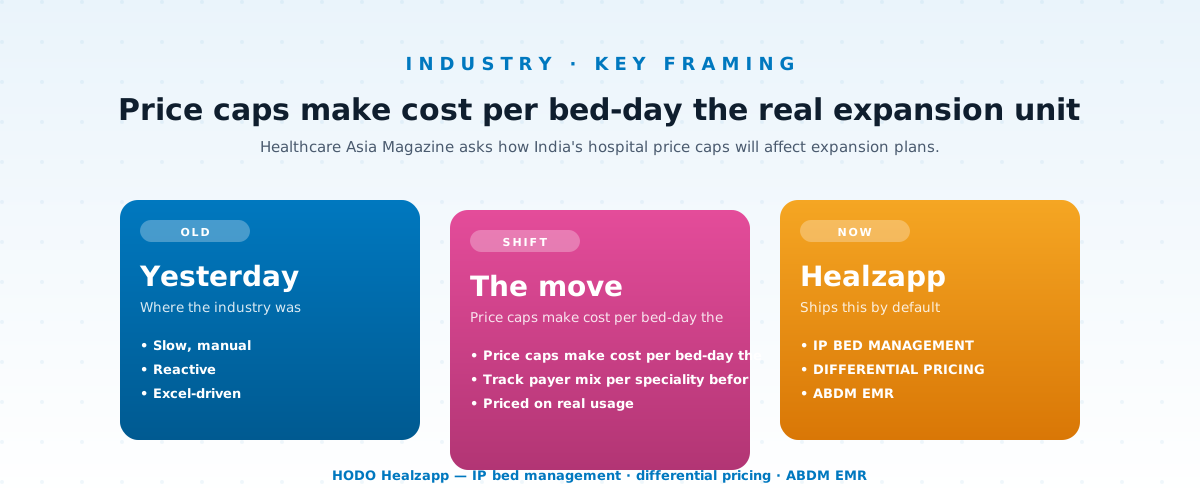
Price caps make cost per bed-day the real expansion unit.
Cost per occupied bed-day decides the next block
Cost per occupied bed-day is a simple idea that is painful to compute. It adds nursing hours actually rostered against that ward, consumables issued, pharmacy indents, diagnostics performed, housekeeping and utilities, and the equipment EMI or lease allocated to the speciality, then divides by beds actually occupied, not beds installed. Most hospitals of this size know a blended margin at month-end and an occupancy percentage at week-end. Very few know what a general ward bed-day costs in orthopaedics versus what it costs in paediatrics.
Without that split, a capped-rate projection for a new block is guesswork. With it, several levers become visible immediately. Discharge timing is the largest and most ignored: a hospital whose discharge summaries and final bills clear at 4 pm instead of 11 am loses close to half a bed-day of capacity on every discharge, which under a cap cannot be recovered by charging more. Average length of stay by package, bed turnaround interval between discharge and next admission, and the gap between admission advice and actual bed allotment all move the same number. These are HIS-resident metrics, not accounting metrics, and they only exist if bed status, nursing activity and billing sit on the same system rather than in three disconnected registers.
Payer mix becomes a capacity decision, not a finance line
When rates are capped, blended realisation is determined almost entirely by payer mix, and payer mix is set every morning by whoever allots beds. A PMJAY package rate, a TPA tariff, a corporate agreement and a cash rate for the same procedure can differ widely, which means the admissions desk is making a margin decision each time it assigns a bed to one queue or another. Most hospitals treat this as a front-office formality and then discover the consequence six weeks later in the receivables ageing report.
Two numbers deserve to be tracked weekly rather than monthly. The first is realisation per occupied bed-day by payer and by speciality, not billed value, but realised value after package deductions, non-payable items and short settlements. The second is claim rejection and short-payment rate by payer, with the reason codes attached, because a 6 per cent rejection rate on a scheme block is effectively a second price cap layered on top of the official one. Cashflow discipline matters just as much as margin here. A new block running on 45 to 90 day scheme and TPA receivables needs working capital planning alongside capex, and a hospital that cannot produce payer-wise outstanding on demand will finance that gap expensively.
The margin leak sits in consumables, pharmacy and the lab
If the revenue side is fixed by notification, every remaining rupee of improvement comes from the cost side. In practice the leak concentrates in a handful of predictable places. Implants and high-value consumables procured above the package allowance turn a profitable case into a loss-making one. Pharmacy indents raised at the ward and never tied back to the patient bill become unbilled consumption. Lab and imaging tests get repeated because the earlier result was not visible to the treating consultant at the bedside. Tests sent to a partner lab at near-retail cost erode what the in-house menu would have earned. Analyser values typed in manually produce transcription errors that trigger repeat runs and reagent wastage.
None of these are clinical failures. They are integration failures, and each one is measurable. A monthly review of consumable cost per package against the capped allowance, pharmacy issue-to-bill reconciliation, repeat-test percentage, outsourced-test cost share, and equipment downtime against AMC coverage will usually surface more recoverable margin than any tariff renegotiation available to a 100-bed hospital. The hospitals that survive cap regimes are the ones that run this review as a standing operational discipline rather than an annual audit exercise.
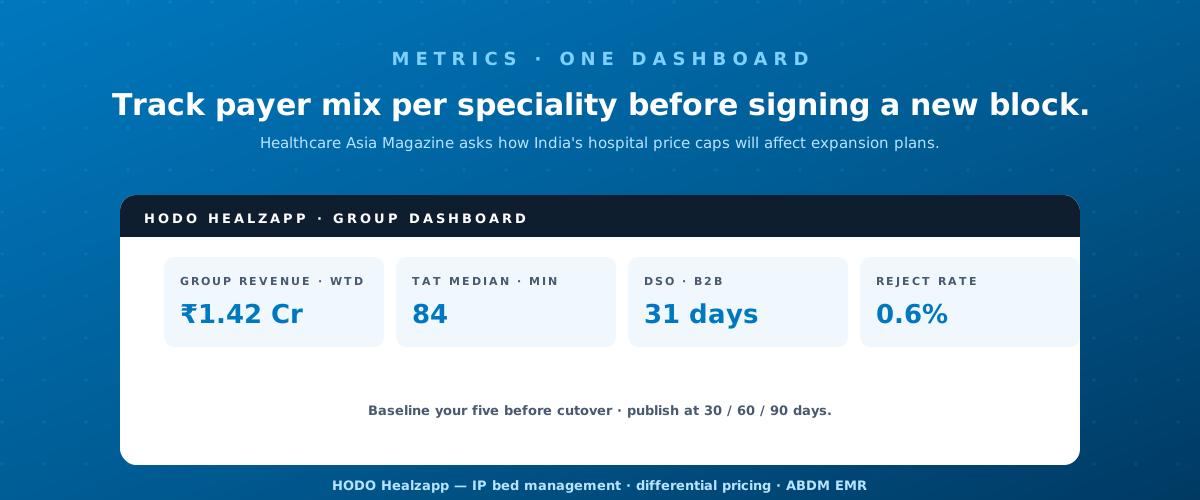
Track payer mix per speciality before signing a new block.
Expansion under a cap is a repeatability problem
The deeper constraint on adding centres is not capital, it is standardisation. When a second or third unit invents its own service master, its own rate card, its own discount practice and its own discharge workflow, the cap exposes the variance ruthlessly. The same procedure gets billed three ways, package compliance differs by site, and consolidated reporting becomes a monthly reconciliation project instead of a dashboard.
Expansion that works under price caps looks boring from the outside: one service and tariff master, payer-wise rate cards applied by rule rather than by front-office judgement, identical IP workflows across units, consolidated books that close without manual mapping, and referral and corporate channels that keep ancillary volume flowing into the new centre from day one. Boring is the point. Repeatability is what allows a capped-rate business to add beds without adding proportional overhead.
What this means for HODO customers
HODO Healzapp is built for exactly this cohort, ~100-bed hospitals and Indian clinic chains operating under scheme and TPA rate pressure. Differential pricing holds payer-wise and partner-wise rate cards so PMJAY, TPA, corporate and cash realisation are applied by rule instead of being reconstructed at month-end. IP bed management with the Nursing Station gives live bed status, turnaround and discharge timing, which is where capped-rate capacity is won or lost. Machine Interfacing removes manual analyser entry and the repeat-test wastage that follows it, while Multi-outlet scale-up with one-click new-centre setup and Tally integration keep masters, tariffs and consolidated books consistent as the second and third unit come online.