Carlyle has acquired Knack RCM and Equalize RCM and intends to combine them into a single AI-native, global multi-specialty revenue cycle management platform, according to The Economic Times. The deal is pointed at American providers, and much of the delivery muscle sits in Indian cities. For a 100-bed hospital in Kozhikode, Nagpur or Guntur, the useful part is not the transaction itself, it is what a private equity firm has decided is now worth industrialising.
What Carlyle actually bought
Strip the announcement of its adjectives and the purchase is simple: two mid-sized RCM service businesses, a combined client base spread across specialties, and a trained workforce that already processes claims at volume. The AI-native label describes an intended direction, coding assistance, denial prediction, automated follow-up on ageing claims, document extraction from remittance advice, rather than something finished on day one.
What makes the bet rational is the raw material underneath. RCM vendors buy access to millions of structured encounters: consistent payer identifiers, standard code sets, machine-readable remittance files, predictable adjudication rules. That uniformity is precisely what makes models useful on billing work. The commercial logic is that once claim data is regular enough, a large share of follow-up stops being judgement and becomes pattern matching, and margin follows from there.
The lesson travels even though the deal does not. Capital is moving towards whoever holds clean, structured claim data, not towards whoever employs the largest billing team. A hospital that cannot produce its own claim file in a consistent shape is sitting on an asset nobody can automate, including itself. That is a data discipline question, and it is answered in the HIS long before anyone shops for an AI layer.
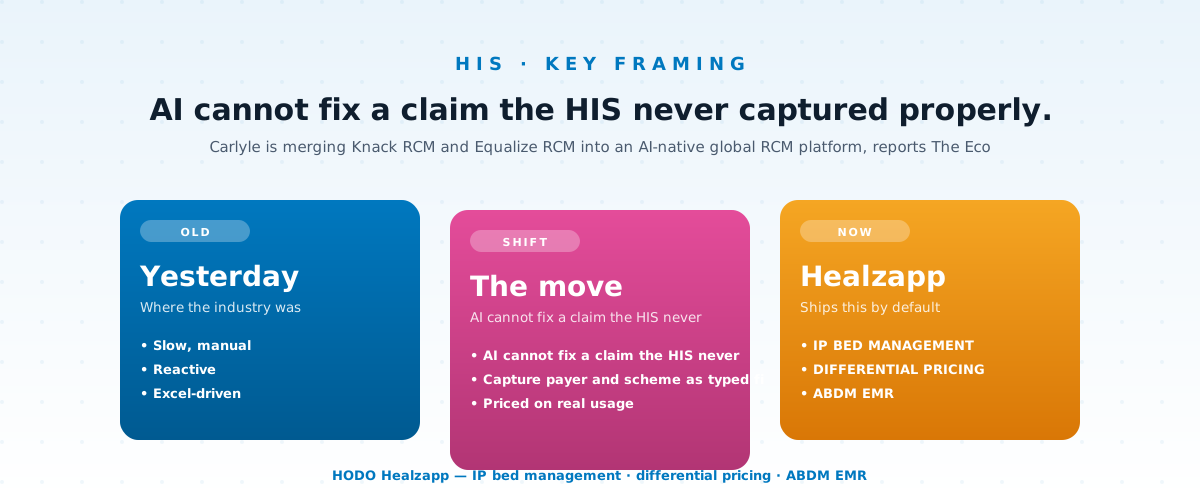
AI cannot fix a claim the HIS never captured properly.
Why India's RCM export machine skips Indian hospitals
India runs one of the world's largest healthcare back offices, and almost none of that capability points inward. The export business works because the substrate is stable: one broad coding standard, payer rules published in advance, electronic remittance that can be parsed, and denial reasons that arrive as codes rather than as phone calls.
Domestic claims work has none of that uniformity. A single 100-bed hospital may be dealing with a dozen TPAs, two or three insurers directly, a state scheme, PMJAY, several corporate and PSU panels, and cash patients, each with its own pre-authorisation format, document checklist, tariff sheet and portal. Package inclusions change without a data feed. Queries come back as scanned letters. The same procedure carries four different names across four rate cards.
So the offshore playbook cannot be imported wholesale. What can be imported is the sequencing. The vendors now being rolled up did not begin with models; they began by forcing every encounter into the same shape, and only then put software on top. The Indian hospital's version of that groundwork is unglamorous and entirely doable: one patient identity that survives across visits, one charge master, one field where payer and scheme are recorded at registration, and a discharge process that cannot close while mandatory documents are missing. None of that requires artificial intelligence. All of it decides whether artificial intelligence would have anything to work with later.
AI on claims is only as good as the source record
Most claim trouble in a mid-sized Indian hospital is created in the first twenty minutes of the visit and discovered three weeks later. The front desk types the TPA name slightly differently from last month, so payer-wise ageing cannot be totalled. The scheme changes mid-stay and the earlier days are never re-tagged. Investigations get billed after the discharge summary is signed, so the file and the bill disagree. The clinical note records a working impression in free text that does not support the procedure claimed.
An AI layer trained on this material learns the hospital's inconsistencies rather than the payer's rules. The fix is structural. Payer, scheme, policy number and corporate panel belong in typed fields captured at registration, not written into a remarks box. Charges should reach the bill from the point of service automatically, Machine Interfacing doing that for lab and imaging removes an entire category of missed and duplicated line items. Clinical documentation should be assembled, not reconstructed: an EMR (AI-condensed history) that gives the billing executive a readable summary of the admission shortens the gap between what happened and what gets claimed.
The test is blunt. Pick ten recent discharges and ask how long it takes to assemble a complete claim file without telephoning a consultant. If the answer is more than a few minutes, the problem is capture, not follow-up, and no amount of automation downstream will repair it.
Payer mix is a pricing problem before it is a billing problem
Hospitals in the 50–150 bed range usually know their overall realisation. Far fewer can state the realisation per payer after deductions, or the average days in accounts receivable for each TPA separately. Without that split, a deteriorating panel hides inside a healthy-looking aggregate for months.
The mechanics are ordinary. Each TPA, corporate and scheme should carry its own tariff in the system rather than in a shared spreadsheet that someone updates by hand, Differential pricing exists for exactly this, and it also removes the argument about which version of the rate card was current on the date of admission. Referring doctors and corporate partners need their own visibility into what was sent and what was settled, which is the practical use of B2B Referral / Outsource Lab / Corporate-partner logins. Finance needs the ledger to agree with the billing system without a monthly re-keying exercise, which is what Tally integration is for.
Once those three are in place, receivables ageing by payer becomes a report rather than a project, and renegotiation conversations can be held with evidence instead of impressions.
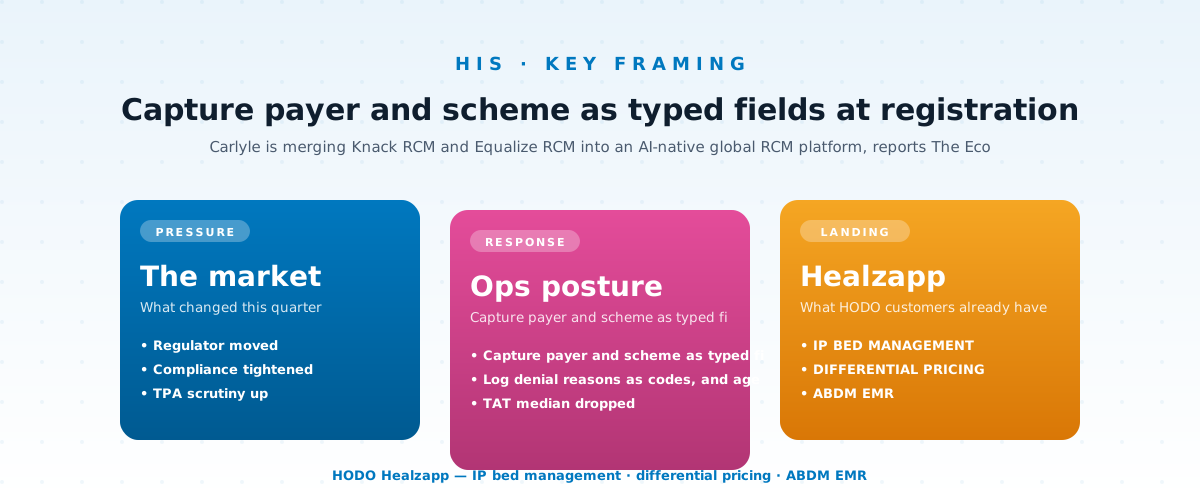
Capture payer and scheme as typed fields at registration.
The staffing squeeze nobody budgeted for
There is a second-order effect of consolidation that hospital administrators should price in. A larger, better-capitalised RCM platform hires aggressively, and it hires from the same pool of billing and coding staff that Indian hospitals depend on. The billing supervisor who personally remembers which TPA insists on which annexure is a recruitable asset.
The defence is not higher salaries alone. It is reducing how much of the revenue cycle lives in one person's memory. Payer rules should sit in the system as configuration. Denial reasons should be logged as a fixed list of codes, not as free text, so that repeat causes surface on a report rather than in a meeting. Checklists should be enforced at the point where a file is submitted. Two people should be able to run the claims desk on any given week without a handover document.
Measured properly, the goal is narrow: raise first-pass acceptance, and shorten days in receivables per payer. Both are visible weekly. Both improve from process discipline long before any model is involved.
What this means for HODO customers
The signal from the Carlyle deal is that structured claim data is the thing being valued, and that is built inside the hospital information system, not bolted on afterwards. In Healzapp, Billing holds payer, scheme and tariff as typed fields from registration onwards so payer-wise realisation and ageing can be reported without manual consolidation. Differential pricing keeps each TPA, corporate panel and scheme on its own rate card, versioned and applied automatically. EMR (AI-condensed history) shortens the distance between the clinical record and the claim file, so submissions go out complete the first time rather than after a round of queries. For groups running more than one unit, Multi-outlet scale-up keeps the same charge master and payer configuration consistent across centres, which is what makes consolidated revenue reporting meaningful at all.