A recent Nasscom analysis, Beyond the HMIS: Why Hospital Transformation Is a Patient-Journey Problem, Not a Software Problem, makes an uncomfortable point for anyone who has spent the last five years buying and configuring hospital information systems. The bottleneck in most Indian hospitals is not the absence of an HMIS. It is the absence of a coherent patient journey that the HMIS is expected to serve.
The HMIS-first mindset has quietly stalled
Between 2018 and 2024, most 100-500 bed Indian hospitals bought at least one HIS platform, and many replaced or bolted on modules multiple times. Board decks routinely cited digital transformation as a strategic priority, and CFOs signed off on seven-figure implementation budgets on the strength of that framing. Yet a walk through the OPD of a mid-sized private hospital in Kochi, Pune or Nagpur still shows queues at registration, patients circling between billing and pharmacy, and case sheets travelling on paper between the OP consultant and the sample-collection room. The software went in. The journey did not change.
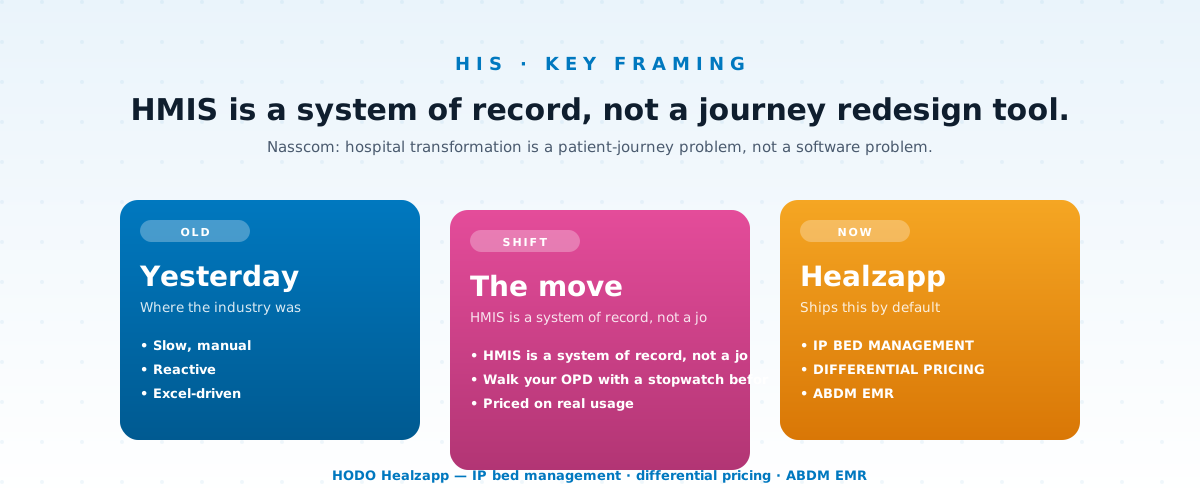
The Nasscom piece frames this bluntly: an HMIS is a system of record. It captures what happened. It does not, on its own, redesign what should happen. When administrators treat HIS procurement as the transformation itself, the vendor is set up to fail and so is the finance team that signed the invoice.
HMIS is a system of record, not a journey redesign tool.
Where HMIS deployments actually break
Operationally, three fault lines show up again and again during HIS audits. First, the registration desk still asks for the same demographic data that the appointment app already captured, because the appointment module and front-office module were purchased from different vendors or deployed by different project managers. Second, the discharge summary is typed twice: once by the resident into the EMR, once by the billing clerk into the invoice narrative, because nobody defined a single source of clinical truth. Third, IP bed status is updated by nursing on a whiteboard and then re-entered into the HIS at end of shift, which means the admissions counsellor is quoting bed availability from data that is six hours old.
Each of these is a journey problem masquerading as a software problem. Replacing the HIS does not solve them. Sequencing the journey, and configuring the HIS to enforce that sequence, does.
What mapping the journey actually looks like
Owners who have moved the needle on throughput share a common practice: they physically walk the OPD and IPD paths of a patient for a full day, stopwatch in hand, before signing off on any new HIS scope. Registration to consultation. Consultation to lab. Lab to billing. Billing to pharmacy. Every handoff is logged with elapsed time and the number of times the patient repeats information already in the system.
The output is usually a spreadsheet with 40-60 discrete steps and the observation that 15-20 of them add zero value. Consolidating registration and billing at a single counter, pushing lab report delivery to WhatsApp instead of a physical printout collected the next day, and moving token queue management to a TV display rather than a receptionist shouting names, these are journey redesigns. The HIS then supports them, rather than dictating them.
Metrics operators should track after redesign
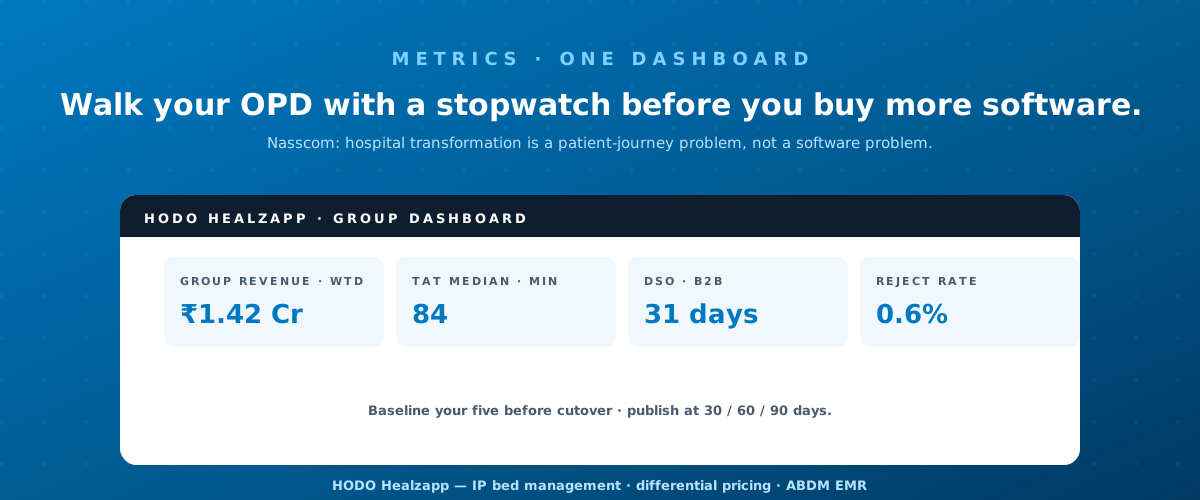
The metrics that matter to a hospital owner are not the ones vendors put on demo slides. They are: OPD door-to-consult time, lab TAT from sample collection to report delivery, IP admission-to-bed-allocated time, claim submission lag from discharge, and revenue realisation cycle from patient billing to bank credit. Every one of these is a journey measure, not a software feature.
Hospital groups that publish these numbers monthly to the leadership team, even only internally, tend to see them improve. Groups that only look at HIS uptime and module adoption rate do not. The Nasscom framing is useful here because it forces the conversation away from did we implement Module X and towards did the patient's experience of this journey get shorter and cleaner.
Walk your OPD with a stopwatch before you buy more software.
The multi-outlet compounding problem
For diagnostic chains, clinic groups and hospital brands expanding to a second, fifth or twentieth outlet, the journey problem compounds. The centre-of-excellence model, where the flagship defines the process and new outlets clone it, works only if the flagship's process is documented and enforceable. Each new centre inherits whatever informal workarounds the flagship developed, and adds its own local ones. Within eighteen months the group is running four dialects of the same HIS: same vendor, same version, wildly different workflows. Corporate reporting becomes an exercise in reconciliation. Referring-doctor payouts get contested because the underlying transaction data does not line up. Standardising the patient journey at the group level, and then encoding that journey into the HIS as the default configuration for every new centre, is what makes multi-outlet operations profitable rather than merely bigger.
What this means for HODO customers
Healzapp is built on the assumption that the HIS should enforce a designed patient journey rather than record whatever happens. Three features are worth reviewing in this context. Appointments captures demographics and consent once so registration does not re-ask, cutting the door-to-consult step. TV Token Display replaces receptionist-driven queue calling and gives the OPD a visible flow that patients and staff can both read. EMR (AI-condensed history) gives the consultant a two-line prior summary rather than a scroll of past visits, so the consultation itself is faster and the discharge or prescription flows into billing without a re-typing loop. For groups scaling outlets, Multi-outlet scale-up with one-click new-centre setup means the journey configured at the flagship is what every new centre inherits on day one.