Hamad Medical Corporation has cut the average wait for a specialist appointment from 58 days to 16 days, according to Gulf Times. That is a 72% reduction inside a public system, and the number is now a benchmark private polyclinics across the UAE, Qatar, Kuwait and Bahrain will be asked about by their own patients, because those patients read the same newspaper.
Why the 58-to-16 number matters for private clinics
HMC is Qatar's public network, so the direct comparison with a Dubai or Sharjah polyclinic is not apples to apples. But the operational lesson travels. Specialist wait time is not a clinical variable, it is a scheduling, referral and no-show variable. When a walk-in patient at a Sheikh Zayed Road clinic is told the dermatologist is booked for three weeks, the cause is almost always one of four things: single-slot booking, insurance pre-authorisation delays, referral leakage from GP to specialist inside the same clinic, or a no-show rate above 15% that goes unmeasured. HMC did not hire 3x more specialists in twelve months, it worked the schedule. Private polyclinics have more room to move here than a public hospital does, because they own the entire patient journey from reception to billing to follow-up. The question worth asking this week: what would your own booking board show if you measured true wait-to-third-available-slot, per doctor, for the last 90 days? Most clinic owners have never seen that number for their own practice.
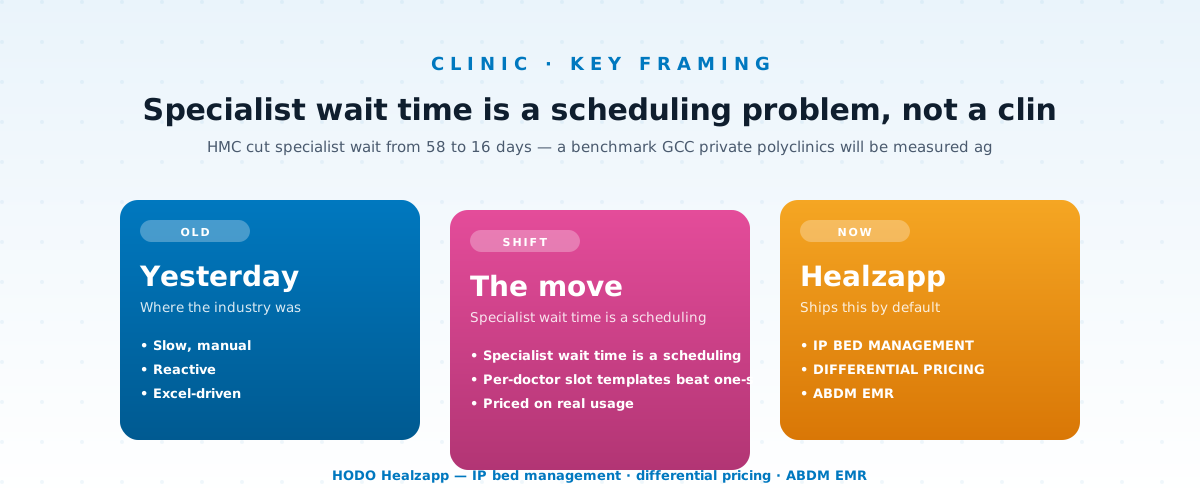
Specialist wait time is a scheduling problem, not a clinical one.
Multi-doctor scheduling as the primary lever
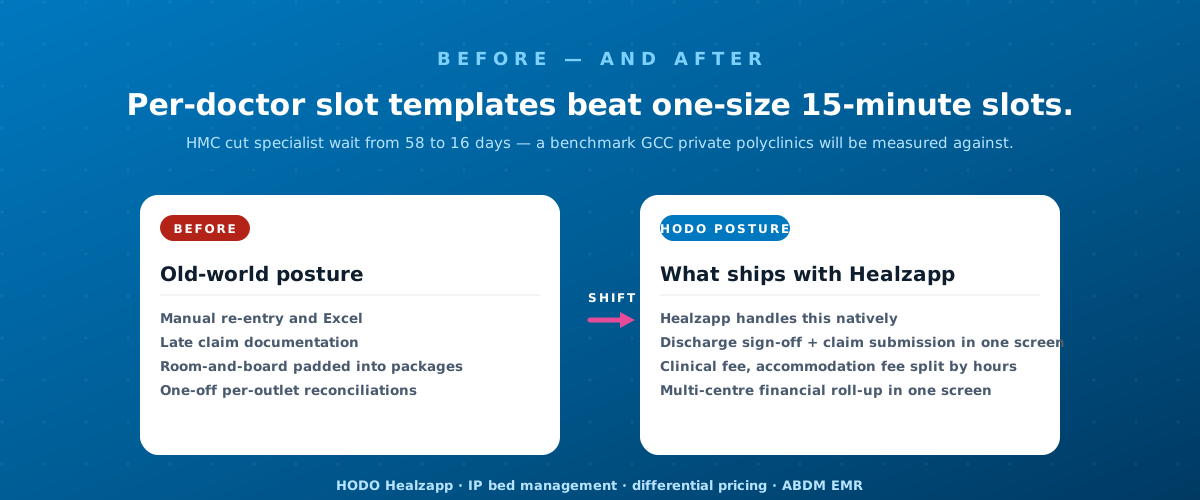
Most GCC polyclinics run 6–20 doctors across two or three shifts. The scheduling engine underneath that is where wait times either compress or blow out. Fixed 15-minute slots for every specialty is the most common mistake, a dermatologist's follow-up is not a 15-minute visit, and a GP consultation for a family of four is not one either. Slot templates need to vary by doctor, by visit type, and by insurance carrier, because pre-auth adds real minutes at reception. The second lever is same-day capacity: reserving roughly 20% of a specialist's day for urgent add-ons that a GP inside the same building can push into. The third is patient-driven rescheduling. When patients can shift their own slot from a mobile app instead of ringing reception, no-show rates typically drop by 30–40% in a clinic setting, freeing capacity for someone on the waitlist within the same week.
Insurance pre-auth is a scheduling problem in disguise
In Dubai, Abu Dhabi and Doha, insurance pre-authorisation for specialist visits, MRI, endoscopy, cardiology follow-up, is often the actual reason a slot sits empty. The clinic offered the slot, the patient wanted it, but the insurer approval took six days. The right response is not more phone calls to the insurer; it is running pre-auth as a parallel workstream the moment the GP writes the referral, not when the patient rings reception to book. A HIS that treats referral, pre-auth and specialist booking as three separate screens will always leak time. A HIS that treats them as one workflow, with DHA or MOHAP-format claim data pre-populated from the GP encounter, gets the patient into the specialist chair inside a week. That is the operational shape of HMC's win, translated for private practice.
Teleconsultation as a triage valve, not a product line
Every polyclinic in the Gulf added teleconsultation during 2020–2022, most treated it as a separate revenue line, and most quietly let it drift. That is a missed lever. The strongest use of teleconsultation in a multi-specialty clinic is not as a standalone service, it is as a 10-minute triage call the GP or nurse does before deciding whether a patient needs a specialist slot at all. Roughly a third of dermatology, ENT and gastro walk-ins can be resolved or deferred at the triage layer. That third, removed from the specialist waitlist, is where the 58-to-16 style compression actually comes from. It also protects specialist time for cases that genuinely need it, which is the throughput metric a clinic owner cares about at the end of the quarter.
The final 40% of wait-time reduction is unglamorous. It is TV token displays at reception so patients know where they are in the queue and stop crowding the desk. It is multi-currency billing that finishes in one screen so the next patient is not waiting behind a payment dispute. It is WhatsApp report delivery so lab and imaging results reach the patient and referring GP without a follow-up phone call at 8pm. Each of these saves minutes, but minutes compound into slots, and slots compound into wait times. A polyclinic that fixes the front desk and the report handoff can add roughly one specialist's worth of daily capacity without hiring anyone new.
What this means for HODO customers
For polyclinic groups running HODO Healzapp across Dubai, Abu Dhabi, Doha, Kuwait or Manama, the levers above map to modules already in the stack. Appointments supports per-doctor slot templates, same-day reserved capacity and patient-driven rescheduling through the Patient Health App, the tooling to move no-show rates down and third-available-slot times with them. Teleconsultation sits inside the same encounter record, which is what makes a 10-minute triage call useful rather than administrative overhead. WhatsApp/SMS report delivery closes the loop on lab and imaging results without a receptionist making outbound calls. Add multi-currency billing configured for DHA and MOHAP claim formats, and the four operational drags behind long specialist waits, slot design, pre-auth latency, unnecessary specialist visits, and report handoff, are each addressed by a named module rather than a workaround. HMC's 58-to-16 number is a public benchmark now; private clinics that treat it as one will find their patients doing the comparison for them.