Abu Dhabi has just opened Hub71+ Life Sciences, a dedicated cluster for biotech and medtech startups inside the Hub71 ecosystem, according to Gulf Business. The move signals that the UAE wants more than digital-health apps, it wants clinical-grade companies building diagnostics, therapeutics, and connected medical devices in the emirate. For healthcare founders sitting on a lab-at-home idea or a diagnostic platform, the runway just got longer, but so did the buyer's checklist.
What Hub71+ Life Sciences actually is
The new cluster sits alongside Hub71's existing verticals and adds infrastructure that generic tech accelerators cannot easily match: wet-lab space, regulatory pathways aligned with the Department of Health Abu Dhabi (DoH), and access to clinical networks through Mubadala-linked hospitals. The stated intent is to attract international life-sciences companies and localise R&D that would otherwise happen in Boston, London, or Bengaluru. For founders, this is not another co-working space with a healthcare label, it is the first serious signal that Abu Dhabi wants to compete for medtech deep-tech, not only SaaS.
The practical implication is that capital is easier to reach, but the bar for what counts as "life sciences" is higher. A pure-play appointment-booking app will not clear it. A diagnostic company with a machine-integrated LIMS, or a home-collection network with a defensible operations model, will. Founders assessing whether to apply should audit their pitch against that harder line before spending a slot in the pipeline.
Abu Dhabi's Hub71+ Life Sciences raises the bar for medtech founders.
Why the timing works for medtech founders in the GCC
Three shifts make 2026 a genuinely good year to build a UAE-headquartered medtech or diagnostic business.
First, insurance penetration in Abu Dhabi and Dubai now covers most residents, and DHA and DoH have both hardened the coding and claims rails. A new lab or clinic can bill an insurer within weeks, instead of waiting eighteen months for panel empanelment as often happens in other markets.
Second, population health data is being centralised via Malaffi in Abu Dhabi and NABIDH in Dubai. A startup that integrates its LIMS or HIS with these networks from day one is instantly discoverable to referring physicians, a distribution advantage that older lab chains do not have.
Third, the labour cost of running a night-shift phlebotomy team or a 24-hour report-processing operation is materially lower than in Western Europe, but the price ceiling per test is closer to European levels. That gap is where lab-at-home and specialty diagnostic founders will find their gross margin.
The build-vs-buy trap that kills first-time healthtech founders
Most first-time founders in this space burn eight to fourteen months of runway building a lab information system, a barcode workflow, and a report-delivery pipeline from scratch. By the time the MVP works, the clinical partner has moved on, the seed round has drained, and the team is doing engineering work that adds zero defensibility.
The pattern is predictable because it feels productive. Writing code is measurable; buying software feels like an admission that the technical moat is thin. But investors funding UAE life-sciences companies in 2026 are not paying for a rebuilt LIMS. They are paying for clinical validation, insurance contracts, a phlebotomist network, and unit economics per home visit.
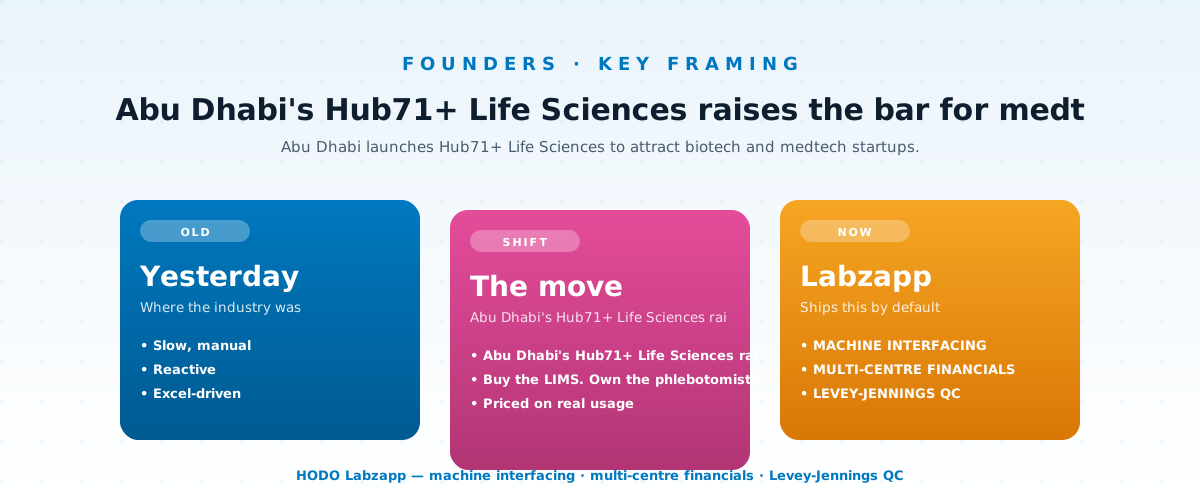
A cleaner playbook is to rent the operational software and own the clinical protocols and the go-to-market. A LIMS with barcoded samples, machine interfacing, and franchisee management already exists off-the-shelf. A regulatory-approved home-collection SOP, a Malaffi integration certified for a specific test panel, and a signed corporate wellness contract do not. Founders should spend their engineering cycles where they cannot buy.
Reference architecture for a lab-at-home or diagnostic startup
Founders who ask what a reasonable diagnostic stack looks like in 2026 tend to converge on the same five components: a LIMS with barcoded sample tracking, machine interfaces to the analysers on-site, a mobile phlebotomy application for home-collection routing, an automated report-delivery layer over WhatsApp and email, and a partner portal for referring clinics and corporates.
Off-the-shelf platforms cover this well. HODO Labzapp, for example, is used by lab chains and lab-at-home networks that need multi-centre financial consolidation, TAT reporting per test category, and Levey-Jennings quality-control charts without a dedicated data team. The advantage for a founder is not the feature list, it is that the phlebotomy chain-of-custody, the barcode-to-machine handshake, and the corporate-partner login flows have already survived audits at other operators.
What the founder still owns is the specialty test menu, the referring-doctor relationships, the pricing model, the phlebotomist SLAs, and the clinical governance. That is where a Hub71+ investor will look for defensibility, not in whether the LIMS was built in-house.
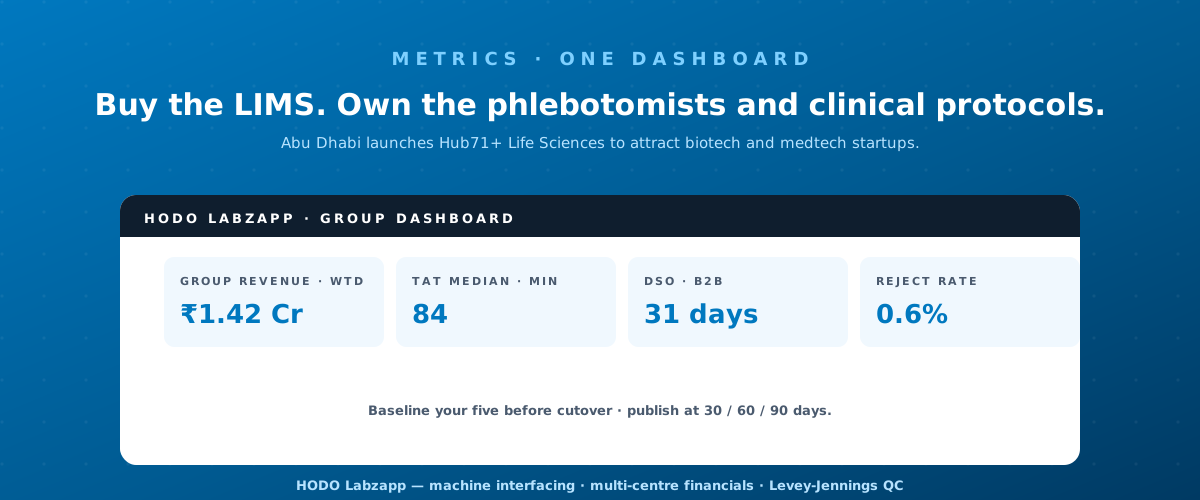
Buy the LIMS. Own the phlebotomists and clinical protocols.
Unit economics, TAT, and the metrics investors will ask about
Life-sciences investors in the GCC evaluate diagnostic and home-collection companies on three numbers: cost per collected sample all-in, including phlebotomist time, kit and route; turnaround time from collection to signed report; and gross margin per test category. Anything above these, brand, marketing spend, application design, is downstream.
A founder pitching Hub71+ should be ready to show TAT distributions per test, not only averages; sample rejection rates by centre; and partner-portal volume as a percentage of total orders. Reporting infrastructure that produces these numbers weekly is worth more than a slicker patient-facing application. Operators who cannot answer "what is your TAT p95 on CBC across the last thirty days" will not raise a serious Series A in this market, regardless of the deck.
What this means for builders
For founders applying to Hub71+ Life Sciences or building adjacent to it, the message is straightforward: buy the operational spine, own the clinical and commercial moat. A diagnostic or lab-at-home business is not defensible because it wrote its own LIMS; it is defensible because it has a phlebotomist network, a corporate contract book, and clinical protocols regulators trust.
Reference architecture in HODO Labzapp, Barcoded samples + machine interfacing, TAT reporting, and partner-lab integration with anonymised sample tracking, covers the operational layer that first-time medtech founders otherwise rebuild badly. Combined with franchisee management for multi-outlet expansion, it lets a founding team spend its engineering cycles on what actually moves valuation: clinical validation, regulatory approvals, and unit economics per visit.