
The Ministry of Railways has completed Ayushman Bharat Digital Mission integration across 695 hospitals and health centres in its network, according to a report by ANI News. It is one of the largest single-owner ABDM onboarding exercises in India to date, and it changes the conversation for every hospital owner still treating digital health integration as a next-year problem.
Indian Railway runs one of the country's oldest occupational health networks — 125 hospitals and roughly 570 health centres spread across every zone from Kashmir to Kanyakumari. Getting all 695 units on to ABDM means each facility now issues ABHA-linked records, publishes discharge summaries and OP notes to the Personal Health Records app, and — critically — accepts data pulled from external hospitals when a railway employee arrives with prior investigations.
For a hospital owner reading the ANI note, the interesting number is not 695. It is the operational uniformity that had to be enforced across a decentralised, geographically scattered, historically paper-heavy network. Zonal railway hospitals ran different HIS installations, different lab systems, and in many cases no digital EMR at all. The lift was not just technical; it was procedural, and it was executed in a compressed timeline. Private chains with a fraction of that footprint have taken longer to get to the same place.
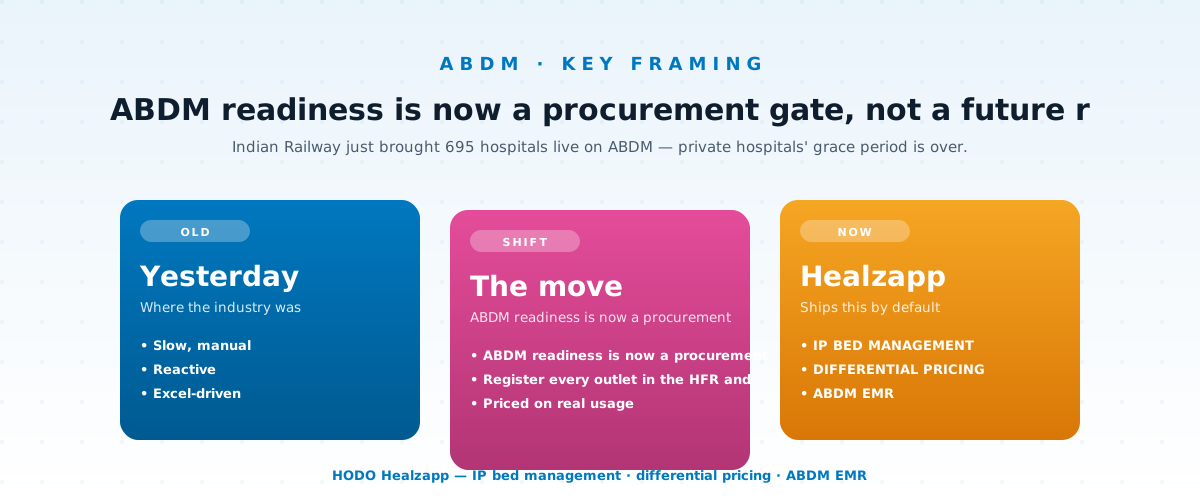
Until 2024, most private-hospital procurement RFPs treated ABDM support as a future-roadmap line item. The Railway rollout, following on from ESIC and several state-government networks, closes that loophole. Insurance TPAs, corporate health-benefits managers, and increasingly the Insurance Regulatory and Development Authority of India expect claim documentation to be ABHA-linked. A hospital that cannot mint an ABHA number at registration, or cannot publish a structured discharge summary to the national health exchange, is quietly getting deprioritised by empanelment desks.
For a 200-bed hospital, that flows downstream in three ways: delayed claim settlement because supporting documents are still faxed PDFs, higher TPA rejections when the discharge summary format does not match the linked ABHA record, and lost corporate contracts to competitors who can offer an ABDM-verified patient journey. None of this is speculative — it is already visible in the tender language coming out of PSU hospitals and larger corporate health-cover buyers this year.
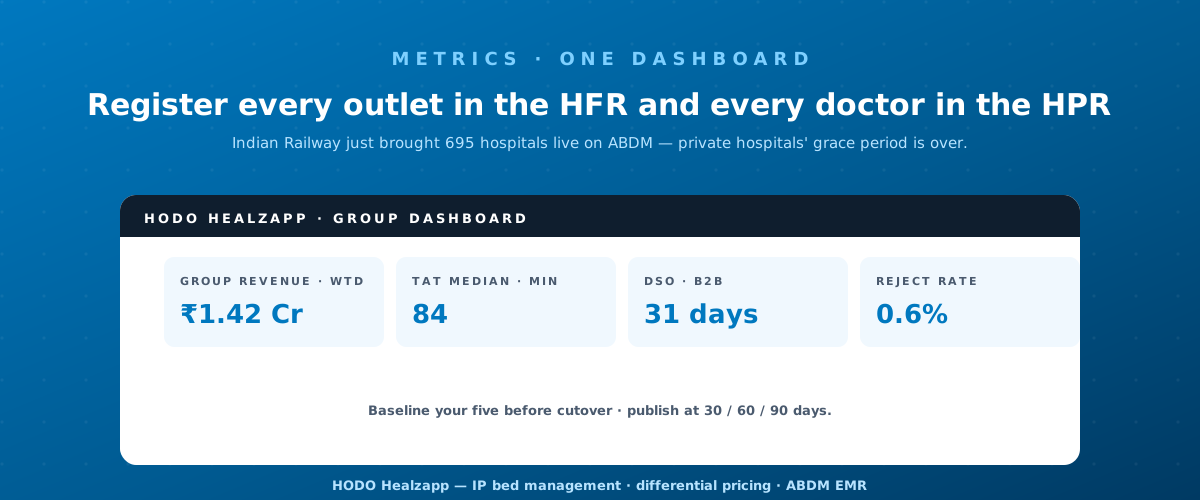
Vendors love to claim ABDM compliance. The Railway integration exposes what real compliance looks like at scale. First, HPR (Health Professional Registry) linkage — every doctor writing a note must be signed against a verified HPR ID, not just a system user. Many older HIS installations still treat doctor as a free-text field. Second, HFR (Health Facility Registry) linkage — each outlet, ward and OT is a distinct registered facility, which becomes painful for chains that spun up branches without formalising each one. Third, FHIR R4 compliance for the actual data payload — an HIS that internally stores data in a proprietary schema has to translate every discharge summary, prescription and lab report at publish time.
Failure at any one of these gates means the hospital appears integrated on paper but cannot actually complete a linked health record transaction. The Railway rollout succeeded because a central team enforced all three across zones. Private chains without that central discipline routinely have two zones live and three failing silently.
The 50-500 bed segment and the multi-outlet clinic segment often watch these government rollouts and assume none of it applies to them. It does — with the added complication that they cannot mandate a central IT team the way Indian Railway can. A pathology chain with 40 collection centres, for instance, has the same HFR registration problem as a railway division: every centre is a distinct facility, every phlebotomist should be an HPR-linked user, and every report published to a patient's ABHA locker has to carry the right facility and professional signatures.
The chains that will scale cleanly over the next three years are the ones treating ABDM registration as part of new-outlet setup, not as a retrofit. Adding a new centre should trigger HFR registration, ABDM gateway credentialing, and staff HPR mapping in the same workflow as ordering signage and getting the trade licence. If those steps live in three different spreadsheets and one WhatsApp group, the chain will be firefighting integrations for years.
A short list, borrowed from what the Railway integration teams actually checked. Does the HIS mint an ABHA number at the registration counter without adding a step for the front-desk staff? Can it publish a structured discharge summary — not a PDF scan — to the PHR? Does it maintain a live HPR mapping for every practising doctor, and does it flag notes written by unmapped users? Can a new outlet be brought on to the same ABDM configuration in days, not months? Does it support consent-artefact-based data fetch, so a patient walking in with prior records at another empanelled hospital is not asked to repeat every test?
If the answer to any of these is we-can-build-that, the vendor is not ABDM-ready — they are ABDM-hopeful. There is now a meaningful commercial difference between the two.
The Railway rollout raises the floor. For HODO client hospitals, three product surfaces do the heavy lifting here. ABDM-compliant EMR handles the ABHA linkage, HPR-signed clinical notes, and FHIR-compliant publish workflow at the point of care, so front-desk and clinical staff do not have to think about the underlying protocol. Multi-outlet scale-up with one-click new-centre setup means a new branch inherits the parent facility's ABDM configuration, HFR registration workflow, and staff-mapping template rather than being onboarded from scratch. Patient Health App gives the patient the direct receipt of records into their PHR, closing the loop that TPAs and empanelment desks are now checking. Hospitals that already run these three do not need to react to news like the Railway announcement — they are already inside the standard.
See how Healzapp handles this — book a 30-min demo.
See how Healzapp, Labzapp and EReazy fit your speciality in a free 30-minute demo.
Book a Free Demo