
Black Book Research's 2026 India Digital Health & Acute Care EHR Market Report, released via Newswire, argues that Indian hospitals are entering a HIS replacement cycle driven by ABDM compliance pressure, cloud economics, and vendor consolidation. For hospital owners who bought their current HIS between 2015 and 2019, the report reads as a procurement deadline in disguise rather than an industry note.
The Black Book note lists three converging shifts. First, ABDM-linked procurement is no longer a future compliance checkbox — state health missions, insurance TPAs, and PMJAY empanelment reviews are asking for ABHA Health ID capture, consent artefacts, and FHIR-based data exchange as prerequisites. Second, the report highlights rapid cloud adoption, with tier-2 and tier-3 hospitals skipping on-premise refresh cycles altogether and moving straight to subscription-hosted HIS. Third, and most consequential for boards, is the HIS replacement wave — an estimated cohort of Indian hospitals whose legacy HIS installations cannot economically be upgraded to ABDM's Milestone 2 and Milestone 3 requirements, so the vendor conversation shifts from patching to replacing. The signal for administrators is that the buying window that quietly opened in 2024 is now maturing into active RFPs, and the vendors who show up in those shortlists are already narrowing.
Three practical forces are compressing the timeline. ABDM's own scoring — Health Facility Registry linkage, ABHA capture rate, and FHIR bundle submission — is now surfaced on public dashboards, which state governments read before renewing empanelment. Insurance TPAs, particularly Star, Care, and the PSU insurers, are moving toward digital pre-auth workflows where legacy HIS integrations break under the new payload structures. And senior IT staff at 200-500 bed hospitals are ageing out of the on-premise Oracle-and-VB stack that many hospitals still run — replacement engineers are hard to hire for and harder to retain. The result is a procurement environment where wait one more year is the more expensive option, not the safe one. Boards that used to defer HIS decisions to the CIO are now treating them as capex-and-cashflow items reviewed at the promoter level, with a clear question: what does the replacement cost this year versus what does the empanelment loss cost next year.
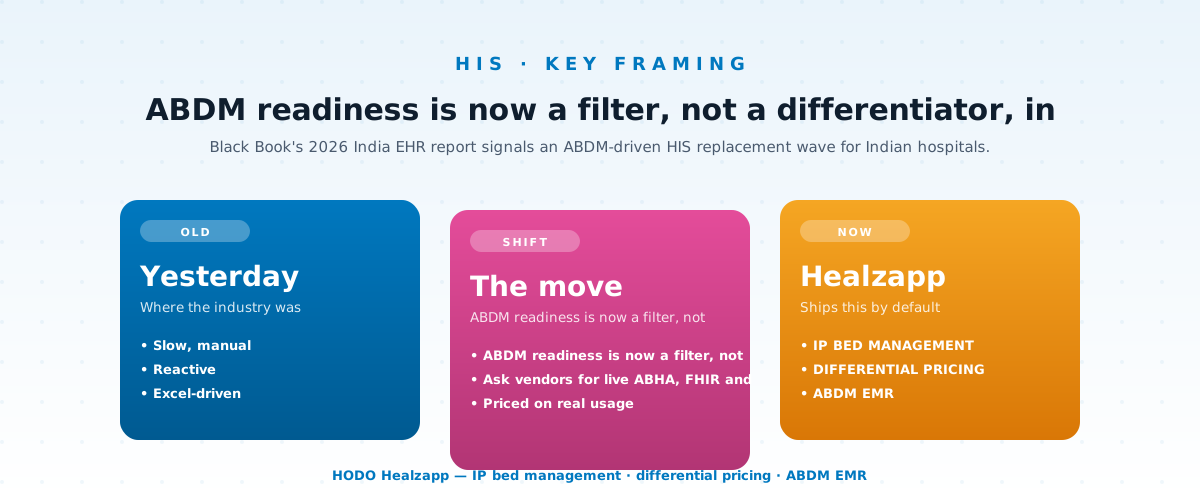
For any HIS shortlist in 2026, ABDM readiness has stopped being a differentiator and started being a filter. A vendor that is not listed under NRCeS, not on the Telemedicine Practice Registry, and not among the ABDM-integrated cohort will typically get eliminated in the pre-qualification round of PMJAY and CGHS empanelment renewals. Administrators should ask for three artefacts before signing: a working demo of ABHA-linked patient registration, a sample FHIR bundle exchange with a partner facility, and consent-artefact storage that survives audit. Vendors who answer these with slideware rather than a live sandbox are the ones most likely to push the replacement wave conversation into 2027 — usually at the customer's cost. The RFP language for 2026 should treat ABDM certification the way it once treated HL7 support: table stakes, not a headline feature.
Black Book's cloud finding is worth reading carefully because it changes the total cost of ownership maths that most Indian hospital finance teams still use. On-premise HIS at 200-bed scale typically carries a hidden annual cost of Rs 18-25 lakh across server refresh, UPS, air-conditioning, and one dedicated sysadmin — not counting the DR site most hospitals do not maintain. Cloud-hosted HIS with a per-bed or per-visit subscription flips this into an opex line that scales with revenue. More importantly, ABDM's FHIR APIs, health-locker integrations, and consent manager callbacks are designed assuming the HIS is reachable over HTTPS with predictable uptime — a bar most on-premise deployments struggle to meet without a second-site DR investment. For multi-outlet clinic chains and diagnostic groups, cloud also removes the biggest friction in opening new centres: waiting six weeks for a server, a static IP, and a VPN tunnel is now a competitive disadvantage.
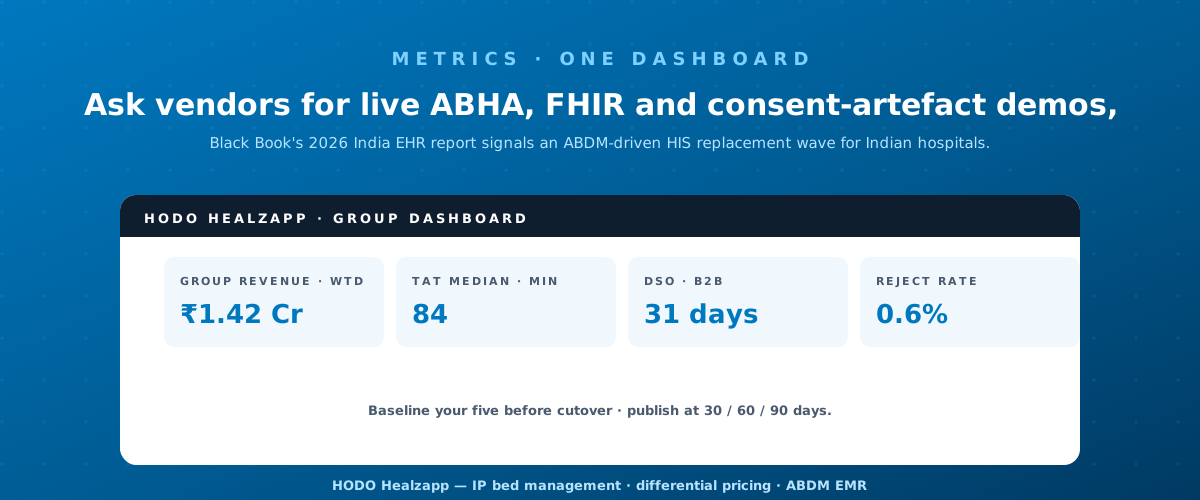
A practical buyer checklist for the 2026 replacement wave has five items. One, ABDM certification with a demonstrable ABHA capture rate at existing clients, not just a compliance badge on the website. Two, multi-outlet architecture — the ability to open a new branch, franchisee, or day-care centre without a fresh implementation project. Three, machine interfacing depth: analysers, radiology modalities, and OT equipment should push results into the EMR without manual transcription. Four, TPA and insurance workflow support, because 40-60% of Indian hospital cashflow now runs through cashless channels and any HIS that treats TPA claims as an afterthought will bleed working capital during the transition. Five, a plausible AI story grounded in operational use — condensed patient history at triage, denial-code prediction, no-show forecasting — rather than a generic chatbot wrapper. Vendors who cannot walk through all five in a two-hour session are not ready for the replacement wave.
HODO Healzapp is built into exactly this procurement moment. It ships as an ABDM-compliant EMR, so ABHA capture, consent artefacts, and FHIR exchange are part of the standard workflow rather than a bolt-on module bought later. The Multi-outlet scale-up with one-click new-centre setup matches the cloud-first, chain-expansion pattern Black Book flagged — new branches inherit master data, differential pricing, and TPA contracts without a fresh go-live cycle. And the EMR (AI-condensed history) feature answers the operational-AI question that boards are now asking their CIOs, without wandering into speculative clinical territory. For hospitals already running HODO, the report is a reminder that the ABDM-linked features you paid for are increasingly what state empanelment reviewers ask to see. For hospitals still on a 2016-vintage HIS, the report is the paperwork that lets the CIO put a replacement decision on the next board agenda without having to argue the market timing.
See how Healzapp handles this — book a 30-min demo.
See how Healzapp, Labzapp and EReazy fit your speciality in a free 30-minute demo.
Book a Free Demo