Bengaluru-based home diagnostics startup Inito has raised $29 Mn led by British International Investment (BII) with participation from Fireside Ventures, per Inc42's report on the round. For founders building the next lab-at-home, doctor-at-home or home-collection network, in India or the GCC, the round matters less for Inito's specific fertility-testing thesis and more for what growth-stage investors are now willing to underwrite in Indian home-diagnostics: a category that used to be a phlebotomist-with-a-cooler business is being funded as consumer-tech infrastructure.
What the round actually signals
BII is a development finance investor, not a pure venture shop. Its cheque tends to follow theses where a category can absorb hundreds of crores of capital and still show unit economics. That reads as a bet on Indian home-diagnostics being large enough to build a category-defining brand, not just a franchise chain glued together. Fireside's participation adds the consumer-brand playbook on top: repeat purchase, D2C funnel discipline, cohort retention.
For a founder reading this in Pune, Kochi or Hyderabad, the takeaway is not "raise $29 Mn." It is that the ceiling on lab-at-home has moved. Two years ago, most home-collection plays were treated as low-margin logistics wrappers around a franchisee lab. Today, an investor of BII's discipline is prepared to underwrite the operational maturity, the LIMS backbone and the brand recall required to own a customer visit rather than rent it from a bigger chain.
The hook is India-specific, but the same read-through holds for Dubai and Riyadh operators watching Series A-stage home-collection plays in the GCC catch a similar tailwind from wellness-heavy consumer demand.
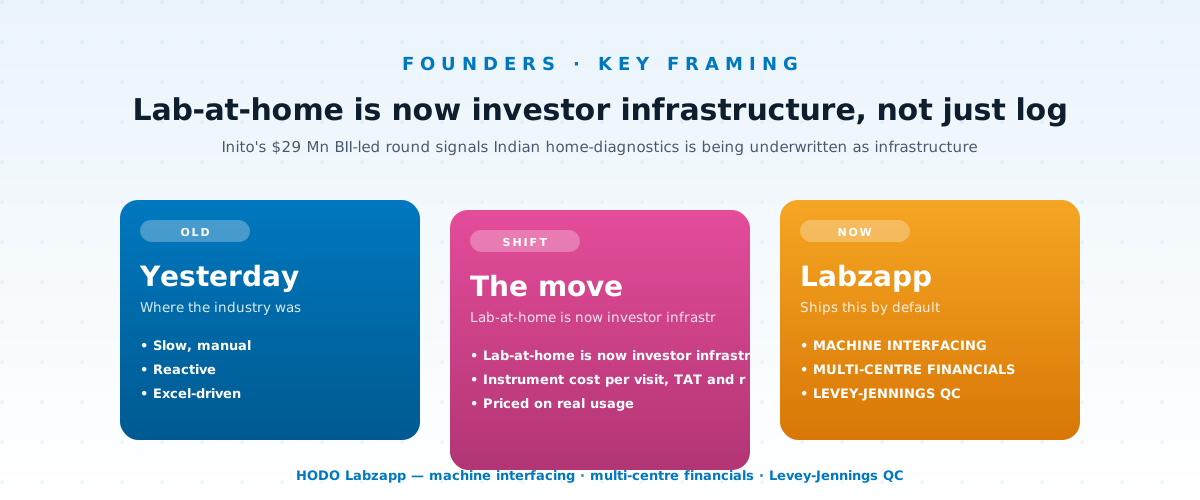
Lab-at-home is now investor infrastructure, not just logistics.
The unit economics that decide whether you survive
Lab-at-home founders lose money in three predictable places: dead miles, dead time and re-collection. A phlebotomist who does four collections in a shift instead of seven turns a ₹150 cost-per-visit into ₹260 without anyone noticing until the monthly P&L. A sample that arrives at the central lab too late for the next analyser run misses the promised report time and burns customer-support cost on apology calls. A haemolysed or clotted sample forces a repeat visit and destroys the margin on that entire order.
Three numbers to instrument from day one: cost per visit (fully loaded, phleb salary, fuel, kit, insurance), effective TAT from booking to report delivery, and re-collection rate by route and by phleb. If any of the three drift, the P&L drifts with them. Most early-stage founders track only revenue per test and discover the leak six months late.
The corollary is that route density is the moat. A brand doing 30 visits per day inside one pincode wins over a competitor doing 300 visits per day scattered across a city. Growth capital exists to buy density, not raw geography, and the ops software has to make that visible in a daily dashboard, not a monthly MIS deck.
Sample chain-of-custody is the invisible product
Consumers see the phlebotomist and the WhatsApp report. Investors see the middle 90 minutes. From needle to analyser, every sample needs a barcode at source, temperature-logged transport and a scan at every hand-off, collection, hub, central lab, machine deck.
Without that spine, a founder cannot answer three questions that decide whether the operation scales: which phleb's samples fail QC most often, which route has the longest cold-chain gap, and which analyser is the bottleneck on peak intake days. Manual registers cannot answer those in real time; spreadsheets stop working somewhere past 200 visits per day.
This is where an off-the-shelf LIMS pays for itself. A home-collection stack with barcoded samples, phlebotomy/home-collection workflows and machine interfacing turns the invisible middle into a queryable log. If a re-collection happens on Tuesday morning, the founder can trace it to a phleb, a route, an analyser or a reagent lot within minutes, not by asking the ops lead to "check what happened."
Regulatory and partner path, the boring moat
NABL accreditation is table stakes for any lab that wants corporate contracts and premium consumer trust. Beyond that, three operational partnerships shape the P&L: referral doctors, corporate wellness contracts and partner labs for esoteric tests the central lab does not run.
Each partner needs different pricing, different report formats and, critically, different views into the sample pipeline. A referring gynaecologist wants patient-level reports on their panel. A corporate HR head wants an anonymised dashboard for their annual health-check drive. A partner lab handling a niche molecular test wants the sample tracked with no PHI leaked to their staff.
Founders who try to solve this with email attachments hit a wall by year two. Portals, referral-doctor logins, corporate-partner logins, partner-lab integration with anonymised sample tracking, are what let a lab-at-home brand sign 40 corporate accounts without doubling the ops team. Differential pricing per partner sits underneath: the same test priced three ways for retail, corporate and B2B, without a spreadsheet override travelling around WhatsApp.
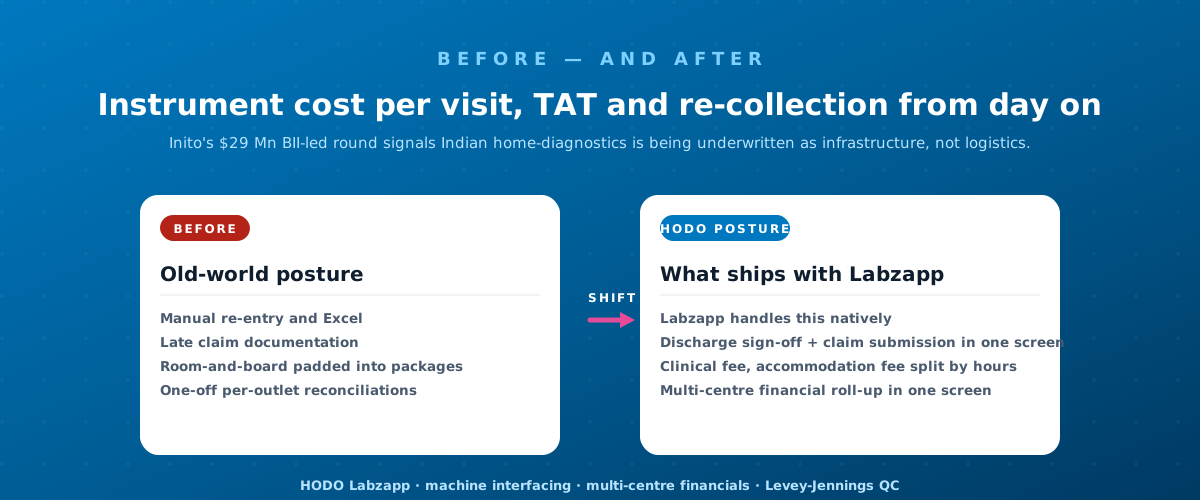
Instrument cost per visit, TAT and re-collection from day one.
Build vs buy the LIMS, the founder's most expensive decision
Every home-diagnostics founder eventually asks whether to build the LIMS in-house. The pitch for building is control and IP; the reality is that a production-grade LIMS with barcoded samples, analyser interfacing, Levey-Jennings QC, report delivery, franchisee management and multi-centre financials is a 12-18 month engineering programme with a permanent maintenance cost thereafter.
A category leader spends its engineering cycles on demand generation, funnel conversion, phleb allocation algorithms and consumer-app UX, not on rebuilding a LIMS that specialised vendors have shipped for a decade. The pattern that tends to work: buy the LIMS, own the consumer app and the routing intelligence layer, integrate the two through APIs. That is roughly how Indian home-diagnostics operators at scale have staged their stack over the last five years.
The upside of a hosted LIMS on Google Cloud Platform is that a founder does not carry the DR/backup problem, the compliance audit paperwork or the 3 AM pager duty for a report-generation outage. Those hours go back into the P&L instead of onto the engineering roadmap.
What this means for builders
Founders reading Inito's round as a validation moment should treat it as a costing exercise, not a fundraising cue. The category is being underwritten at scale, but the underwriting assumes ops maturity that most early-stage lab-at-home operators still run on WhatsApp groups and Excel sheets. The gap between a phleb network and a fundable brand is exactly the stack that makes chain-of-custody, TAT and per-visit economics legible.
HODO Labzapp is built for that operator. The phlebotomy/home-collection workflows module handles routing, sample barcoding at source and hand-off logging. Automated SMS/WhatsApp/Email report delivery removes the manual send that eats a support agent's morning. Franchisee management with referral-doctor and corporate-partner portals lets a brand grow into 20 outlets and 40 corporate accounts without adding proportional headcount.