
Healthcare doesn’t fail because we lack innovation. It fails when innovation loses sight of its purpose. For decades, we’ve measured progress by what we build — more hospitals, more devices, more hospital software, more data. Yet millions of patients still experience the same three frustrations. This post is about what changes when hospital management software and lab management software are built for people first, and scale second.
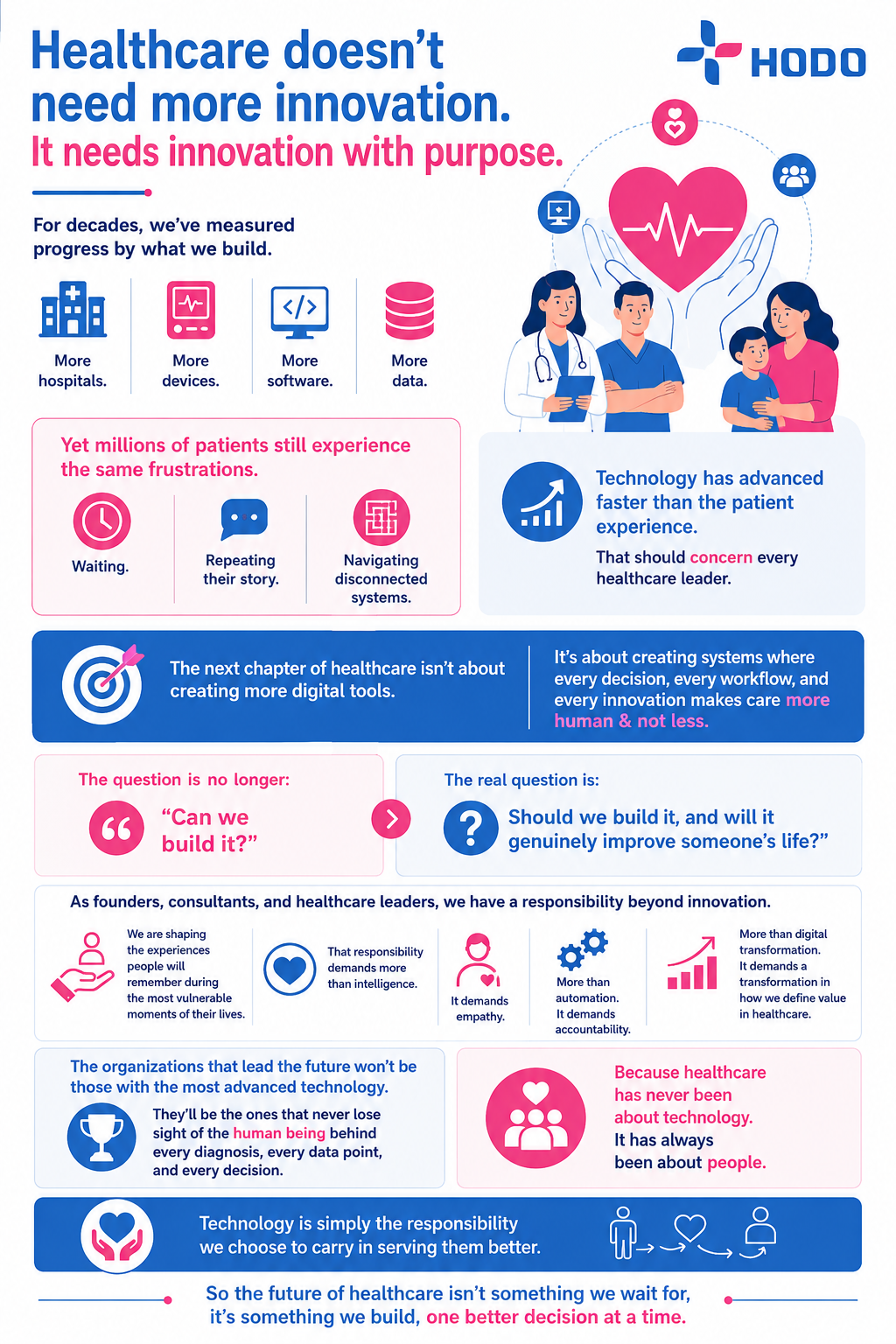
For most of the last two decades, healthcare has measured progress by output: more beds, more devices, more digital tools, more dashboards, more data points captured per visit. That framing gave us the current stack — but it also gave us something else. Technology has advanced faster than the patient experience. That should concern every healthcare leader, and every vendor building for them.
The next chapter of healthcare software is not about creating more tools. It is about creating connected hospital software and connected lab software — systems where every workflow, every module, and every innovation makes care more human, not less.
Ask 100 patients across India and the GCC what breaks their trust in a hospital or diagnostic centre, and the answers cluster into three:
None of those failures is a failure of medical judgement. All of them are failures of operational architecture — of how the software behind the front desk connects, or doesn’t. And that is where a modern HMIS (Hospital Management Information System) and LIMS (Lab Information Management System) stack earn their keep, or fail to.
Every healthcare software team can build a new feature. Every founder can ship a new module. The harder question — the one that separates a helpful hospital information system from a distracting one — is:
Should we build it, and will it genuinely improve someone’s life?
At HODO, that filter is applied to every module we ship in Healzapp (our hospital and clinic management software) and Labzapp (our lab management software / LIMS). A feature that adds two clicks to a nurse’s day doesn’t earn its slot on the roadmap just because it looks good in a demo. A dashboard doesn’t earn its slot because the CEO likes it — it earns it when the nurse who opens Healzapp at 07:00 IST leaves work earlier because of it.
Being a healthcare software vendor is not a neutral position. Every button we design shapes the experience of a patient on one of the hardest days of their life. That responsibility demands three things at once:
HODO Healzapp is the Hospital Management Software (HMIS / HMS / HIMS) tier of our platform, running today across 500+ outlets in India, UAE, Qatar, Kuwait and Bahrain. Every module was audited against the same question: “does this make the patient’s day, and the staff’s day, better?”
Read more on the Healzapp for hospitals and Healzapp for clinics pages.
If Healzapp is HODO’s answer to “purposeful hospital software”, Labzapp is our answer to “purposeful lab software” (LIMS / LIS). Diagnostic centres, path labs and multi-branch chains use it to stop being defined by their slowest sample — and start being known for their most reliable report.
Purposeful lab software is not about adding more machines to the stack — it’s about removing the friction between the sample and the story it tells about the patient.
The healthcare organisations that win the next decade — the hospital chains, the diagnostic groups, the specialty clinics — will not be the ones with the most advanced technology stack. They will be the ones that never lose sight of the human being behind every diagnosis, every data point, and every decision.
That is because healthcare has never really been about technology. It has always been about people. Hospital software and lab software are simply the responsibility we choose to carry in serving those people better.
The future of healthcare is not something we wait for. It is something we build — one better decision, one better module, one better patient experience at a time.
Innovation with purpose means every feature in a hospital management software stack has to survive one test: does it measurably improve the patient’s experience or the staff’s day? Fancy dashboards, one-more-click AI tools and rarely-used modules fail this test. Reducing wait time, cutting duplicate data entry, and freeing the doctor to look at the patient instead of the screen all pass it.
Healzapp connects OPD, IPD, OT, EMR, pharmacy, lab, insurance and billing on one platform, so a patient registers once and their record follows them through the entire hospital. WhatsApp reminders reduce no-shows, a TV token display cuts perceived wait, and the Patient Health App lets patients see reports and pay bills without standing in a queue.
Labzapp is a full Lab Information Management System (LIMS) with barcoded sample tracking, bidirectional analyser interfacing, NABL-ready QC (LJ graphs), multi-centre financials, and automated report delivery on SMS, WhatsApp and email. The result: lower TAT, fewer transcription errors, and patients who get their report before the consultation ends.
Yes. HODO Healzapp and Labzapp are built on a shared database. A test ordered in OPD flows straight to the lab worklist, the analyser pushes the validated result back, the EMR auto-updates, the report goes to the patient on WhatsApp, and the billing rolls the consultation + lab charges into one invoice at discharge. No manual hand-off, no missed entries, no duplicate billing.
HODO serves India, UAE, Qatar, Kuwait, Bahrain and other GCC markets across 500+ outlets. The platform is deployed in hospitals, clinics, diagnostic labs and vet labs, and is among the first 20 healthtech companies in India integrated with the Ayushman Bharat Digital Mission (ABDM).
Yes. HODO is listed with the National Resource Centre for EHR Standards (NRCeS) and the official Telemedicine Registry of India, and is an active participant in ABDM initiatives. That regulatory alignment matters because purposeful hospital software must plug into national health infrastructure, not sit around it.
Want to see how Healzapp and Labzapp bring purpose-driven hospital software and lab software together on a single platform? Book a free 30-minute demo built around your specific setup.
See how Healzapp, Labzapp and EReazy fit your speciality in a free 30-minute demo.
Book a Free Demo