Deccan Herald reported this week that Ayushman Bharat now covers roughly 60 crore Indians, while the hospitals delivering that care continue to wait months to be paid for it. The headline is Indian, but the mechanic underneath it is not. Any clinic that earns most of its revenue from a third party rather than from the patient at the counter is running its operations on borrowed cash, and in the UAE, Qatar, Kuwait and Bahrain, where insurance funds the majority of polyclinic footfall, the same arithmetic applies under different acronyms.
The failure mode is consistent across markets. A clinic adds doctors, adds specialities, signs another insurer or another corporate scheme, and watches monthly gross billing climb. Salaries, rent, DHA or MOHAP licensing renewals, consumables and lab outsourcing costs all settle in the same month the service is delivered. The revenue does not. It settles when the payer's adjudication cycle says it does, typically 30 to 90 days out, and considerably longer for anything that gets rejected and resubmitted.
That gap is working capital, and it grows in direct proportion to growth itself. A polyclinic that doubles its insured volume doubles its float. Owners who read only the monthly billing report see a healthy business; owners who read the bank balance see a tightening one. The two are not in conflict, they are simply measuring different months.
The operational conclusion is unglamorous but important: for a payer-funded clinic, cashflow is not a finance-department concern that surfaces at year-end. It is a daily operations metric, produced by what the reception desk captures, what the doctor codes, and how fast the claim leaves the building. Treating it as an accounting problem guarantees it is diagnosed too late to fix cheaply.
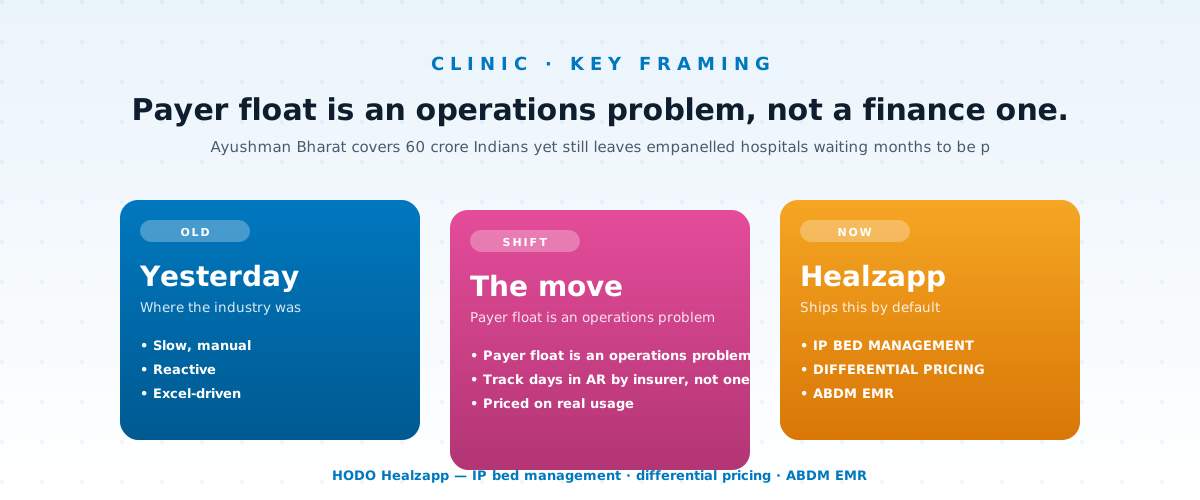
Payer float is an operations problem, not a finance one.
What the GCC claim cycle actually looks like
A typical insured visit in a Gulf polyclinic passes through more control points than the consultation itself suggests. Eligibility has to be verified against the member's card and plan. Network status has to be confirmed, the patient may be covered, but not for this clinic, or not for this speciality. Co-payment and deductible rules differ by plan tier and have to be collected at the counter, because recovering them later from a walk-in patient is close to impossible. Certain investigations and procedures need prior approval before the service is delivered, not after.
Then the claim is coded, batched and submitted electronically. Whatever the local scheme's submission format, the outcome is one of three: paid, partially paid, or rejected with a denial code. Partial payments are the quiet killer. They rarely trigger an alert, they land as a reduced remittance against a batch, and unless someone reconciles line by line, the shortfall is simply absorbed.
Most clinics handle this with a mix of spreadsheets and institutional memory held by one or two long-serving staff. It works until volume rises, until that staff member resigns, or until an insurer changes a rule quietly. The cycle does not need to be complicated to be expensive, it needs only to be untracked.
Denials are manufactured at the front desk
The instinct after a rejection is to blame the payer. The evidence usually points closer to home. A large share of denials trace back to something that happened before the doctor saw the patient: an expired card accepted without a check, a policy number keyed in with a transposed digit, the wrong plan selected, a missing prior approval, a service billed under a speciality the clinic is not licensed for at that location, or a patient record duplicated so that the claim history is split across two files.
Each of these is a front-office data-capture failure, and each is preventable at the point of capture rather than correctable three weeks later. The economics of that distinction are severe. Catching a wrong policy number while the patient is still in the waiting room costs under a minute. Catching it after rejection costs a staff member locating the file, contacting the patient, obtaining correct details, re-coding, resubmitting, and waiting out another full adjudication cycle, plus the risk that the resubmission window has closed and the amount is simply written off.
Practically, this means the reception workflow should make correct capture the path of least resistance. Structured patient records rather than free-text notes. Insurer and plan selected from a controlled list rather than typed. Prior-approval status visible on the appointment before the patient is called in. Duplicate detection at registration. None of this is exotic; it is the difference between a clinic whose denial rate sits in low single digits and one that quietly loses several percent of revenue every month.
The number most polyclinic owners cannot produce on demand
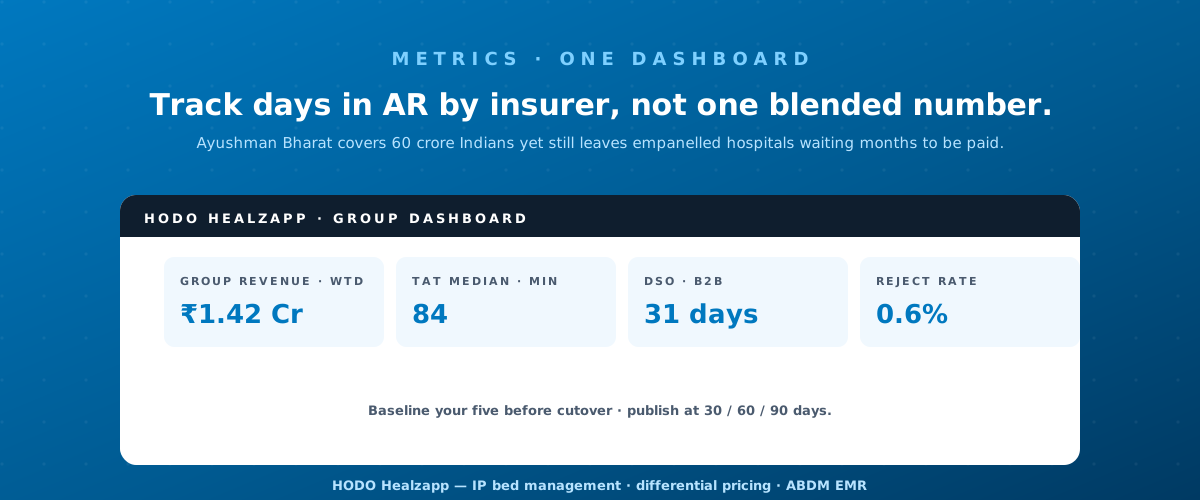
Ask a polyclinic owner what their average collection period is and most will give a blended figure, if any. Ask for days in accounts receivable broken down by insurer, and the answer is usually unavailable. That breakdown is the single most useful cashflow number a payer-funded clinic can hold, because it converts a vague complaint about slow payers into a list ranked by cost.
Once the number exists per insurer, decisions follow naturally. Contracts with structurally slow payers can be renegotiated or priced differently at renewal. Ageing buckets, 0-30, 31-60, 61-90, 90-plus, show where follow-up effort should concentrate instead of being spread evenly across everything outstanding. Denial codes grouped by frequency show which three or four front-desk fixes would remove the bulk of rework. Rejection-to-resubmission time becomes a staff performance metric rather than an anecdote.
The same discipline applies to corporate and referral arrangements, which behave like payers even when they are not insurers. Corporate health packages, referring clinics and outsourced lab partners each carry their own rate card and their own settlement behaviour, and each deserves its own ageing view rather than being folded into one receivables total.
Track days in AR by insurer, not one blended number.
Multi-doctor and multi-branch multiply the leakage
A single-branch clinic with three doctors can run its claim cycle on discipline alone. A group with four branches, twenty doctors and six insurers cannot. Every additional payer introduces another rate card, another co-pay rule, another approval threshold. Every additional branch introduces another set of licensed specialities and another local staff habit.
Scale turns small inconsistencies into systematic loss. If one branch applies an older insurer tariff, the gap does not announce itself, it shows up as a stream of partial payments that look like normal variance. If a new centre opens with a manually rebuilt service master, the errors introduced on day one persist for years. The practical requirement is that pricing, insurer configuration and claim rules are held centrally and inherited by each location, with performance visible per branch, per doctor and per payer rather than as a group average that hides both the best and the worst performers.
What this means for HODO customers
The operational answer to payer float is not a collections drive. It is capturing the right data at registration, holding payer rules centrally, and being able to see receivables by insurer at any time. HODO Healzapp is built around that flow for Gulf polyclinics: Billing (incl. multi-currency / GCC patterns) handles co-pay, deductible and insurer-specific settlement patterns without spreadsheet workarounds; Differential pricing keeps a separate, centrally controlled rate card per insurer and corporate partner so tariff drift does not reach the invoice; B2B Referral / Outsource Lab / Corporate-partner logins gives partners and corporates their own visibility instead of routing every query through reception; and Multi-outlet scale-up with one-click new-centre setup means a new branch inherits the configuration that already works rather than rebuilding it by hand. Measured monthly, days in AR by payer is the metric that tells an owner whether any of it is working.